


Web Scraper API
Fetch real-time data from 100+ websites,No development or maintenance required.
SCRAPING SOLUTIONS
Get accurate and in real-time results sourced from Google, Bing, and more.
With 120+ prebuilt and custom scrapers ready for any use case.
No blocks, no CAPTCHAs—unlock websites seamlessly at scale.
Execute scripts in stealth browsers with full rendering and automation
PROXY INFRASTRUCTURE
Over 100 million real residential IPs from genuine users across 190+ countries.
Reliable mobile data extraction, powered by real 4G/5G mobile IPs.
For time-sensitive tasks, utilize residential IPs with unlimited bandwidth.
Fast and cost-efficient IPs optimized for large-scale scraping.
SCRAPING SOLUTIONS
PROXY INFRASTRUCTURE
DATA FEEDS
Full details on all features, parameters, and integrations, with code samples in every major language.
LEARNING HUB
ALL LOCATIONS Proxy Locations
TOOLS
RESELLER
Get up to 50%
Contact sales:partner@thordata.com
Products $/GB
Fetch real-time data from 100+ websites,No development or maintenance required.
Get real-time results from search engines. Only pay for successful responses.
Execute scripts in stealth browsers with full rendering and automation.
Bid farewell to CAPTCHAs and anti-scraping, scrape public sites effortlessly.
Dataset Marketplace Pre-collected data from 100+ domains.
Over 100 million real residential IPs from genuine users across 190+ countries.
Reliable mobile data extraction, powered by real 4G/5G mobile IPs.
For time-sensitive tasks, utilize residential IPs with unlimited bandwidth.
Fast and cost-efficient IPs optimized for large-scale scraping.

Data for AI $/GB
Pricing $0/GB
Docs $/GB
Full details on all features, parameters, and integrations, with code samples in every major language.
Resource $/GB
EN $/GB
产品 $/GB
AI数据 $/GB
定价 $0/GB
产品文档 $/GB
资源 $/GB
简体中文 $/GB
<–!>

<–!>

Exploring the Landscape of Web Data Scraping in 2026 Microsoft’s adjustments to the Bing Search API have become a critical turning point. This change has prompted developers and businesses worldwide to reassess their strategies for acquiring search data to ensure business continuity and data accuracy.
In this article, you will see:
• What Bing Search API is and the challenges triggered by its discontinuation;
• The use cases it supports and its core technical features;
• Practical tips and criteria for evaluating its alternatives;
• In-depth comparisons of top alternatives to Bing Search API;
• How different types of users can accurately match the most suitable alternatives.
Microsoft has officially announced that the Bing Search API will be retired on August 11, 2025. This means that all existing API instances and documentation examples are no longer available for developers, and new customer registrations will no longer be accepted. This change is a significant shock for developers who have long relied on the Microsoft search ecosystem, marking the end of an old era and the beginning of a new integration model.
Currently, Microsoft encourages users to fully migrate to Azure AI Agent. This new agent uses Bing Search as an underlying plugin, aiming to provide real-time response capabilities for large language models (LLMs). However, if your business goal is to acquire large-scale structured SERP data or perform deep data mining and analysis of search results, this dialogue generation-based migration solution clearly cannot meet your needs, as it has inherent limitations in data granularity and collection efficiency.
That is why thousands of developers around the world are actively exploring third-party alternatives to Bing Search API. These third-party Web Scraper APIs not only circumvent Azure’s complex permission management but also provide more flexible JSON output formats. Before diving into these tools, it is necessary to analyze the significant difficulties that developers and users face in practice after the retirement of Bing Search API.
The end of the Bing Search API is not just the shutdown of a single interface; it has also triggered a series of chain reactions that directly impact existing automation workflows. The following are the main challenges triggered by this change:
The Bing Search API previously wrapped multiple functional modules, such as web, image, video, and news searches, under a unified endpoint. Without this integration, developers must navigate fragmented services, greatly increasing the complexity of system architecture maintenance and integration costs.
Bing Index is typically updated faster than other search engines, especially in the areas of breaking news and real-time trends. Many cheap alternatives cannot provide enterprise-level SLA guarantees due to a lack of robust crawling clusters, which may lead to serious delays in your SEO data.
Azure AI Agent focuses on generative dialogues rather than providing structured JSON data like the Bing Web Search API. For developers who need to accurately extract specific SERP elements, this shift from “data extraction” to “content generation” can lead to a complete break in downstream business logic.
Many enterprises have legacy systems deeply tied to Microsoft’s SDK and complex authentication logic. Forced migration means significant R&D hours must be invested in refactoring underlying code. This technology stack change not only extends the R&D cycle but may also pose risks of downtime for existing web scraping operations during the migration period.
Microsoft’s Bing Search API pricing is fixed, while prices in the third-party market vary significantly. We need to find a balance in unstable market pricing that meets high concurrency demands without driving costs out of control.
Large enterprises must strictly adhere to privacy agreements such as GDPR when using data. When shifting from the official API to third-party scraping tools, we need to reevaluate the compliance of the vendor’s data sources to mitigate potential legal risks.
The Bing Search API refers to a set of tools provided by Microsoft that allows programmatic access to its search results, aimed at enabling developers to embed Bing’s powerful search capabilities directly into their applications. The following is a description of the key API features:
| Key API | Overview |
| Bing Web Search API | Provides global web search results, rankings, and metadata information. |
| Bing Image Search API | Supports searching for high-quality images and related thumbnails and metadata by keywords. |
| Bing Video Search API | Fetches video content sources, thumbnails, and their ranking performance on Bing. |
| Bing News Search API | Retrieves global news reports in real time, with support for filtering by category and region. |
| Bing Visual Search API | Identifies image content and searches for similar visual information by uploading an image or URL. |
| Bing Autosuggest API | Provides real-time search suggestions and keyword completions based on user input fragments. |
| Bing Local Business Search API | Finds business information, reviews, and contact details near a specific geographic location. |
The Bing Search API can, by default, return ranking results that highly match user intent. However, for professional developers who want complete control over the responses, the following core functions of the Bing Web Search API were key to enhancing their user experience:
1. Filtering Results: Allows users to filter adult content through SafeSearch settings and enables refined result filtering based on freshness, region, language, and site domain.
2. Pagination Control: By using the Offset and Count parameters, developers can easily implement pagination for large-scale search results.
3. Hit Highlighting: The API automatically highlights keywords that match the query terms in the returned summary snippets, facilitating highlighted rendering on the front-end pages.
So, what scenarios urgently require continued access to Bing search data through alternatives? The following is the answer to this question.
• SEO Monitoring: Real-time tracking of keyword ranking changes across different regions and devices.
• AI and RAG Processes: Providing real-time external knowledge bases for large models to reduce the occurrence of AI hallucinations.
• Competitive Research: Automated collection of competitors’ advertising activities and content update frequencies.
• Visual and News Research: Analyzing specific trends or brand mentions in visual communication within large-scale datasets.
• Brand Reputation Management: Getting immediate alerts on negative news or comments for timely public relations actions.
• Localized Data Acquisition: Simulating search results from different geographical locations to analyze local market preferences.
Some users may think that the best alternatives to Bing Search API are DuckDuckGo API or Yandex Search API. However, these native APIs often have strict rate limits and do not have complete coverage of Bing data. Therefore, for enterprise users needing high reliability and high concurrency support, the most reliable alternative is to use dedicated Search Engine Scraping API.
If you want to replace the Bing Search API integration, please follow the following criteria when selecting:
1. Bing Scraping Capabilities: The dedicated API must be able to reliably collect all SERP elements from Bing search, including ads, snippets, and maps.
2. Output Format: It should support standardized JSON format for easy parsing by systems without manual scraping rules.
3. Real-time Freshness: Ensure that each request is a real-time scrape initiated to the search engine, not data extracted from an outdated cache.
4. Accuracy: How well do the returned results match and complete the actual Bing search results page?
5. Latency Control: Globally distributed nodes must ensure response times are within seconds to support real-time application scenarios.
6. Integration Support: Provide SDKs for mainstream programming languages and support various advanced parameters (such as cc, mkt, etc.) for precise targeting.
7. Other Search Engine APIs: Can you easily access APIs of other search engines like Google, Yandex, and DuckDuckGo through the same service?
8. Free Options: Offer sufficient free trial quotas, allowing developers to complete technical validations before deciding to pay.
9. Pricing Model: Adopt a transparent pricing model based on pay-per-success to avoid paying for failed requests.
10. Compliance: Does the service provider explicitly adhere to the robots.txt protocol and ensure that its data collection methods are within the framework of data protection regulations like GDPR?
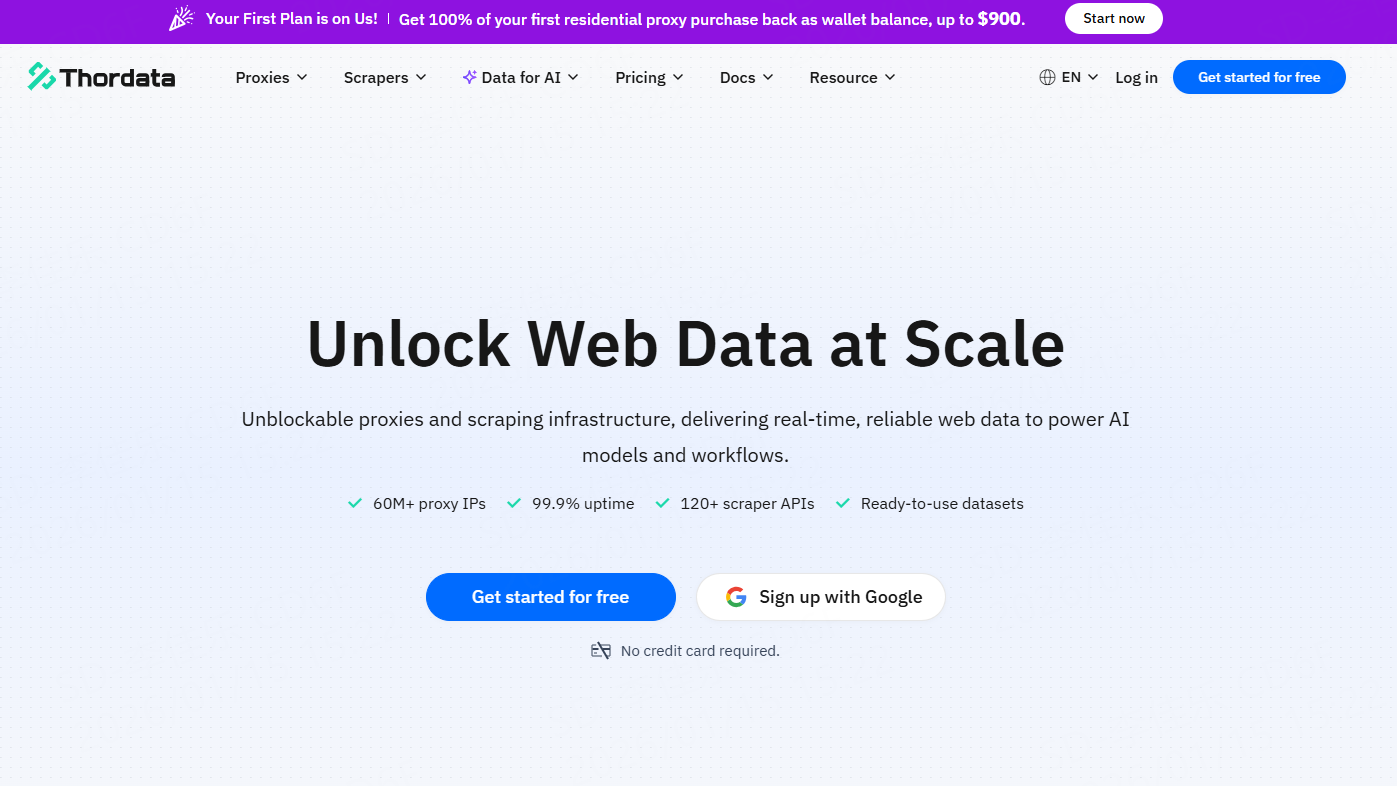
Thordata is a service provider focused on offering high-quality web data APIs, and its pay-per-success model is simple and straightforward, making it popular among developers. Its API design follows RESTful principles, emphasizing stability and data parseability. Our development team has found that its success rate consistently remains above 99% during large-scale deployments using Thordata.
Thordata’s Bing Search API is an important part of its robust SERP API product ecosystem. The platform ensures a very high scraping success rate through rotating proxy pools and CAPTCHA auto-recognition technology. In addition to supporting Bing, it also covers the following search engines:
Its features include:
• A network of over 60 million residential proxies effectively avoids IP blocks.
• Millisecond-level ultra-low response latency.
• Precise targeting supporting over 190 countries and regions worldwide.
• Automatically parses Bing’s complex HTML structure and outputs clean JSON.
• Built-in smart CAPTCHA recognition and proxy rotation mechanisms.
• Supports real-time concurrent processing with extremely high concurrency capacity.
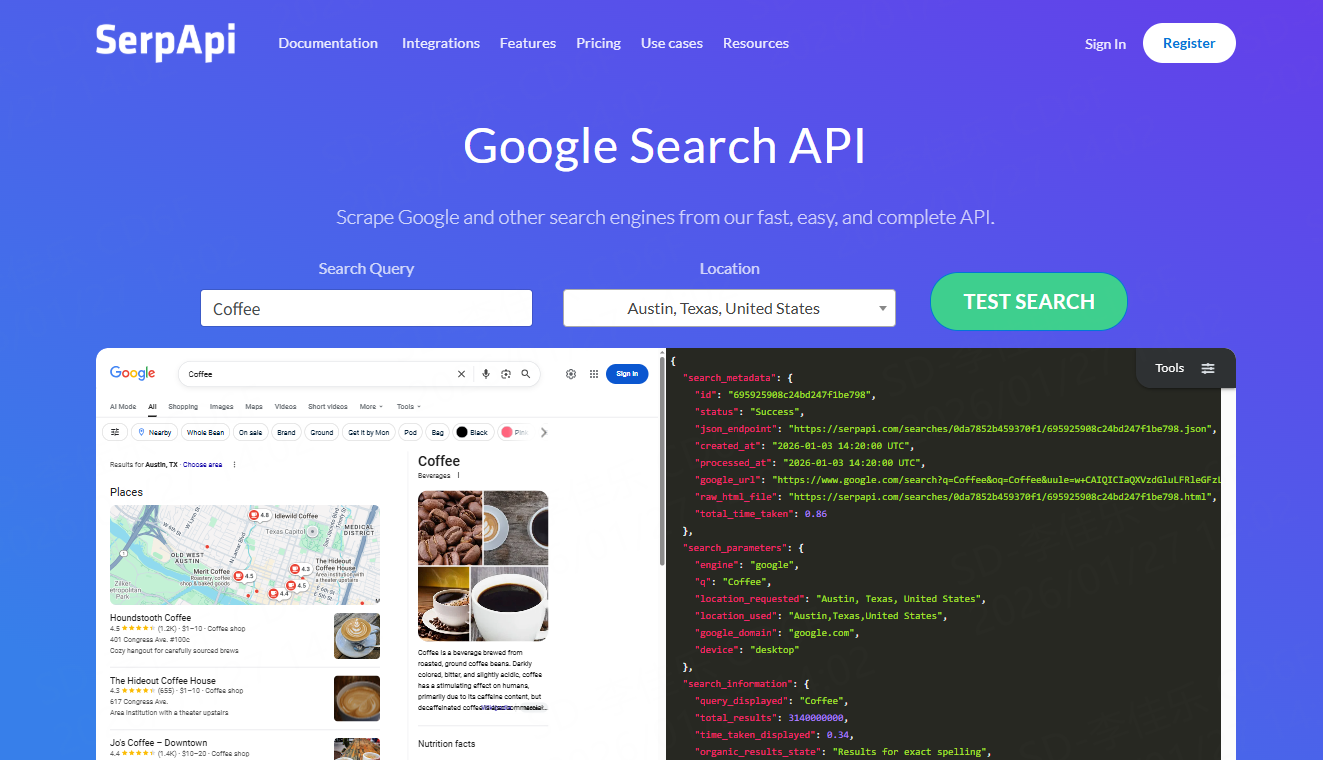
SerpAPI is a long-established SERP data provider, known for its ease of use and extensive search engine coverage. It provides an abstract layer that allows users to work without dealing with underlying proxies and parsing logic.
Features:
• Provides real-time parsing of Bing search results.
• Offers a very intuitive online Playground for testing requests.
• Provides extremely detailed JSON result mapping.
• Supports official libraries for multiple programming languages.
DataForSEO provides extremely rich API interfaces for SEO tool developers, with very detailed data dimensions. It not only provides ranking data but also includes deeper analytical metrics such as search volume and competition level.
Features:
• Integrates multiple SEO-related data toolsets.
• Offers a highly competitive pay-as-you-go pricing strategy.
• Supports large-scale asynchronous task processing mechanisms.
Scrapingdog focuses on “simplifying web scraping,” and its API is designed to help users bypass anti-scraping mechanisms. It not only provides search engine results but also supports scraping of general websites, making it a versatile tool.
Features:
• Automatically handles complex JavaScript rendering.
• Built-in rotating proxy mechanism to prevent IP blocking.
• Provides very easy integration documentation and technical support.
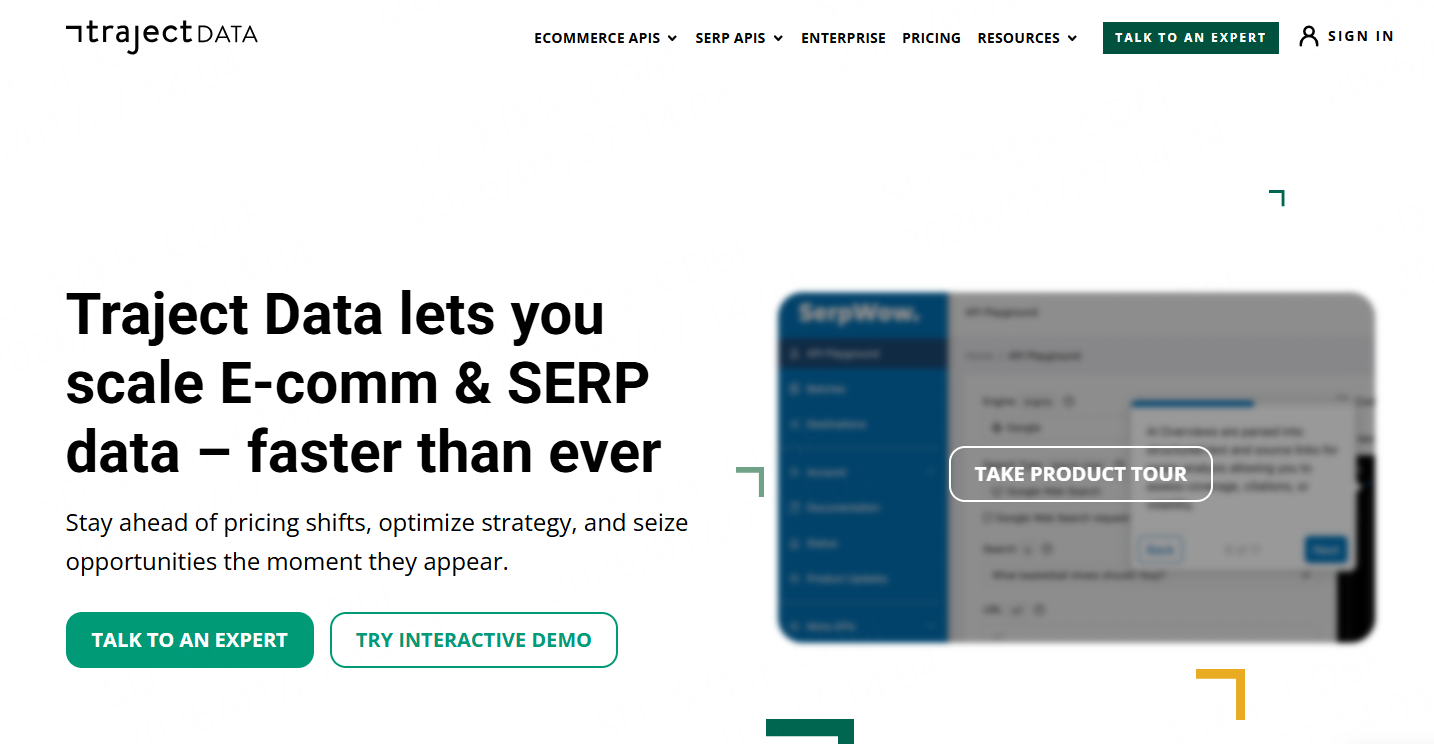
Traject Data focuses on providing enterprise-level ranking tracking data. Its API interface is known for its stability, capable of handling millions of daily keyword queries, making it suitable for large marketing agencies.
Features:
• Focuses on highly accurate ranking tracking data.
• Supports multi-language search result collection across the entire web.
• Provides customized data delivery solutions for large enterprises.
| API | Bing Scraping Features | Response Time | Output Format | Integration Support | Compliance | Free Option | Starting Price |
| Thordata | ✅ | 🚀 Very Fast | JSON+HTML | ✅ | GDPR/CCPA | 🎁 5,000 responses, 7-day free trial | $18/month |
| SerpAPI | ✅ | ⚡ Fast | JSON | ✅ | GDPR | 🎁 250 free searches | $25/month |
| DataForSEO | ✅ | ⚡ Fast | JSON+CSV | ✅ | GDPR | ❌ None | $600/1M SERPs |
| Scrapingdog | ✅ | 🔄 Depends on rendering | JSON+Markdown | ✅ | GDPR | 🎁 1000 credits free | $90/month |
| Traject Data | ✅ | 🐢 Slow | JSON+XML | ✅ | GDPR | ❌ None | $125/month |
Which API to choose depends on your specific business scale and technology stack needs. Below is a decision tree we’ve summarized to help you quickly identify your target:
1. Are you a small to medium-sized business user seeking extreme cost-effectiveness and high concurrency?
• 👉 Choose Thordata. Its pay-per-success model and free 5,000 requests make it the most cost-effective choice in 2026.
2. Are you an SEO expert needing very detailed SEO metrics (like search volume)?
• 👉 Choose DataForSEO. Although its billing is relatively complex, it has the most comprehensive data dimensions.
3. Are you an enterprise tech team needing to build a high stability, high concurrency data pipeline?
• 👉 Choose Thordata. Their performance in reliability and scalability is more trustworthy.
4. Facing strong anti-scraping restrictions and needing JS rendering?
• 👉 Choose Scrapingdog. Its built-in browser rendering capability can solve most challenges.
The end of the official Bing Search API is not the finish line, but rather an opportunity for the evolution of data collection methods. Transitioning to professional Scraping API is a necessary path for developers to maintain their technical competitiveness in 2026. Thordata, with its outstanding stability, precise geolocation, and flexible billing options, has become the preferred choice for many former Microsoft API users.
Sign up for Thordata now and receive your first 5,000 API requests for free!
Here is a simple Python call example that demonstrates how efficient it is to use the SERP API:
python

import requests

# Example: Collecting Bing search results through Thordata
api_endpoint = "https://api.thordata.com/v1/bing/search"
params = {
    "api_key": "YOUR_ACTUAL_API_KEY",
    "query": "bing search api pricing",
    "location": "United States",
    "format": "json"
}
response = requests.get(api_endpoint, params=params)
if response.status_code == 200:
    data = response.json()
    # Our team can directly process the structured SERP data here
    print(f"Successfully retrieved {len(data['results'])} results")
In today's rapidly evolving landscape of digital marketing and artificial intelligence, obtaining accurate search data is more important than ever. Although the retirement of the Bing Search API has caused short-term disruptions for many developers, alternatives in the market (such as Thordata's SERP API solution) offer more powerful and flexible functionalities. The key to choosing is to assess your own business needs—whether it is cost, data depth, ease of use, or multi-engine support—and find the tool that best matches those needs.
We hope the information provided is helpful. However, if you have any further questions, feel free to contact us at support@thordata.com or via online chat.

<--!>
Frequently asked questions
What is the alternative to Bing API?
The best alternative to Bing API is a professional search engine API provider like Thordata. They provide dedicated Bing search API endpoints that can return structured JSON data and handle the underlying complexities of proxies and anti-scraping, offering reliable guarantees in functionality, stability, and compliance.
Is the Bing search API still available?
No, the native Bing Search API was officially shut down in August 2025. The current official recommendation is to use Azure AI Agent, but for users needing structured data, third-party SERP APIs are the more ideal choice.
How does the Bing search API work?
Its core principle is to send HTTP requests containing keywords and parameters to a specified endpoint. The server then real-time scrapes and parses the Bing search results page, and finally returns structured data in JSON format for developers to use directly.
<--!>
About the author
Anna is a content specialist who thrives on bringing ideas to life through engaging and impactful storytelling. Passionate about digital trends, she specializes in transforming complex concepts into content that resonates with diverse audiences. Beyond her work, Anna loves exploring new creative passions and keeping pace with the evolving digital landscape.
The thordata Blog offers all its content in its original form and solely for informational intent. We do not offer any guarantees regarding the information found on the thordata Blog or any external sites that it may direct you to. It is essential that you seek legal counsel and thoroughly examine the specific terms of service of any website before engaging in any scraping endeavors, or obtain a scraping permit if required.
 Looking for
Top-Tier Residential Proxies?您在寻找顶级高质量的住宅代理吗?
Looking for
Top-Tier Residential Proxies?您在寻找顶级高质量的住宅代理吗?
AI Data Collection Explained: Process, Examples, and Ethics
AI data collection is at the h ...
Kael Odin
2026-07-24

Afina Browser for Stable Proxy Workflows, Multi-Accounting and Web Automation
This guide explains how to thi ...
Jenny Avery
2026-07-23
Oxylabs vs Thordata — Which Residential Proxy Provider Wins in 2026?
Thordata has emerged as a comp ...
Kael Odin
2026-07-22
NetNut Is Down — Why Thordata Is the Reliable NetNut Replacement You Need
a reliable, fully operational, ...
Kael Odin
2026-07-22
Why Thordata Is the Smart Bright Data Alternative for Residential Proxies
If you're looking for a Bright ...
Kael Odin
2026-07-22

What residential proxy IP should I use for job posting and salary market intelligence?
Use a residential proxy IP whe ...
Xyla Huxley
2026-07-21

Which residential proxy IP should I use to monitor ESG registries and carbon credit public data?
Use a residential proxy IP whe ...
Xyla Huxley
2026-07-21
What residential proxy IP can help media companies verify streaming catalog availability by region?
Use a residential proxy IP whe ...
Xyla Hxuley
2026-07-21

Which residential proxy IP should I use for insurance quote QA without collecting private customer data?
Use a residential proxy IP for ...
Xyla Huxley
2026-07-21
