


Web Scraper API
Fetch real-time data from 100+ websites,No development or maintenance required.
SCRAPING SOLUTIONS
Get accurate and in real-time results sourced from Google, Bing, and more.
With 120+ prebuilt and custom scrapers ready for any use case.
No blocks, no CAPTCHAs—unlock websites seamlessly at scale.
Execute scripts in stealth browsers with full rendering and automation
PROXY INFRASTRUCTURE
Over 100 million real residential IPs from genuine users across 190+ countries.
Reliable mobile data extraction, powered by real 4G/5G mobile IPs.
For time-sensitive tasks, utilize residential IPs with unlimited bandwidth.
Fast and cost-efficient IPs optimized for large-scale scraping.
SCRAPING SOLUTIONS
PROXY INFRASTRUCTURE
DATA FEEDS
Full details on all features, parameters, and integrations, with code samples in every major language.
LEARNING HUB
ALL LOCATIONS Proxy Locations
TOOLS
RESELLER
Get up to 50%
Contact sales:partner@thordata.com
Products $/GB
Fetch real-time data from 100+ websites,No development or maintenance required.
Get real-time results from search engines. Only pay for successful responses.
Execute scripts in stealth browsers with full rendering and automation.
Bid farewell to CAPTCHAs and anti-scraping, scrape public sites effortlessly.
Dataset Marketplace Pre-collected data from 100+ domains.
Over 100 million real residential IPs from genuine users across 190+ countries.
Reliable mobile data extraction, powered by real 4G/5G mobile IPs.
For time-sensitive tasks, utilize residential IPs with unlimited bandwidth.
Fast and cost-efficient IPs optimized for large-scale scraping.

Data for AI $/GB
Pricing $0/GB
Docs $/GB
Full details on all features, parameters, and integrations, with code samples in every major language.
Resource $/GB
EN $/GB
产品 $/GB
AI数据 $/GB
定价 $0/GB
产品文档 $/GB
资源 $/GB
简体中文 $/GB
<–!>
<–!>

In today’s increasingly competitive digital environment, obtaining real-time and accurate internet information has become the core competitiveness for business survival. Facing the rapidly changing web structures and increasingly stringent anti-scraping mechanisms, choosing the right web scraping tools is key to ensuring business continuity and data accuracy.
In this article, you will see:
• What are Web Scraping Tools and their core functions
• Key criteria for choosing Web Scraping Tools
• In-depth reviews of the top 10 data scraping tools
• Solutions to challenges in the Web Scraping process
• A decision path for different types of users
Web scraping tools are essentially automated software designed to simulate human browsing behavior, systematically extracting and collecting structured data from websites. Today, these tools have evolved from simple HTML extractors into intelligent systems integrated with AI web scraping capabilities, able to handle complex dynamically loaded content, automatically bypass CAPTCHAs, and simulate genuine human browsing behavior. By using these tools, businesses can efficiently conduct price monitoring, market research, lead generation, and provide high-quality training data for large language models (LLMs).
From a technical perspective, these tools access target web pages by sending HTTP requests or launching headless browsers. Once the page content is fully loaded, the built-in parsing engine uses CSS selectors or XPath paths to precisely locate the required information, such as product names, prices, user reviews, etc. Modern Web Scraper API further encapsulate complex proxy management and anti-blocking logic, allowing developers to obtain cleaned data through a simple API call. As Zyte mentioned in their 2026 web scraping white paper, “data collection has shifted from mere scraping to an end-to-end automated intelligent flow.”
When faced with a wide variety of the best tools for web scraping, establishing a clear evaluation framework is crucial. Here are 10 core evaluation criteria:
1. Functionality: Can the tool handle dynamically rendered pages with JavaScript and schedule complex scraping tasks?
2. IP Rotation Method: Assess whether it has a built-in high-quality residential proxy network to prevent IP bans.
3. Error Handling: Can the system automatically retry requests and take remedial measures when encountering CAPTCHAs or network fluctuations?
4. Scalability: Does the tool support running in high-concurrency environments and handle millions of daily requests?
5. Usability: Does it provide a visual interface or a powerful library support for users of different technical backgrounds?
6. Best Use Cases: Is the tool better suited for quick one-time scraping or a stable, large-scale, long-term production data pipeline?
7. Integration Support: Can it easily connect with your existing data stack (such as Airflow, cloud storage) via API or SDK?
8. Free Trial: Check if the vendor offers a free trial quota to validate the tool’s effectiveness before purchase.
Pricing: Is the pricing model transparent and predictable? Is it based on monthly subscriptions, pay-as-you-go, or a one-time purchase?
Ratings: Refer to real user reviews on Trustpilot to validate the reliability of their customer service and technical support.
Below is a quick comparison table of the top 10 web scraper software based on the criteria mentioned above:
| Tool | Features | IP Rotation | Scalability | Ease of Use | Best Use Case | Free Trial | Starting Price | Rating |
| Thordata | Scraping API | Automatic | Very High | Very Easy | Large-scale data collection | ✅ 7-day free trial (5,000 credits) | $30/mo | ⭐⭐⭐⭐☆ |
| Scrapingdog | Scraping API | Automatic | High | Simple | Lead Generation | ✅ | $40/mo | ⭐⭐⭐⭐⭐ |
| ScraperAPI | Scraping API | Automatic | Very High | Simple | General-purpose scraping | ❌ None | $49/mo | ⭐⭐⭐⭐⭐ |
| Scrapingbee | Scraping API | Automatic | High | Medium | Handling Complex JS Websites | ✅ | $49/mo | / |
| Octoparse | No-Code Desktop Tool | Automatic | Medium | Very Easy | Market Analysis | ✅/strong> | $99/mo | ⭐⭐⭐⭐☆ |
| Scrapy | Open-Source Scraping Framework | Manual Proxy Integration | Very High | Difficult | Distributed Large Systems | Open-source free | $0 | / |
| Playwright | Browser Automation Library | Manual Proxy Integration | Medium | Medium | Dynamic UI | Open-source free | $0 | / |
| BeautifulSoup | HTML/XML Parsing Library | None (Requires Requests) | Low | Very Easy | Static Page Extraction | Open-source free | $0 | / |
| Puppeteer | Chrome Browser Control | Manual Proxy Integration | High | Medium | SEO Rendering | Open-source free | $0 | / |
| Firecrawl | AI/LLM Data Extraction | Automatic | High | Simple | AI Training | ✅ | ¥2.5k/mo | / |
💡 Note: Our team recommends that before making a final decision, you utilize the free trial quotas offered by these tools to conduct actual tests on your target sites. After all, no tool can perfectly handle all scenarios; the best web scraping experience often comes from a precise match between the tool’s features and your specific business logic.
👉 Disclaimer: The information in this table is based on publicly available data from their websites as of January 29, 2026. The web services industry evolves rapidly, and their features, pricing, and policies may change at any time. We recommend that you visit the relevant official websites to verify the latest information before making a purchase.
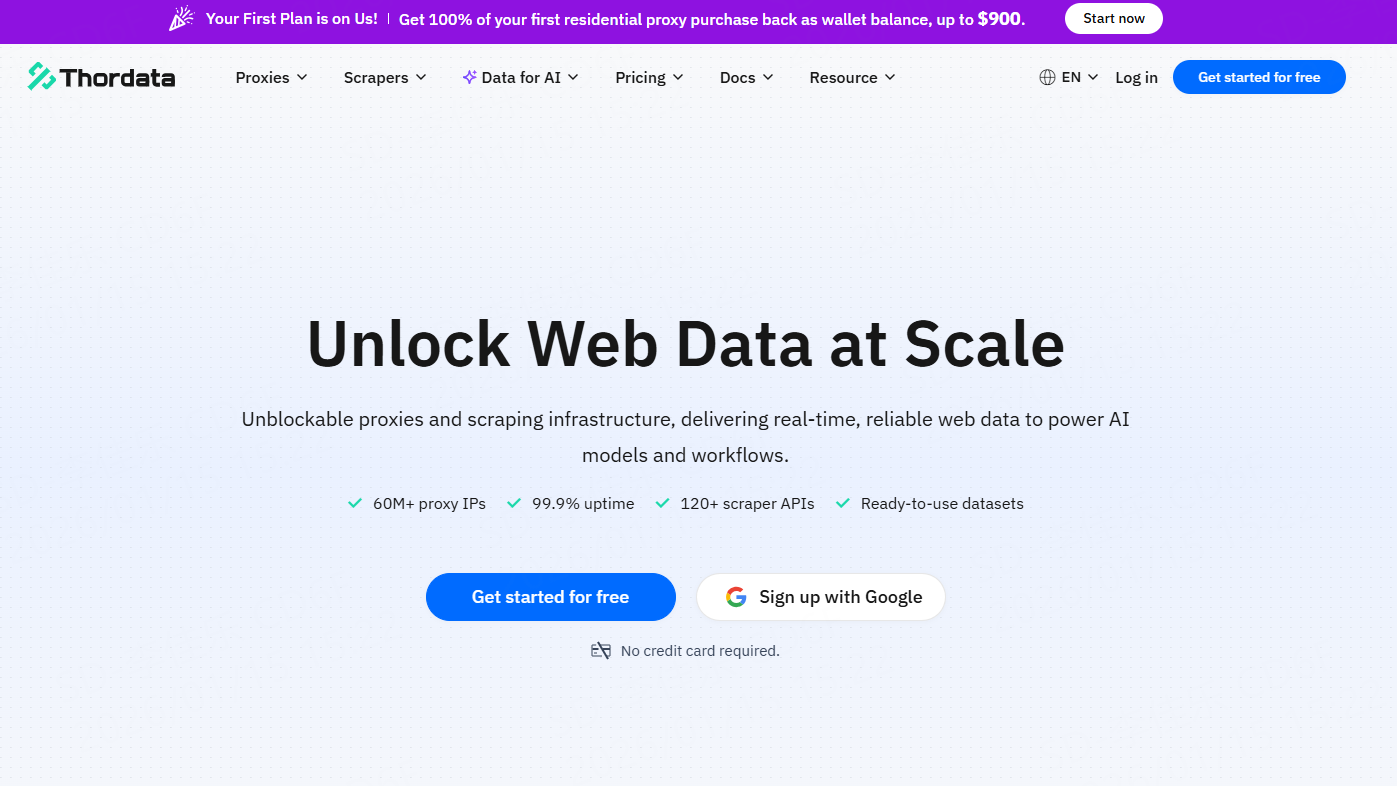
Thordata is a leading global provider of data scraping solutions, focused on offering high-performance proxy services and data scraping tools for enterprises. At its core, it operates a residential proxy network covering over 190 countries with more than 60 million IPs, providing a solid IP foundation for data collection in complex environments. The IP rotation required for web scraping is fully automated by its system, greatly reducing the risk of users being flagged by target websites.
Based on its robust proxy infrastructure, Thordata offers a range of web scraping solutions to meet different levels of scraping needs, including the Web Scraper API. This API is designed to provide developers with a simple HTTP interface that automatically handles IP rotation, request header management, and basic anti-scraping bypass.
Thordata’s Web Scraper API allows users to retrieve rendered page HTML content with a single API call, without needing to manage the complexities of a proxy pool, making it especially suitable for teams that need stable access to global web content without being blocked by anti-scraping measures.
Features:
1. Automatically handles complex browser fingerprints to bypass advanced anti-scraping systems.
2. Built-in dynamic web rendering capabilities perfectly handle dynamically loaded content.
3. Real-time geolocation capabilities support localized scraping globally.
4. Extremely high concurrency capacity supports the synchronous execution of massive tasks.
5. High concurrency support ensures low-latency responses even under large-scale tasks.
6. Automatic retry mechanism effectively handles intermittent network failures during scraping.
In addition to the API solution, Thordata also offers a Scraping Browser for users who need deep control over browser behavior. This is a fully managed browser environment that allows you to run Puppeteer, Playwright, or Selenium scripts directly in the cloud, while Thordata automatically handles all challenges related to proxies, fingerprint obfuscation, and even CAPTCHAs in the background.
Our team used this solution in an e-commerce price monitoring project, using Playwright scripts to simulate login and scrolling, while Thordata ensured the purity and anonymity of each browser instance, ultimately increasing the project’s stability rate from 70% to 99.5%.
Pros:
• A large and clean residential proxy pool.
• Comprehensive developer documentation with multi-language code examples.
• Supports precise scraping requests based on geographic location.
• Provides around-the-clock support from technical experts.
Cons:
• Advanced configuration options may have a learning curve for novice users.
Pricing: Starting from $30 per month.
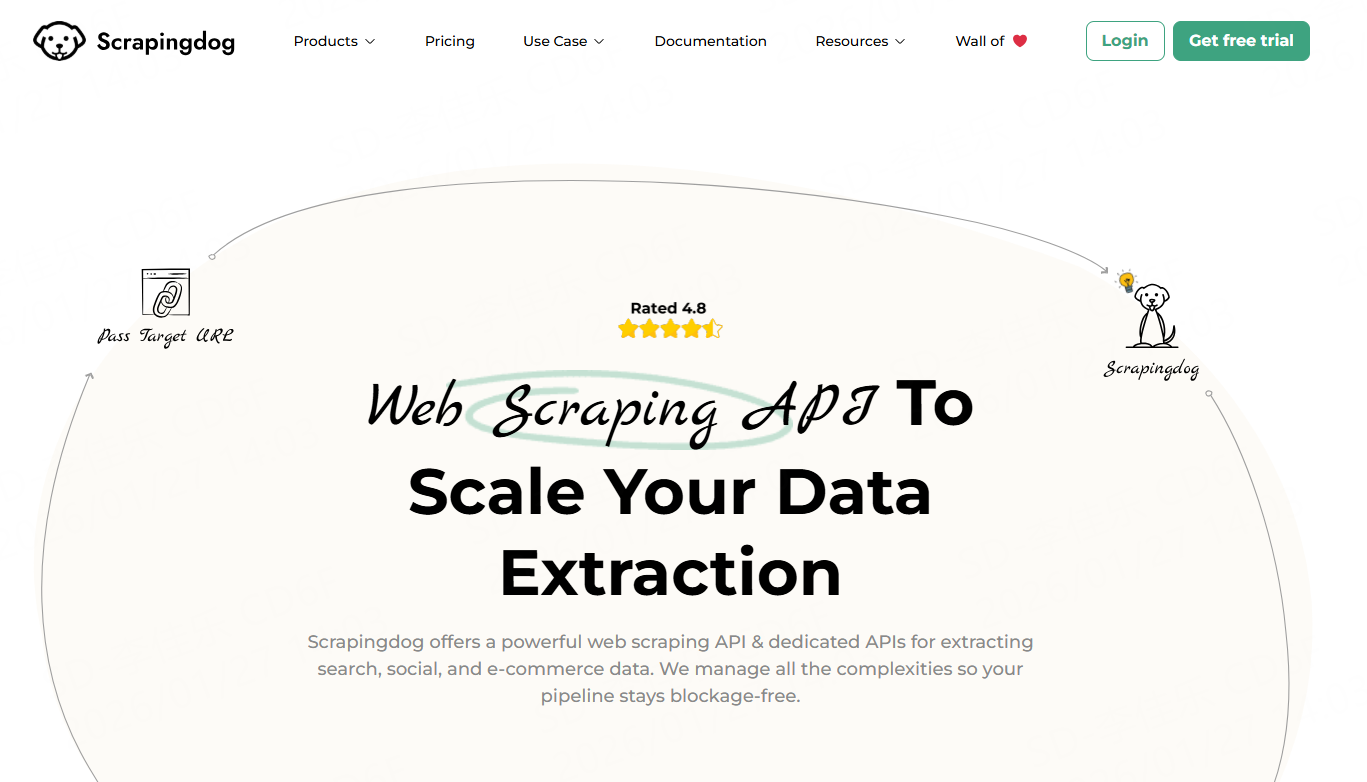
Scrapingdog is an integrated web scraping API service. It packages all the hassles of modern web scraping into a simple API call. You just send it the target URL, and it automatically handles JavaScript rendering, proxy rotation, and even CAPTCHAs, returning clean HTML or structured JSON data.
Pros:
• The API is designed to be extremely simple, with a quick learning curve and clear documentation.
• It has a built-in headless browser and smart proxies, providing a one-stop solution for common scraping obstacles.
• It offers a free plan suitable for small-scale testing and learning.
Cons:
• For extremely large-scale scraping (tens of millions of requests per day), costs may be high.
• Customization capabilities are limited, and deeply complex interaction logic may still require custom scripts.
• Compared to self-built solutions, it has less control over the underlying system.
Pricing: Starting from $40 per month.
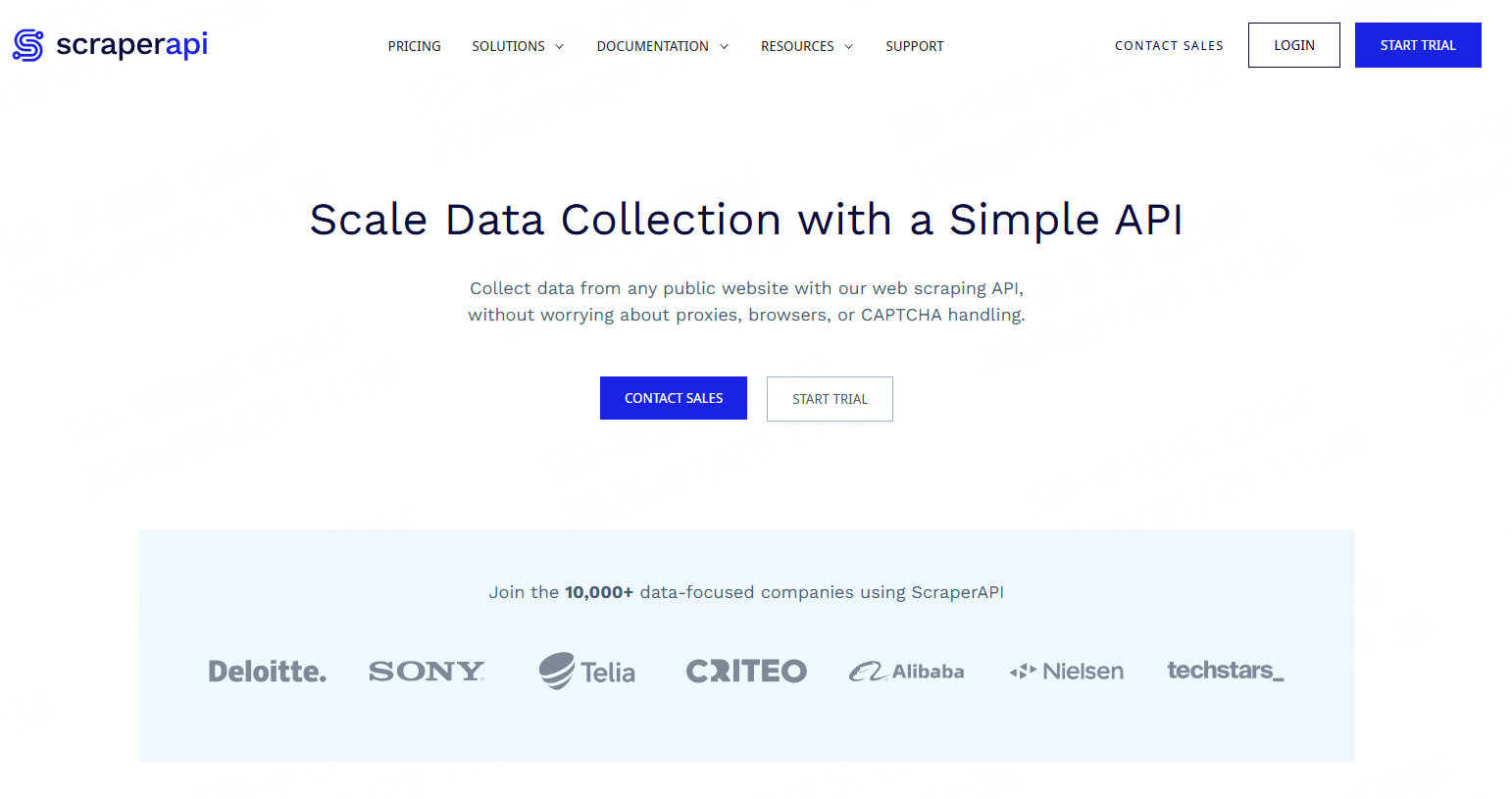
As one of the pioneers in the web scraping API field, ScraperAPI has earned a good reputation for its stability and reliability. It provides a powerful cloud platform that handles proxies, browsers, and CAPTCHAs through a single API endpoint. Its services have been optimized over the years, exhibiting balanced performance in connection speed and success rates. For development teams needing to build stable data sources without being burdened by technical details, it is a very reliable choice.
Pros:
• Globally distributed servers ensure excellent request stability.
• Supports concurrent requests, custom request headers, geolocation targeting, and other advanced features.
• Perfectly compatible with various programming languages and mainstream frameworks.
Cons:
• For certain specific formats, users need to write their own parsing logic.
• Its costs increase rapidly with the growth of data volume.
Pricing: Starting from $49 per month.
Scrapingbee focuses on solving the most challenging JavaScript rendering issues in modern web pages and is a powerful tool for handling single-page applications (SPAs). When you send a URL to Scrapingbee, it loads the page in a real Google Chrome browser environment, executes all JavaScript, and then returns the fully rendered HTML.
Pros:
• JavaScript rendering is its strong suit, achieving excellent results with dynamic pages.
• It also provides screenshot API functionality, which can be used for page monitoring.
• Billing is based on “API call count” rather than bandwidth, making budget control easier.
Cons:
• Due to the use of a real browser, response times may be slightly slower than pure HTTP requests.
• The concurrency handling capacity may occasionally experience latency fluctuations under very high loads.
• The costs can be slightly excessive for static web pages that are not rendered with JS.
Pricing: Starting from $49 per month.
Octoparse is a leader in the visual web scraping field, offering feature-rich desktop software that allows users to build complex scraping workflows without writing a single line of code through intuitive point-and-click and graphical interfaces. You can browse websites like using a browser, clicking on the data you want to extract, and Octoparse will automatically generate the scraping logic in the background.
Pros:
• A completely no-code experience significantly reduces the technical barrier.
• Graphical workflow design provides clear and visual logic.
• It offers a vast number of preset templates covering major e-commerce and news sites.
• Supports cloud collection and scheduled tasks, freeing up local computers.
Cons:
• When handling extremely complex dynamic websites, flexibility may not be as good as programming.
• The licensing cost for large-scale data collection can be quite high.
• The desktop client can consume significant local resources when handling extremely large-scale tasks.
Pricing: Starting from $99 per month.
Scrapy is an open-source, high-performance web scraping framework written in Python. t is not just a library; Iit is a complete development framework that provides a powerful middleware system and data pipeline logic. Because of this, it offers unparalleled flexibility and control. You can control every detail of requests, define complex data extraction and processing pipelines, and easily scale to distributed scraping.
Pros:
• The asynchronous processing architecture provides unmatched scraping speed.
• Powerful middleware allows for highly customized request and response logic.
• It integrates perfectly with data analysis libraries in the Python ecosystem.
• Completely free and has extensive support for third-party plugins.
Cons:
• The learning curve is steep, requiring a solid foundation in Python programming.
• Users must handle proxies, CAPTCHAs, browser rendering, and other anti-scraping measures themselves.
• Deployment and maintenance require some operational knowledge.
Pricing: Free and open-source.
Playwright is a modern browser automation library launched by Microsoft and has become the mainstream choice for web scraper software, replacing Selenium. It supports Chromium, Firefox, and WebKit browsers and provides a unified and powerful API. Although primarily designed for end-to-end testing, its exceptional browser control capabilities make it a great tool for scraping highly interactive, dynamic websites.
Pros:
• Native multi-browser support ensures consistent behavior across platforms.
• Native support for asynchronous programming models avoids the blocking issues of traditional automation tools.
• The recording feature allows for quick generation of high-quality executable code.
• Cross-language support includes Python, Node.js, Java, and .NET.
Cons:
• It is essentially a library, requiring integration with programming languages (Node.js, Python, Java, etc.) for use.
• Running a full browser instance consumes a significant amount of system CPU resources.
• The system overhead is too high for tasks that only require static data.
Pricing: Free and open-source.
BeautifulSoup is the most famous HTML/XML parsing library in the Python ecosystem. It does not scrape web pages by itself (it needs to be used with libraries like requests), but it can parse complex HTML documents into a tree structure, allowing you to query and extract data using extremely simple methods (like find_all). For simple static web scraping tasks, it is an excellent choice for beginners and quick development.
Pros:
• The learning curve is extremely gentle, and the syntax is intuitive and easy to understand.
• It has powerful HTML parsing capabilities and can handle messy markup.
• When used with the Requests library, it can handle 80% of basic scraping tasks.
Cons:
• It cannot handle pages rendered with JavaScript.
• It does not have built-in request, scheduling, or concurrency handling features, requiring users to build them themselves.
• It cannot handle any form of dynamic content or interaction logic.
Pricing: Free and open-source.
Puppeteer is a Node.js library maintained by the Chrome team that controls the Chrome browser via the DevTools protocol. For developers familiar with JavaScript, using Puppeteer to build the frontend part of AI web scraping tools is a very natural choice. It can delve into every detail of the browser, even manipulating the Canvas or handling complex WebGL rendering.
Pros:
• It has the highest synchronization rate with the Chrome browser and is extremely powerful.
• It can generate perfect page PDF reports and high-quality screenshots.
• Its efficiency in headless mode is top-notch compared to similar tools.
Cons:
• It only supports Chrome/Chromium-based browsers.
• The API design is not as modern as Playwright in some aspects.
• Users need to handle anti-detection and proxy integration themselves.
Pricing: Free and open-source.
As an emerging AI web scraping tool, Firecrawl focuses on transforming web content into a clean Markdown format suitable for large language models (LLMs). This is very valuable for building knowledge bases, training customized LLMs, or performing in-depth content analysis. As emphasized by Firecrawl’s official documentation, it simplifies the conversion path from “URL to knowledge,” making it the preferred choice for building Retrieval-Augmented Generation (RAG) systems.
Pros:
• AI intelligent parsing can extract semantic content rather than fixed tags.
• Directly outputs a format that meets LLM training and inference requirements.
• Can map and transform entire websites into a unified format with a high degree of automation.
• The effect of scraping and converting content-based websites (blogs, news) is significant.
Cons:
• For tasks requiring precise extraction of specific fields, it is not as accurate as traditional locators.
• As an emerging service, its ecosystem and functionality maturity are still developing.
• It may not be detailed enough for traditional structured scraping for non-AI purposes.
Pricing: Starting from ¥2.5k per month.
In the practical operation of data collection, developers often encounter numerous obstacles, and these challenges become increasingly complex with the advancement of anti-scraping technologies.
1. IP Blocking and Rate Limiting
Challenge: When a server detects high-frequency access from the same IP address, it triggers an interception mechanism immediately. This is the most common means of protecting server resources, but it also poses challenges for large-scale data collection.
Solution: You must implement a robust IP rotation strategy. By using a Web Scraper API with a large resource pool, you can assign different geographical locations and IP identities for each request. At the same time, simulating irregular human access intervals (random wait times) can also effectively reduce risks.
2. Dynamic Content Loading
Challenge: Modern web pages often use frameworks like AJAX, React, or Vue for asynchronous loading, which causes traditional static extraction tools to be unable to retrieve actual data content.
Solution: The best way to handle this challenge is to introduce tools with browser rendering capabilities, such as the best Python tools for web scraping, like Playwright. If you want to reduce resource consumption on local servers, you can also resolve this by calling APIs that support cloud-based JavaScript rendering.
Below, we will provide a code example that our team used to solve the problem of dynamic rendering while developing a real-time price monitoring system with Python and Playwright:
from playwright.sync_api import sync_playwright

def fetch_dynamic_data(url):
    with sync_playwright() as p:
        # Launch a headless browser and configure simulation parameters
        browser = p.chromium.launch(headless=True)
        context = browser.new_context(user_agent="Mozilla/5.0 ...")
        page = context.new_page()

        # Access the target URL and wait for the network to be idle
        page.goto(url, wait_until="networkidle")

        # Simulate a real user scrolling down to trigger infinite loading
        page.evaluate("window.scrollTo(0, document.body.scrollHeight)")
        page.wait_for_timeout(2000)

        # Extract the complete HTML after rendering
        content = page.content()
        browser.close()
        return content

# This method ensures that we can scrape all dynamically generated price data via JavaScript
3. Anti-Scraping Fingerprint Detection
Challenge: Advanced anti-scraping systems (such as Distil Networks and Imperva) collect browser fingerprints, including User-Agent, Canvas, WebGL, font lists, and dozens of other parameters, to identify and block automated tools.
Solution: Use specialized tools to obfuscate or generate real browser fingerprints. For example, Playwright and Puppeteer can be configured with launch parameters to simulate a real browser. A more hassle-free solution is to use hosted services like Thordata's Scraping Browser, which automatically provides a fresh, real browser environment for each session. At the same time, regularly update the User-Agent string list in your scraping scripts.
Feeling confused by the many web scraper software options? This concise decision tree will help you quickly identify the most suitable tool category based on your situation.
👉 If you are a technical novice or business analyst:
• Want a quick start without coding? Choose Octoparse.
• Just want to easily extract training data for AI? Choose Firecrawl.
👉 If you are a developer needing custom control:
• Prefer the Python ecosystem? Choose Scrapy with anonymous proxies.
• Need to handle extremely complex interactions? Choose Playwright or Puppeteer.
👉 If you are an enterprise user needing large-scale data:
• Need a one-stop, anti-scraping-restricted solution for extracting structured data? First choice: Thordata.
• On a limited budget but need API services? Choose Scrapingdog or ScraperAPI.
In 2026, web scraping is no longer just a technical means of obtaining information; it has evolved into a complex art. Whether you choose highly automated Google web scraping tool extensions or prefer to use the best Python tools for web scraping for deep customization, the key is to find the balance between efficiency, cost, and compliance. For most medium to large projects, adopting infrastructure-level solutions like Thordata typically provides the highest long-term return on investment (ROI). Choosing the right tools can turn the entire internet into your private database.
Want to learn more about the best scraping tools for specific purposes? Discover your next choice here: "Best Wikipedia Scraping API," "Best Real Estate Web Scraping Tools," "Best Bing Search API," "Best Hotel Price Scraper API," and "Best Amazon ASIN Scraping API."
We hope the information provided is helpful. However, if you have any further questions, feel free to contact us at support@thordata.com or via online chat.

<--!>
Frequently asked questions
What is a Web Scraper Tool?
A web scraper tool is an automated software that simulates browser behavior and converts unstructured HTML on web pages into structured formats that are easy to store and analyze, such as spreadsheets or databases.
What is the Best Tool for Web Scraping?
There is no absolute “best,” only the most suitable one. For enterprise-level large-scale applications, Thordata is in a leading position due to its powerful proxy network and stable scraping capabilities; for individual developers, Scrapy and Playwright are mainstream choices.
Can ChatGPT Scrape Data from a Website?
Although ChatGPT has certain code-writing capabilities, it cannot directly perform large-scale scraping tasks. You can use it to write Python scraping scripts, or combine it with its Browsing feature to obtain a small amount of real-time information.
<--!>
About the author
Anna is a content specialist who thrives on bringing ideas to life through engaging and impactful storytelling. Passionate about digital trends, she specializes in transforming complex concepts into content that resonates with diverse audiences. Beyond her work, Anna loves exploring new creative passions and keeping pace with the evolving digital landscape.
The thordata Blog offers all its content in its original form and solely for informational intent. We do not offer any guarantees regarding the information found on the thordata Blog or any external sites that it may direct you to. It is essential that you seek legal counsel and thoroughly examine the specific terms of service of any website before engaging in any scraping endeavors, or obtain a scraping permit if required.
 Looking for
Top-Tier Residential Proxies?您在寻找顶级高质量的住宅代理吗?
Looking for
Top-Tier Residential Proxies?您在寻找顶级高质量的住宅代理吗?
AI Data Collection Explained: Process, Examples, and Ethics
AI data collection is at the h ...
Kael Odin
2026-07-24
Afina Browser for Stable Proxy Workflows, Multi-Accounting and Web Automation
This guide explains how to thi ...
Jenny Avery
2026-07-23
Oxylabs vs Thordata — Which Residential Proxy Provider Wins in 2026?
Thordata has emerged as a comp ...
Kael Odin
2026-07-22
NetNut Is Down — Why Thordata Is the Reliable NetNut Replacement You Need
a reliable, fully operational, ...
Kael Odin
2026-07-22
Why Thordata Is the Smart Bright Data Alternative for Residential Proxies
If you're looking for a Bright ...
Kael Odin
2026-07-22
What residential proxy IP should I use for job posting and salary market intelligence?
Use a residential proxy IP whe ...
Xyla Huxley
2026-07-21
Which residential proxy IP should I use to monitor ESG registries and carbon credit public data?
Use a residential proxy IP whe ...
Xyla Huxley
2026-07-21
What residential proxy IP can help media companies verify streaming catalog availability by region?
Use a residential proxy IP whe ...
Xyla Hxuley
2026-07-21
Which residential proxy IP should I use for insurance quote QA without collecting private customer data?
Use a residential proxy IP for ...
Xyla Huxley
2026-07-21
