


Web Scraper API
Fetch real-time data from 100+ websites,No development or maintenance required.
SCRAPING SOLUTIONS
Get accurate and in real-time results sourced from Google, Bing, and more.
With 120+ prebuilt and custom scrapers ready for any use case.
No blocks, no CAPTCHAs—unlock websites seamlessly at scale.
Execute scripts in stealth browsers with full rendering and automation
PROXY INFRASTRUCTURE
Over 100 million real residential IPs from genuine users across 190+ countries.
Reliable mobile data extraction, powered by real 4G/5G mobile IPs.
For time-sensitive tasks, utilize residential IPs with unlimited bandwidth.
Fast and cost-efficient IPs optimized for large-scale scraping.
SCRAPING SOLUTIONS
PROXY INFRASTRUCTURE
DATA FEEDS
Full details on all features, parameters, and integrations, with code samples in every major language.
LEARNING HUB
ALL LOCATIONS Proxy Locations
TOOLS
RESELLER
Get up to 50%
Contact sales:partner@thordata.com
Products $/GB
Fetch real-time data from 100+ websites,No development or maintenance required.
Get real-time results from search engines. Only pay for successful responses.
Execute scripts in stealth browsers with full rendering and automation.
Bid farewell to CAPTCHAs and anti-scraping, scrape public sites effortlessly.
Dataset Marketplace Pre-collected data from 100+ domains.
Over 100 million real residential IPs from genuine users across 190+ countries.
Reliable mobile data extraction, powered by real 4G/5G mobile IPs.
For time-sensitive tasks, utilize residential IPs with unlimited bandwidth.
Fast and cost-efficient IPs optimized for large-scale scraping.

Data for AI $/GB
Pricing $0/GB
Docs $/GB
Full details on all features, parameters, and integrations, with code samples in every major language.
Resource $/GB
EN $/GB
产品 $/GB
AI数据 $/GB
定价 $0/GB
产品文档 $/GB
资源 $/GB
简体中文 $/GB
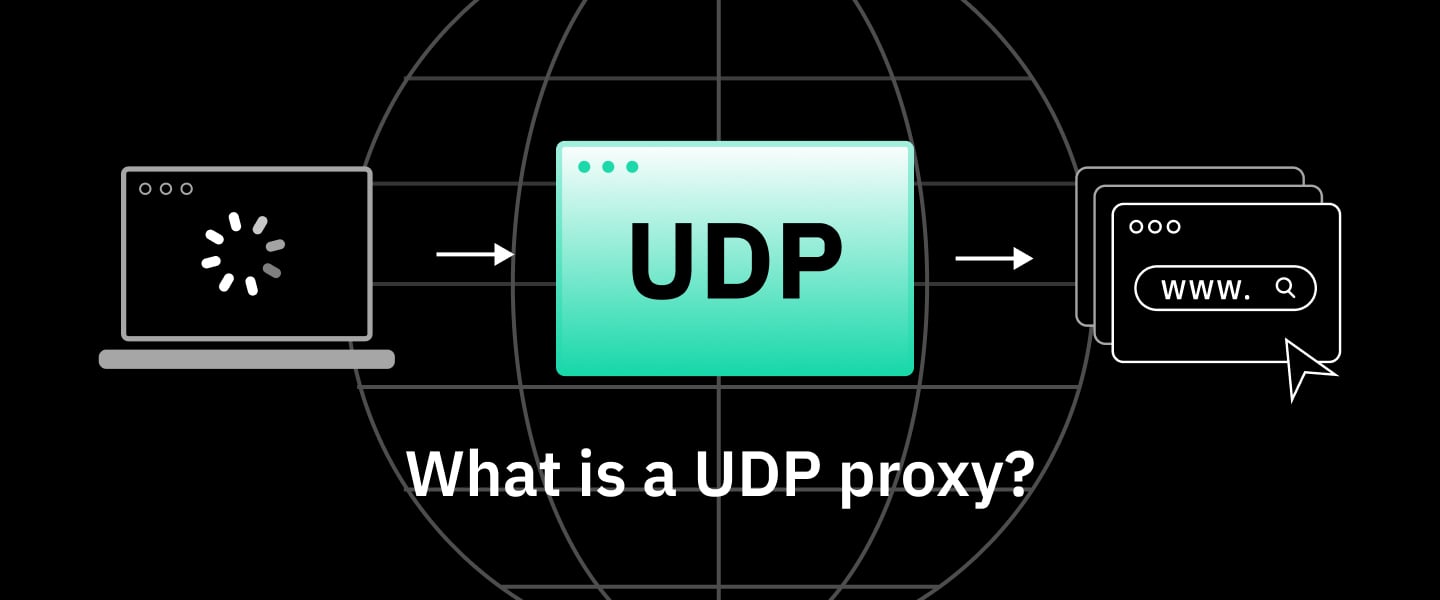

In the digital age, data transmission efficiency is closely related to user experience. As one of the core components of the network architecture, UDP proxy has been widely used in online games, real-time audio and video transmission, DNS acceleration and other fields due to its significant advantage of low latency. This paper will systematically analyze the core advantages and practical value of UDP proxies from the underlying principles to the measured data.
UDP proxy is a datagram forwarding proxy service based on UDP protocol, designed for connectionless communication scenarios. It does not establish a persistent connection, does not perform transmission acknowledgement or packet loss retransmission, but uses a “best effort delivery” strategy to achieve efficient forwarding with minimal overhead.
To put it simply:
Your device sends UDP data packets to the proxy server → the proxy server forwards them directly to the target address → the target server responds and the data packets return to the original route → There is no handshake, no retransmission and no connection status maintenance in the whole process.
This design makes the single packet forwarding delay of UDP proxy usually stable within 10-30ms, far lower than 100-300ms of TCP proxy.
The working principle of the UDP proxy can be divided into the following stages:
The proxy server listens on the specified port to receive UDP datagrams from the client.
The proxy parses the datagram header information, extracts the target address, and establishes the session mapping relationship between the client and the target server.
The proxy forwards the datagram to the destination server while replacing the source address with the proxy server address, thus hiding the true identity of the client.
After the target server’s response datagram arrives at the proxy, the proxy returns it to the corresponding client according to the session mapping table.
Because UDP has no connection, the proxy manages the session status through the timeout mechanism, and automatically releases the mapping resources when there is no data transmission within the set time.
Below, we will disassemble the five core advantages of UDP proxies one by one, and accurately analyze their technical implementation logic and actual business value.
Eliminate the complete cancellation of three-way handshake, ACK acknowledgement per packet, congestion control and retransmission waiting, a single data transmission delay is usually less than 5ms,
To validate the actual latency performance of UDP proxies, we conducted real-world benchmark tests under public network conditions.
The test environment and methodology are outlined below to ensure reproducibility.
Test setup:
– Client location: Paris, France (public internet)
– Client system: Ubuntu 22.04
– Proxy server: Frankfurt (10 Gbps network interface)
– Target server: Frankfurt
– Packet size: 512 bytes
– Total samples: 10,000 UDP packets
– Tools used: iperf3, ping (UDP mode)
Observed results:
– Average latency: 3.8 ms
– 95th percentile latency (p95): 4.6 ms
– Average jitter: 0.6 ms
– Packet loss rate: 0.21%
These results confirm that UDP proxy forwarding introduces minimal overhead. The consistently low jitter indicates a stable forwarding path without retransmission-induced delay spikes, which is critical for latency-sensitive applications such as competitive online gaming and real-time media delivery.
The UDP proxy maintains continuous stream forwarding in a high packet loss network. With FEC/interpolation technology at the application layer, the UDP proxy can smoothly mask the impact of packet loss and realize “zero interruption” fault tolerance, which is significantly better than TCP retransmission.
To further evaluate proxy behavior under unstable network conditions, we simulated packet loss and compared UDP and TCP proxy performance using controlled network emulation.
We introduced artificial packet loss using Linux tc netem and observed proxy behavior under identical conditions.
Network simulation parameters:
– Simulated packet loss rates: 5% and 10%
– Baseline round-trip time (RTT): 20 ms
– Test duration: 5 minutes per scenario
– Traffic pattern: continuous UDP stream
Test observations:
– Under 5% packet loss, the UDP proxy maintained a continuous data stream with only minor quality degradation.
– Under 10% packet loss, UDP traffic remained uninterrupted, while TCP proxy connections experienced frequent stalls caused by retransmission delays and congestion backoff mechanisms.
This behavior aligns with the fundamental design goals of both protocols. TCP prioritizes reliability and correctness through retransmission, which can significantly increase latency under packet loss. In contrast, UDP prioritizes timeliness, allowing applications to tolerate limited packet loss in exchange for smooth and continuous real-time transmission.
The UDP proxy adopts a stateless architecture, which completely gets rid of the state maintenance overhead caused by traditional TCP connections and minimizes the CPU and memory usage of the server. This extremely high resource utilization not only releases the full potential of a single server, enabling it to easily cope with hundreds of thousands of concurrent connections, but also significantly reduces the enterprise’s hardware procurement costs and data center energy consumption,Achieve the best balance of performance and cost.
As a security barrier, the proxy server not only hides the user’s real IP address to prevent privacy leakage and tracking, but also intercepts DDoS attack traffic to protect the source station from public network risks and realize the integrated protection of privacy, anonymity and anti-attack.
With low latency, anti-packet loss, and high resource efficiency, UDP proxy is an ideal choice for scenarios with high real-time requirements and low data integrity requirements. It can effectively alleviate the bottleneck of public network transmission and improve service availability and user experience. These core advantages have been fully verified in the following five typical application scenarios.
Reduce latency and jitter, improve connection stability; At the same time, it can hide the source Station and alleviate the disconnection and service interruption caused by DDoS.
It is used for NAT/firewall penetration and media relay to improve the connection rate, real-time performance, and overall stability of calls/conferences.
Forward DNS queries nearby to shorten the resolution delay, and perform cleaning and offloading at the proxy layer to enhance attack resistance and availability.
Gathers a large amount of UDP reporting traffic, solves the problem of device reachability in complex networks, and supports basic isolation and traffic governance.
Carries UDP-based tunnel traffic (such as some VPN schemes), which is used to limit penetration and reduce transmission overhead to meet the requirements of secure access and cross-network interworking.
To clarify the technical boundaries and applicable scenarios of UDP proxies and avoid conceptual confusion, this section will conduct a systematic comparative analysis with typical proxies such as TCP and HTTP in four dimensions: connection model, transmission target, performance characteristics, and core application scenarios.
UDP proxy: based on the connectionless protocol, there is no need to establish and maintain session state, each data packet is independently routed, and the resource consumption is extremely low.
TCP proxy: based on connection-oriented protocols, the connection needs to be established through “three-way handshake” and the state (such as sequence number, window, retransmission queue) is maintained throughout the session, which has relatively high resource overhead.
UDP proxy:
With extremely low latency as the primary goal, does not guarantee the order, arrival, or integrity of packets, allowing small amounts of data to be sacrificed for speed.
TCP proxy:
The primary goal is to ensure that 100 percent of the data is accurate, complete, and orderly, and reliability is achieved through mechanisms such as acknowledgement, retransmission, and sorting, but additional delays are introduced.
UDP proxy:
The Protocol header is small, there is no complex logic such as flow control and congestion control, and the processing is simple. A single machine can carry hundreds of thousands of high-level concurrent connections.
TCP proxy:
the protocol mechanism is complex (such as slow start and congestion avoidance). If TLS encryption is added, the overhead is higher, and high concurrency requires severe server performance.
UDP proxy:
It is designed for real-time sensitive scenarios, such as online games, audio and video calls, live broadcasts, and IoT signaling. It can tolerate instantaneous packet loss with millisecond delay.
TCP proxy:
Designed for data integrity-sensitive scenarios, such as web browsing, file transfer, and API calls. It is strictly required that data arrive in order and without errors. Any data error or loss may lead to business failure. The proxy needs to ensure the reliability of the connection.
Before answering this question, please check the table below. In order to have a more intuitive feeling, we can also add HTTP proxy :
|
Characteristic |
UDP proxy |
TCP proxy |
HTTP proxy |
|
Core positioning |
Extreme low latency · Real-time priority |
Data reliability · Integrity priority |
Web traffic dedicated |
|
Connection mechanism |
No connection (stateless) |
Three-way handshake required to establish a connection |
Request/Response Model |
|
Data reliability |
× No guarantee (packet loss allowed) |
√ Strict guarantee (retransmission mechanism) |
√ Strict guarantee |
|
Typical delay |
<5 ms (milliseconds) |
20~150 ms (retransmission leads to soaring delay) |
30~100 ms |
|
Protocol overhead |
Very low (8 byte header) |
High (20 bytes header + ACK) |
Medium |
|
Resource occupancy |
Extremely low (single support 50000 + concurrent) |
Medium-high (need to maintain connection status) |
Medium |
|
Applicable Scenarios |
Online games, VoIP, DNS acceleration, and IoT device data reporting |
File download, web browsing, email sending and receiving, database backup |
Web page access, crawler, content filtering, load balancing |
|
Whether non-HTTP is supported |
√ |
√ |
×, HTTP/HTTPS |
We can draw the following conclusions about the four proxy techniques:
“Real-time priority → UDP proxy; Reliable priority → TCP proxy; Web dedicated → HTTP proxy.”
•Zero Caton Experience → UDP proxy
•Zero data loss → TCP proxy
•Web page traffic → HTTP proxy
A general-purpose proxy that supports TCP + UDP is suitable for P2P/SSH, but UDP has a delay of 15-80ms and is not suitable for competitive games (<5ms).
For users seeking industrial-grade low latency (such as e-sports players, live broadcast platforms, and IoT platforms), dedicated UDP proxies (such as services provided by Thordata) are the only solution that can stably reduce the latency to <5 ms.
After reading this, I believe that you have clearly clarified the core definition and operation logic of the UDP proxy, as well as its key role in the network link as a relay service based on the UDP protocol at the transport layer. You can now accurately determine which scenarios are more suitable for UDP proxy rather than traditional HTTP proxy.
Thordata has a global high-performance proxy network, providing HTTP(S) full-category proxy services. The Complete product matrix includes:
Data center proxy: More than 1 M+ datacenter IP addresses.
Residential proxy: More than 100 M+ ethical residential IP addresses, covering more than 190 countries.
ISP proxy: More than 55W Premium IP addresses.
Mobile proxy: More than 600K mobile proxy servers in more than 30 countries/regions.
This high-speed, reliable, and global proxy infrastructure has become the core driving force for multiple scenarios such as web browsing and data collection.

Frequently asked questions
Does a UDP proxy cause packet loss?
UDP doesn’t guarantee delivery, so loss can happen. Good proxies reduce perceived loss with better routing and optional app-layer protection.
When should you avoid using a UDP proxy?
For tasks needing full reliability (file transfer, web browsing, payments/logins), use TCP/HTTP proxies or add reliability at the application layer.
Can a UDP proxy improve in-game responsiveness?
Often yes—by lowering latency and jitter for steadier input response. Results depend on your local network and node distance.
About the author

Xyla is a technical writer who turns complex networking and data topics into practical, easy-to-follow guides, treating content like troubleshooting: start from real scenarios, validate with data, and explain the “why” behind each solution. Outside of work, she’s a Level 2 badminton referee and marathon trainee—finding her best ideas between the court and the finish line.
The thordata Blog offers all its content in its original form and solely for informational intent. We do not offer any guarantees regarding the information found on the thordata Blog or any external sites that it may direct you to. It is essential that you seek legal counsel and thoroughly examine the specific terms of service of any website before engaging in any scraping endeavors, or obtain a scraping permit if required.
 Looking for
Top-Tier Residential Proxies?您在寻找顶级高质量的住宅代理吗?
Looking for
Top-Tier Residential Proxies?您在寻找顶级高质量的住宅代理吗?
AI Data Collection Explained: Process, Examples, and Ethics
AI data collection is at the h ...
Kael Odin
2026-07-24

Afina Browser for Stable Proxy Workflows, Multi-Accounting and Web Automation
This guide explains how to thi ...
Jenny Avery
2026-07-23
Oxylabs vs Thordata — Which Residential Proxy Provider Wins in 2026?
Thordata has emerged as a comp ...
Kael Odin
2026-07-22
NetNut Is Down — Why Thordata Is the Reliable NetNut Replacement You Need
a reliable, fully operational, ...
Kael Odin
2026-07-22
Why Thordata Is the Smart Bright Data Alternative for Residential Proxies
If you're looking for a Bright ...
Kael Odin
2026-07-22

What residential proxy IP should I use for job posting and salary market intelligence?
Use a residential proxy IP whe ...
Xyla Huxley
2026-07-21
Which residential proxy IP should I use to monitor ESG registries and carbon credit public data?
Use a residential proxy IP whe ...
Xyla Huxley
2026-07-21
What residential proxy IP can help media companies verify streaming catalog availability by region?
Use a residential proxy IP whe ...
Xyla Hxuley
2026-07-21

Which residential proxy IP should I use for insurance quote QA without collecting private customer data?
Use a residential proxy IP for ...
Xyla Huxley
2026-07-21
