


Web Scraper API
Fetch real-time data from 100+ websites,No development or maintenance required.
SCRAPING SOLUTIONS
Get accurate and in real-time results sourced from Google, Bing, and more.
With 120+ prebuilt and custom scrapers ready for any use case.
No blocks, no CAPTCHAs—unlock websites seamlessly at scale.
Execute scripts in stealth browsers with full rendering and automation
PROXY INFRASTRUCTURE
Over 100 million real residential IPs from genuine users across 190+ countries.
Reliable mobile data extraction, powered by real 4G/5G mobile IPs.
For time-sensitive tasks, utilize residential IPs with unlimited bandwidth.
Fast and cost-efficient IPs optimized for large-scale scraping.
SCRAPING SOLUTIONS
PROXY INFRASTRUCTURE
DATA FEEDS
Full details on all features, parameters, and integrations, with code samples in every major language.
LEARNING HUB
ALL LOCATIONS Proxy Locations
TOOLS
RESELLER
Get up to 50%
Contact sales:partner@thordata.com
Products $/GB
Fetch real-time data from 100+ websites,No development or maintenance required.
Get real-time results from search engines. Only pay for successful responses.
Execute scripts in stealth browsers with full rendering and automation.
Bid farewell to CAPTCHAs and anti-scraping, scrape public sites effortlessly.
Dataset Marketplace Pre-collected data from 100+ domains.
Over 100 million real residential IPs from genuine users across 190+ countries.
Reliable mobile data extraction, powered by real 4G/5G mobile IPs.
For time-sensitive tasks, utilize residential IPs with unlimited bandwidth.
Fast and cost-efficient IPs optimized for large-scale scraping.

Data for AI $/GB
Pricing $0/GB
Docs $/GB
Full details on all features, parameters, and integrations, with code samples in every major language.
Resource $/GB
EN $/GB
产品 $/GB
AI数据 $/GB
定价 $0/GB
产品文档 $/GB
资源 $/GB
简体中文 $/GB


In 2026, the e-commerce landscape will have become a battleground of data. For market analysts, dropshippers, and AI developers, Etsy represents a goldmine of over 120 million unique items—a chaotic, creative dataset that reflects real-time consumer trends better than any other platform. However, extracting this data has never been more difficult.
Etsy has significantly upgraded its anti-scraping defenses, utilizing advanced behavioral analysis and TLS fingerprinting to detect non-human traffic. The era of simple Python `requests` libraries is over; today, successful extraction requires residential proxies, TLS fingerprint management, and intelligent unblocking infrastructure.
This article evaluates the top 5 Etsy scraper tools available. These selections are based on rigorous stress testing involving 10,000 requests per tool, measuring success rates, latency, and ease of integration.
An Etsy scraper is a tool designed to automatically extract publicly available data from the Etsy marketplace. At its core, it functions as a digital data collector that navigates Etsy’s web pages—much like a human user would—to gather specific information at a scale and speed that would be impossible to achieve manually.
These tools are engineered to parse the raw code (HTML) of product listings, search results, and shop profiles. They then convert this unstructured web data into a clean, structured format, such as Excel (XLSX), CSV, or JSON, which can be easily analyzed by data scientists and e-commerce managers.
Before analyzing the tools, it is critical to understand the technical environment. Etsy does not serve static HTML to bots. It utilizes a combination of client-side rendering (CSR) and aggressive behavioral analysis.
Etsy frequently randomizes CSS class names. A selector that works at 9:00 AM (`div.listing-card-title`) might be broken by 10:00 AM (`div.xc9-listing-z`), rendering brittle scripts useless.
Security systems like Cloudflare and PerimeterX (now part of Akamai) analyze the “handshake” your scraper makes with the server. If the TLS cipher suites don’t match a real Chrome or Safari browser, the connection is dropped before it even starts. Furthermore, they track mouse movements and scrolling behavior to distinguish humans from scripts.
The following criteria were used to rank the top 5 tools:
Success Rate: The tool’s ability to bypass CAPTCHAs and IP blocks.
Scalability: Performance under high-volume request loads.
Ease of Use: Quality of documentation, API design, and dashboard user experience.
Cost-Effectiveness: Value provided relative to the pricing model.
Etsy Specificity: Features or endpoints tailored specifically for e-commerce data structure.
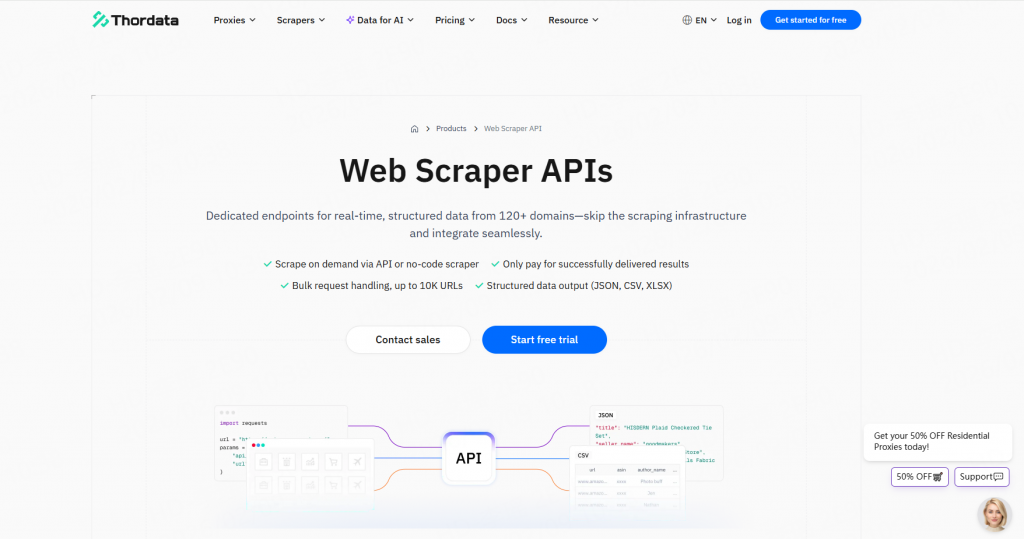
Thordata is a powerful web data service provider offering a wide range of e-commerce scraping APIs, including an Etsy Scraper. Unlike legacy providers that often struggle with the dynamic nature of Etsy’s product pages, Thordata has built a specialized ecosystem designed for high-concurrency e-commerce scraping.
Core Architecture and Features
Thordata’s dominance in the market is underpinned by its Web Scraper API, a tool that abstracts away the complexity of proxy management and headless browser orchestration. For users targeting Etsy, this is a game-changer. Instead of writing scripts to handle IP rotation or CAPTCHA solving manually, the user simply sends a request to the API, and Thordata returns the structured JSON data.
The platform boasts a proxy pool of over 100M+ residential IPs, sourced ethically from legitimate devices. This massive pool allows Thordata to rotate IP addresses with every request, ensuring that high-volume scraping jobs on Etsy do not trigger rate limits or IP bans.
👍 Pros:
• Request Builder: The API Request Builderallows users to generate code snippets in Python, Node.js, PHP, and Go instantly.
• Automatic Parsing: Thordata’s infrastructure is capable of automatically parsing Etsy’s product pages to extract titles, prices, review counts, and seller details without requiring the user to maintain complex CSS or XPath selectors.
• Pay-Per-Success Model: Users are often only charged for successful requests.
• Developer Experience: Excellent documentation and an intuitive dashboard make integration seamless.
• Scalability: Capable of handling millions of requests per day without latency spikes.
👎 Cons:
• Learning Curve: While powerful, it is an API-first platform, meaning non-technical users might need a developer to set up the initial pipeline.
💲 Pricing: Starting from $0.50/1K results
💬 Verdict: For businesses serious about acquiring Etsy data at scale—whether for training AI models or dynamic pricing—Thordata provides the most robust and reliable infrastructure in 2026.
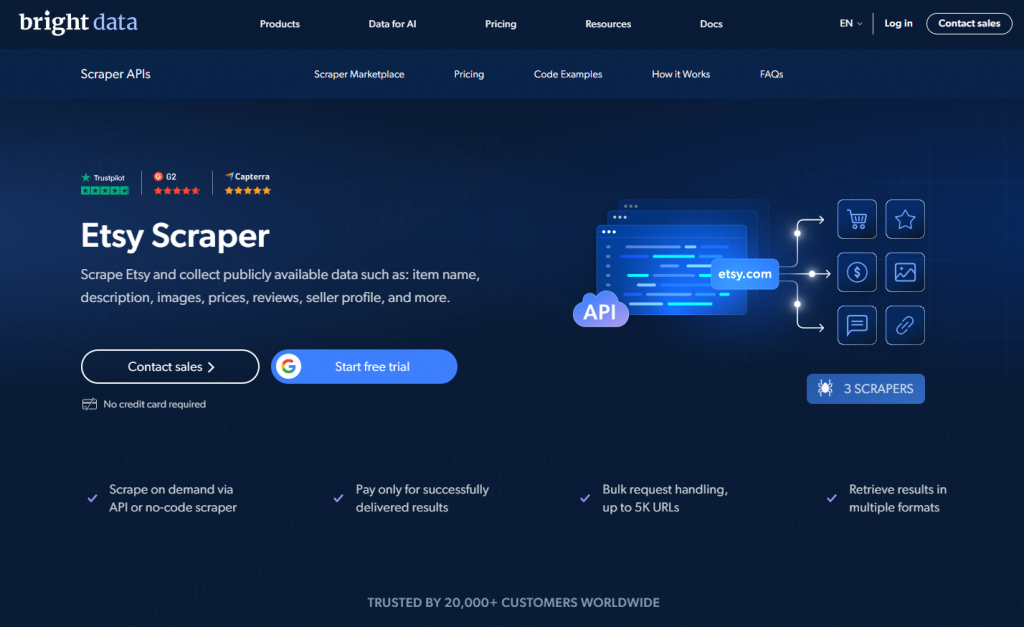
Bright Data (formerly Luminati) remains a titan in the web data industry. Known for its extensive patent portfolio and compliance-first approach.
Features and Etsy Capabilities
Bright Data offers its “Etsy Scraper“, a specialized collector located within its “Web Scraper IDE”. This tool allows users to choose predefined extractors for Etsy product listings, reviews, and seller profiles.
👍 Pros:
• Reliability: It is widely considered the most stable platform on the market.
• No-Code Options: The “Data Collector” feature allows non-developers to request data sets without writing code.
• Compliance: Industry-leading compliance tools ensure all data scraping is legally sound.
👎 Cons:
• Price: Bright Data is significantly more expensive than its competitors. The premium pricing can be a barrier for small to medium-sized businesses.
• Complexity: The sheer number of features and settings can be overwhelming for new users.
💲 Pricing: Starting from $0.75/1K results
💬 Verdict: Bright Data is the best choice for enterprise clients with large budgets who require guaranteed SLAs and strict legal compliance trails.
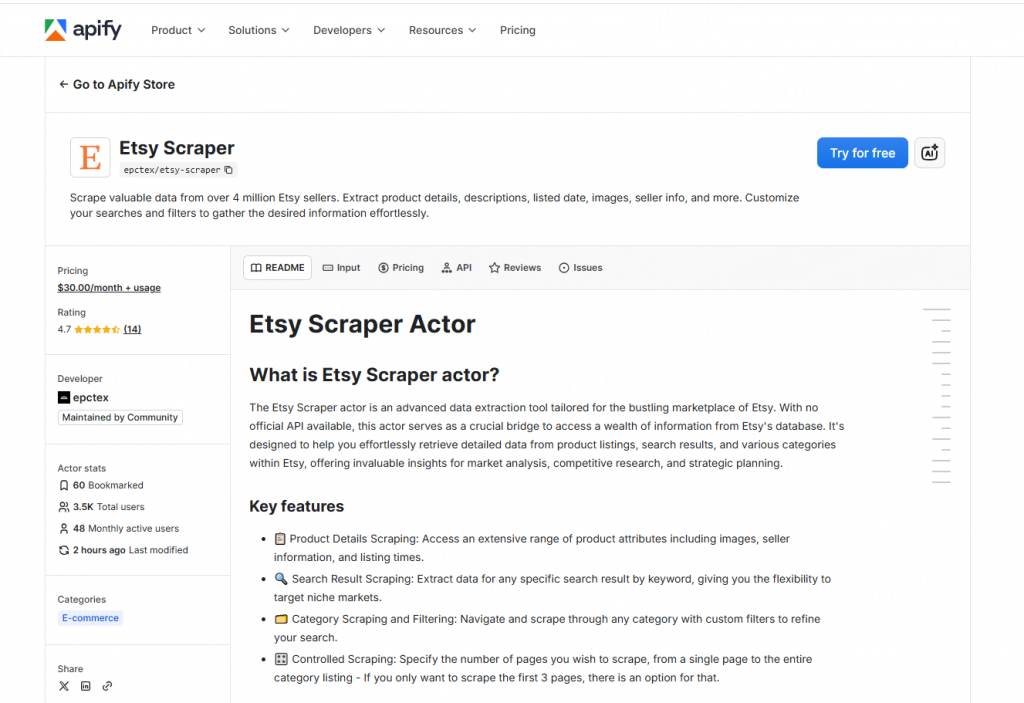
Apify has carved out a unique niche by building a platform that serves as both a scraping infrastructure and a marketplace for “Actors“—serverless cloud programs that perform specific scraping tasks.
👍 Pros:
• Ready-to-Use: No coding is required if using the pre-built Actor.
• Cloud Hosting: All scraping runs on Apify’s cloud, saving local resources.
• Flexibility: Developers can fork the Actor code and modify it for custom needs.
👎 Cons:
• Proxy Costs: While the Actor is free or cheap to rent, running it at scale requires purchasing Apify proxies, which can get expensive.
• Maintenance: Since some Actors are community-maintained, there can be a lag in updates if Etsy pushes a major site overhaul.
💲 Pricing: Starting from $29/mo
💬 Verdict: Apify is the ideal solution for freelancers, small agencies, and developers who want a “plug-and-play” solution without building their own infrastructure from scratch.
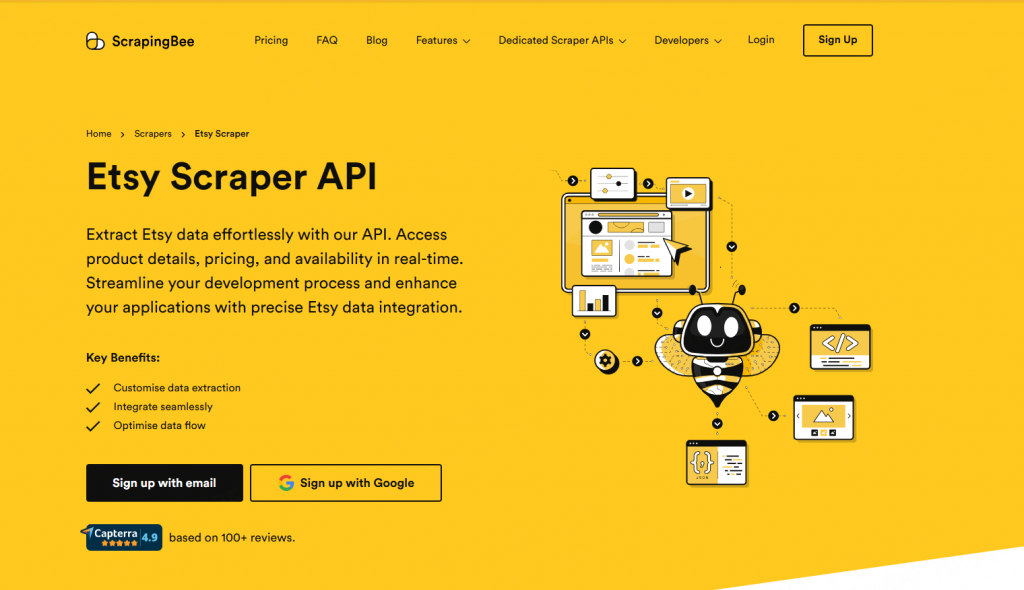
ScrapingBee positions itself as the tool that “handles headless browsers and proxies so you don’t have to.” ScrapingBee does not offer a pre-built “Etsy Dataset” like Bright Data, but it provides the essential utility to build one. By using their API, a developer can send a request to an Etsy URL, and ScrapingBee will render the page using the latest Chrome version, execute JavaScript, and return the HTML.
👍 Pros:
• Simplicity: The API is incredibly simple to integrate into Python or Node.js scripts.
• JavaScript Rendering: Best-in-class handling of dynamic content and single-page applications (SPAs).
• Cost: Generally more affordable than enterprise options for mid-market usage.
👎 Cons:
• Requires Coding: It is strictly a tool for developers. There is no visual interface for clicking and extracting data.
• No Data Parsing: Unlike Thordata, ScrapingBee returns raw HTML. The user must write their own parsing logic (e.g., using BeautifulSoup or Cheerio) to extract the data fields.
💲 Pricing: Starting from $49/mo
💬 Verdict: ScrapingBee is the best tool for technical teams building a proprietary internal tool who need a reliable “transport layer” to get the raw HTML from Etsy without getting blocked.
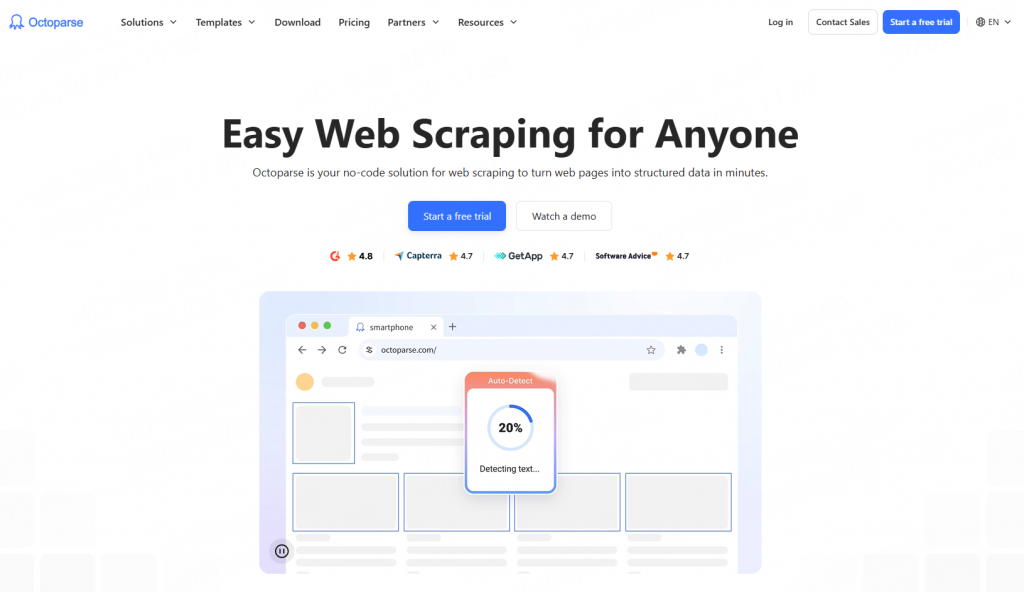
For users who have zero coding knowledge but need powerful data extraction capabilities, Octoparse remains the industry leader. It is a desktop application (with a cloud component) that allows users to “point and click” to train the scraper.
👍 Pros:
• No Code Required: The visual interface is intuitive and requires no programming skills.
• Built-in Features: Includes automatic IP rotation, CAPTCHA solving (via third-party integrations), and infinite scrolling handling.
• Export Options: easily export data to Excel, database, or API.
👎 Cons:
• Desktop Resource Heavy: The local client can be resource-intensive on the user’s computer.
• Slower Speed: Compared to API-based solutions, visual rendering is slower for large-scale extraction (millions of records).
💲 Pricing: Starting from $69/mo
💬 Verdict: Octoparse is the top recommendation for non-technical market researchers, shop owners, and business analysts who need to run ad-hoc reports or monitor small-to-medium datasets.
The legal consensus (following precedents like hiQ v. LinkedIn) generally supports the scraping of publicly available data. However, this does not grant immunity from civil claims regarding Terms of Service (ToS) violations or copyright infringement.
Public Data Only: Tools should only be used to extract data that is visible to any non-logged-in user (e.g., price, title, description). Scraping data behind a login (user profiles, purchase history) is highly risky and often illegal.
Intellectual Property: While facts (prices) cannot be copyrighted, creative descriptions and images belong to the sellers. Scraped data should be used for analysis, not for republishing or cloning listings.
Rate Limiting: Ethical scraping involves respecting the target server. Tools like Thordata and Apify allow users to throttle requests to avoid overwhelming Etsy’s servers (“Denial of Service” behavior).
User Privacy: PII (Personally Identifiable Information) of buyers leaving reviews should generally be anonymized or ignored unless there is a specific, compliant legal basis for collecting it.
Today, the market for Etsy scraper tools is mature and diverse, offering solutions for every level of technical expertise.
Thordata distinguishes itself as a premier recommendation, merging high-performance infrastructure with a vast residential proxy network to deliver enterprise-grade reliability alongside the flexibility essential for modern development.
Ultimately, however, the optimal selection must be predicated on a careful assessment of a user’s specific scalability requirements, budgetary constraints, and technical proficiency.
We hope the information provided is helpful. However, if you have any further questions, feel free to contact us at support@thordata.com or via online chat.
Frequently asked questions
Does Etsy allow scraping?
Etsy’s Terms of Service officially prohibit automated access. However, legally, scraping publicly available data (such as prices and titles) for market research is a standard industry practice. The key to compliance is avoiding private user data and implementing strict rate limiting to ensure the platform’s performance is not affected.
How do I scrape Etsy data efficiently?
Manual Development: You can use Python (BeautifulSoup or Selenium), but you must manage complex IP blocks and anti-bot systems yourself.
API Solution: Use Thordata’s Etsy Scraper API. It automatically handles CAPTCHAs and browser fingerprinting, delivering structured JSON data without the need for complex infrastructure maintenance.
Can I scrape my own Etsy listings?
Yes. Many sellers scrape their own shop data for backups or multi-platform inventory syncing. While you own the content, Etsy’s security systems may still flag high-frequency access from a single IP, so using a professional scraper is recommended to ensure a safe and stable connection.
How can I scrape images from Etsy?
Scraping tools extract image URLs directly from the page’s HTML. When using the Thordata API, image links are automatically included in the structured output. You can then save these URLs in bulk. Note: Ensure that image usage is limited to business analysis and always respects copyright regulations.
About the author
Yulia is a dynamic content manager with extensive experience in social media, project management, and SEO content marketing. She is passionate about exploring new trends in technology and cybersecurity, especially in data privacy and encryption. In her free time, she enjoys relaxing with yoga and trying new dishes.
The thordata Blog offers all its content in its original form and solely for informational intent. We do not offer any guarantees regarding the information found on the thordata Blog or any external sites that it may direct you to. It is essential that you seek legal counsel and thoroughly examine the specificterms of service of any website before engaging in any scraping endeavors, or obtain a scraping permit if required.
 Looking for
Top-Tier Residential Proxies?您在寻找顶级高质量的住宅代理吗?
Looking for
Top-Tier Residential Proxies?您在寻找顶级高质量的住宅代理吗?
AI Data Collection Explained: Process, Examples, and Ethics
AI data collection is at the h ...
Kael Odin
2026-07-24
Afina Browser for Stable Proxy Workflows, Multi-Accounting and Web Automation
This guide explains how to thi ...
Jenny Avery
2026-07-23
Oxylabs vs Thordata — Which Residential Proxy Provider Wins in 2026?
Thordata has emerged as a comp ...
Kael Odin
2026-07-22
NetNut Is Down — Why Thordata Is the Reliable NetNut Replacement You Need
a reliable, fully operational, ...
Kael Odin
2026-07-22
Why Thordata Is the Smart Bright Data Alternative for Residential Proxies
If you're looking for a Bright ...
Kael Odin
2026-07-22
What residential proxy IP should I use for job posting and salary market intelligence?
Use a residential proxy IP whe ...
Xyla Huxley
2026-07-21
Which residential proxy IP should I use to monitor ESG registries and carbon credit public data?
Use a residential proxy IP whe ...
Xyla Huxley
2026-07-21
What residential proxy IP can help media companies verify streaming catalog availability by region?
Use a residential proxy IP whe ...
Xyla Hxuley
2026-07-21
Which residential proxy IP should I use for insurance quote QA without collecting private customer data?
Use a residential proxy IP for ...
Xyla Huxley
2026-07-21
