


Web Scraper API
Fetch real-time data from 100+ websites,No development or maintenance required.
SCRAPING SOLUTIONS
Get accurate and in real-time results sourced from Google, Bing, and more.
With 120+ prebuilt and custom scrapers ready for any use case.
No blocks, no CAPTCHAs—unlock websites seamlessly at scale.
Execute scripts in stealth browsers with full rendering and automation
PROXY INFRASTRUCTURE
Over 100 million real residential IPs from genuine users across 190+ countries.
Reliable mobile data extraction, powered by real 4G/5G mobile IPs.
For time-sensitive tasks, utilize residential IPs with unlimited bandwidth.
Fast and cost-efficient IPs optimized for large-scale scraping.
SCRAPING SOLUTIONS
PROXY INFRASTRUCTURE
DATA FEEDS
Full details on all features, parameters, and integrations, with code samples in every major language.
LEARNING HUB
ALL LOCATIONS Proxy Locations
TOOLS
RESELLER
Get up to 50%
Contact sales:partner@thordata.com
Products $/GB
Fetch real-time data from 100+ websites,No development or maintenance required.
Get real-time results from search engines. Only pay for successful responses.
Execute scripts in stealth browsers with full rendering and automation.
Bid farewell to CAPTCHAs and anti-scraping, scrape public sites effortlessly.
Dataset Marketplace Pre-collected data from 100+ domains.
Over 100 million real residential IPs from genuine users across 190+ countries.
Reliable mobile data extraction, powered by real 4G/5G mobile IPs.
For time-sensitive tasks, utilize residential IPs with unlimited bandwidth.
Fast and cost-efficient IPs optimized for large-scale scraping.

Data for AI $/GB
Pricing $0/GB
Docs $/GB
Full details on all features, parameters, and integrations, with code samples in every major language.
Resource $/GB
EN $/GB
产品 $/GB
AI数据 $/GB
定价 $0/GB
产品文档 $/GB
资源 $/GB
简体中文 $/GB
Since the early days of the internet, developers have written scripts to extract text from HTML tables and paragraphs. Traditional web scraping remains a rigid process that relies strictly on precise code and predictable website structures.
If a website developer radically altered the site structure or changed core class names, your script could break, leaving you with missing data. Artificial intelligence radically shifted how systems parse raw code and extract meaning from visual layouts on the web.
New models parse the page content and determine where the relevant information lives contextually. We are seeing a massive shift from brittle scripts toward AI scraping, where tools adapt on the fly without constant human supervision.
AI data scraping involves using intelligent algorithms to extract information from websites without relying entirely on hardcoded selectors. It merges extraction techniques with machine learning and natural language processing to interpret contextual relationships within the text.
Instead of telling a program to “copy the text inside the third heading tag”, you ask it to “find the product price and shipping details”. AI data scraping tools process the DOM, analyze semantic relationships, and map out the page structure dynamically.
The process begins when a bot retrieves the target data, occasionally relying on headless browsers to handle complex JavaScript rendering for dynamically loaded content. Natural language processing components then analyze the text blocks to understand context, determining if a string of numbers represents a phone number or a serial code.
AI scrapers map the semantic and structural relationships within the underlying code to group related items together. Finally, the system extracts the targeted fields and organizes them into clean, structured data ready for your database.
So if you point an algorithm at a messy local business directory, it parses the scattered names and addresses and spits out a neat CSV file. By streamlining the data parsing phase of the collection pipeline, this automated interpretation drastically cuts down the setup time for new targets.
The differences become obvious the moment a target website rolls out a major redesign. Traditional web scraping relies on XPath or CSS selectors that target specific HTML elements, and they fall apart instantly when those elements change, requiring developers to go in and rewrite the extraction logic manually.
AI scraping operates on semantic understanding of the underlying markup, making it far more resilient to layout shifts and minor structural tweaks.
| Feature | Traditional web scraping | AI scraping |
| Setup | Requires precise coding | Pattern detection |
| Resilience | Breaks easily on UI updates | Adapts to UI updates |
| Data formats | Rigidly structured content | Unstructured and chaotic text |
| Speed | Milliseconds per page | Computationally intensive and slower |
The internet holds vast amounts of information trapped in formats that standard web scrapers traditionally struggled to process natively. AI scrapers excel at parsing these unstructured elements, reading text embedded in images, digesting PDF reports, and analyzing charts.
AI scraping models can look at a scanned menu and extract the dish names and prices. You pull usable structured data from sources that previously demanded specialized tools or manual data entry, though you still need robust validation to catch model hallucinations.
Teams of all sizes leverage intelligent extraction to power their operations. Web scraping has moved beyond the IT department, and marketing, sales, and research groups now run complex data scraping jobs without writing Python scripts:
Running extraction bots comes with a set of responsibilities that you cannot ignore.
The legal implications of pulling information depend heavily on where you live and the nature of the target site. Modern AI web scraping operations typically filter out personally identifiable information during the extraction phase to avoid triggering massive compliance liabilities under frameworks like GDPR and CCPA.
You must also manage your concurrency rate to avoid hammering servers with unreasonable request volumes, relying on distributed residential IPs to avoid accidentally triggering request limits. Firing up thousands of concurrent headless browsers to feed your AI models can easily overwhelm a small website if you fail to manage your connection limits.
Responsible AI web scraping practices should focus on ethical extraction, limiting hits to off-peak hours when targeting smaller domains.
While many data collection targets forbid automated access in their Terms of Service, web scraping public information typically remains legally permissible, at least in the US, with some caveats in the EU. Reckless extraction inevitably triggers IP bans, forcing teams to rely on ethically sourced residential proxy networks to maintain access. Any robust data scraping strategy accounts for these boundaries early on.
The market is flooded with platforms designed to streamline extraction tasks. Finding the right fit depends on your technical background and infrastructure needs. Here are some of the best tools in the market as of 2026:
Many developers construct custom network pipelines using rotating proxies to fetch page content securely, subsequently passing that raw text to core APIs from OpenAI or Anthropic for extraction.
While adopting modern extraction technology reduces the headache of maintaining brittle selectors, managing the associated token costs and maintaining reliable proxy networks becomes the new priority.
The shift toward intelligent extraction systems is fundamentally changing how businesses interact with the web. AI scraping reduces reliance on brittle extraction scripts, though teams still depend on robust proxy networks to fetch the raw markup securely before applying semantic understanding.
As these technologies mature, complex data collection will become more accessible to non-technical teams. The barrier to interpreting raw text is lower, but large-scale extraction still demands premium residential IP networks to bypass modern bot mitigation smoothly.
 Looking for
Top-Tier Residential Proxies?您在寻找顶级高质量的住宅代理吗?
Looking for
Top-Tier Residential Proxies?您在寻找顶级高质量的住宅代理吗?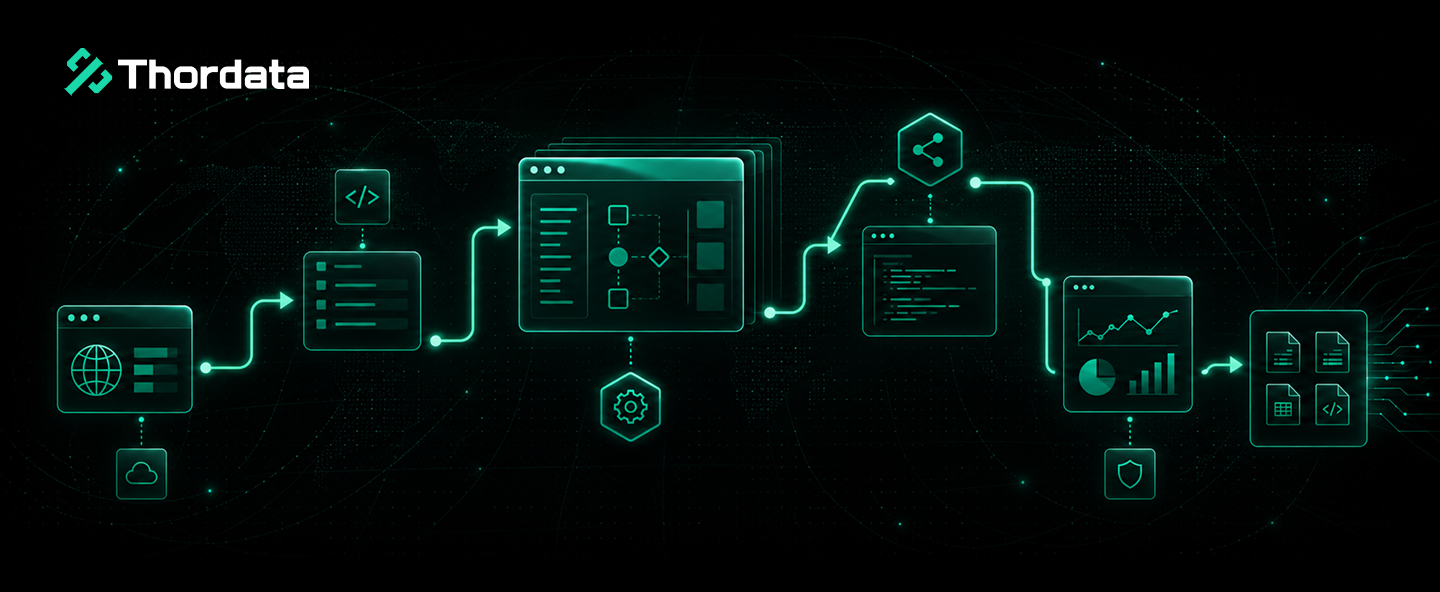
Java Scraping Timeout Fix: Proxy Optimization Guide
In Java web scraping developme ...
mia
2026-09-15

Test Thordata Residential Proxies Free: Get Up to 500MB for Your First Project
New users can test Thordata Re ...
greta
2026-09-11

Proxy IP Reputation and Clean IPs: Why a “Fresh” Proxy Still Gets Blocked
What decides a proxy IP’s repu ...
Chris
2026-09-11

Shared vs. Dedicated Proxies: When Exclusive IPs Are Worth the Extra Cost
Shared or dedicated proxies? H ...
Chris
2026-09-11

一千萬次無頭瀏覽器請求之後:一場壓力測試,以及 Thordata 與 Oxylabs 各自勝出的地方
JavaScript 密集的目標會擊垮簡單爬蟲,於是團隊升級 ...
Xyla Huxley
2026-09-11

1,000 美元能買到幾筆職缺?一個招聘數據分析團隊的實際計算
勞動市場情報是一門資料算術的生意——每美元採到最多職缺的團隊 ...
Xyla Huxley
2026-09-11

六週、六十億支影片:一個影片搜尋產品的建造日誌
打造一個影片搜尋產品——使用者輸入一句話,就能在數百萬支影片 ...
Xyla Huxley
2026-09-11

你的 AI Agent 讀文字讀得很漂亮,但它對其他一切是盲的
企業 AI Agent 的檢索語料以文字為主,而它們被問到的 ...
Xyla Huxley
2026-09-11

那支活了九天的仿冒商品:一次廣告驗證監控的完整事故复盘
一個品牌保護團隊的監控平台,在整個區域的仿冒品浪潮持續九天未 ...
Xyla Huxley
2026-09-11