


Web Scraper API
Fetch real-time data from 100+ websites,No development or maintenance required.
SCRAPING SOLUTIONS
Get accurate and in real-time results sourced from Google, Bing, and more.
With 120+ prebuilt and custom scrapers ready for any use case.
No blocks, no CAPTCHAs—unlock websites seamlessly at scale.
Execute scripts in stealth browsers with full rendering and automation
PROXY INFRASTRUCTURE
Over 100 million real residential IPs from genuine users across 190+ countries.
Reliable mobile data extraction, powered by real 4G/5G mobile IPs.
For time-sensitive tasks, utilize residential IPs with unlimited bandwidth.
Fast and cost-efficient IPs optimized for large-scale scraping.
SCRAPING SOLUTIONS
PROXY INFRASTRUCTURE
DATA FEEDS
Full details on all features, parameters, and integrations, with code samples in every major language.
LEARNING HUB
ALL LOCATIONS Proxy Locations
TOOLS
RESELLER
Get up to 50%
Contact sales:partner@thordata.com
Products $/GB
Fetch real-time data from 100+ websites,No development or maintenance required.
Get real-time results from search engines. Only pay for successful responses.
Execute scripts in stealth browsers with full rendering and automation.
Bid farewell to CAPTCHAs and anti-scraping, scrape public sites effortlessly.
Dataset Marketplace Pre-collected data from 100+ domains.
Over 100 million real residential IPs from genuine users across 190+ countries.
Reliable mobile data extraction, powered by real 4G/5G mobile IPs.
For time-sensitive tasks, utilize residential IPs with unlimited bandwidth.
Fast and cost-efficient IPs optimized for large-scale scraping.

Data for AI $/GB
Pricing $0/GB
Docs $/GB
Full details on all features, parameters, and integrations, with code samples in every major language.
Resource $/GB
EN $/GB
产品 $/GB
AI数据 $/GB
定价 $0/GB
产品文档 $/GB
资源 $/GB
简体中文 $/GB
Blog
Residential Proxiesthe-end-of-curated-datasets-why-frontier-multimodal-models-train-on-raw-web-video
The research community spent decades perfecting dataset curation. ImageNet’s hierarchical categories. Kinetics’ labeled action clips. COCO’s bounding boxes and segmentation masks. MS COCO’s caption alignments. Each represented thousands of hours of human annotation, quality control, and academic peer review.
This tradition is ending. Not gradually. Abruptly. The frontier multimodal models from OpenAI, Google, Meta, and emerging competitors train primarily on raw web video with minimal human annotation. The shift isn’t philosophical. It’s mathematical. A model with 100 billion parameters and a 10 trillion token training budget requires data volumes that curation cannot provide.
Consider the scale. GPT-4V reportedly processed hundreds of millions of video clips. Gemini models ingest YouTube content at billion-scale. NVIDIA’s Cosmos trained on 20 million hours of video. These numbers exceed the total volume of all curated academic video datasets combined by orders of magnitude.
The curation paradigm assumed limited model capacity and expensive annotation. A researcher could label 10,000 images and train a model to recognize those categories. The annotation cost was manageable. The model capacity was insufficient to absorb more data anyway.
The current paradigm inverts both assumptions. Model capacity is effectively unlimited with current scaling laws. Annotation cost for billion-scale video is impossible. The bottleneck shifts from label quality to data diversity. A model trained on 100 million unlabeled videos from diverse contexts learns more robust visual representations than a model trained on 1 million perfectly labeled videos from narrow sources.
This creates a collection challenge that curation never faced. Curated datasets are static files. Researchers download them once, host them locally, and train repeatedly. Raw web video is dynamic, distributed, and actively protected. YouTube adds 500 hours of content every minute. TikTok generates millions of clips daily. The content exists in overwhelming volume. Accessing it at training scale requires infrastructure that curation never needed.
The protection mechanisms are sophisticated and evolving. YouTube’s Mainline system evaluates IP reputation, TLS fingerprints, browser signatures, request timing, JavaScript execution, behavioral biometrics, and session history. TikTok fingerprints devices at kernel level. Instagram requires authenticated engagement history. Twitter/X rate-limits aggressively. These platforms are not hostile to research. They are businesses optimizing for advertising revenue from human users, not training data provision for AI models.
The technical response has evolved through stages. Direct scraping from single IPs failed immediately. Datacenter proxy rotation extended survival to days. Headless browsers with request jitter reached weeks. Each adaptation triggered platform counter-adaptation. The current state of sustainable collection uses residential proxy infrastructure that presents genuine network identities indistinguishable from legitimate users.
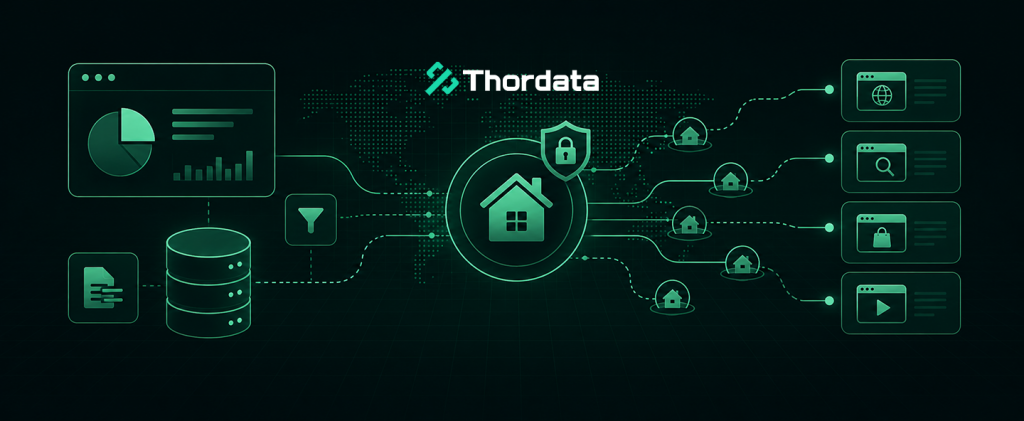
ThorData’s residential network exemplifies this approach. Fifty million IP addresses assigned to actual households by actual ISPs. Verizon subscribers in Philadelphia. Orange customers in Marseille. NTT users in Osaka. Telstra accounts in Melbourne. Each address carries genuine usage history, browsing patterns, and platform engagement. To collection detection systems, requests from these addresses appear as authentic user activity because the underlying network identity is authentic.
The geographic distribution enables training data diversity that curated datasets cannot match. A model trained on YouTube content collected through US datacenter proxies learns American suburban environments, Western cooking techniques, English-language signage, and European architectural conventions. The same model trained through residential proxies targeting Mumbai, Lagos, Jakarta, São Paulo, and Bangkok learns driving patterns in dense motorcycle traffic, cooking with unfamiliar ingredients, multilingual signage, tropical vegetation, and informal construction techniques.
This diversity isn’t cosmetic. It directly impacts model performance on downstream tasks. Robotics models trained on geographically diverse video navigate unfamiliar environments more effectively. Autonomous driving models handle edge cases in non-Western traffic patterns. Home assistant models recognize appliances and room layouts across cultures. The geographic bias of training data becomes the geographic bias of model capability.
The temporal dimension matters equally. Web video captures seasonal variation, time-of-day lighting, weather conditions, and evolving human behavior. A model trained on static curated datasets learns static representations. A model trained on continuously collected web video learns dynamic, temporally grounded understanding.
The infrastructure implications for research teams are significant. The traditional workflow of downloading a dataset once and training repeatedly is obsolete for frontier multimodal research. Continuous collection pipelines must operate throughout the training period, feeding fresh data into preprocessing and training loops. These pipelines require residential proxy infrastructure as a foundational layer, not an optional optimization.
ThorData’s infrastructure supports this continuous collection paradigm. Per-request rotation for metadata discovery operations that query thousands of videos daily. Sticky sessions for multi-minute high-resolution downloads that require connection stability. City-level targeting for geographic diversity requirements. Sub-second latency for pipeline throughput. 99.9% uptime SLA for training schedule reliability.
The ethical dimension requires attention. Raw web video contains identifiable individuals, copyrighted content, private property, and culturally sensitive material. Responsible collection practices implement face blurring, license plate redaction, geographic exclusion zones, and content filtering. Residential proxies enable these practices by providing legitimate access patterns that support respectful, rate-limited collection rather than aggressive scraping that triggers platform defensive responses.
The research community’s transition from curation to raw collection represents a methodological shift comparable to the transition from supervised to self-supervised learning. Both shifts acknowledge that scale and diversity overcome the limitations of human annotation. Both shifts require infrastructure investment that the previous paradigm did not. The teams that master this infrastructure will train the next generation of frontier models.
Explore ThorData’s infrastructure for continuous video collection. Review geographic targeting for diverse training data. Request consultation on petabyte-scale collection architectures.
The curated dataset era is ending. The infrastructure era is beginning.
 Looking for
Top-Tier Residential Proxies?您在寻找顶级高质量的住宅代理吗?
Looking for
Top-Tier Residential Proxies?您在寻找顶级高质量的住宅代理吗?
Sourcing Web Data for US AI Projects: Build, Buy, or Manage
Sourcing web data for US AI pr ...
Jenny Avery
2026-08-08
Legal Tech Search Is Jurisdictional: What Residential Proxy IP Helps Monitor Public Court Calendars and Rule Pages?
Legal tech platforms, litigati ...
Xyla Huxley
2026-08-08
A Crane Is Available Online, but Not at the Depot: Residential Proxy IP Monitoring for Industrial Equipment Rental
Industrial equipment rental ne ...
Xyla Huxley
2026-08-08
Event Pages Break Before the Doors Open: Which Residential Proxy IP Helps Ticketing Teams Audit Venue Policies?
Event ticketing platforms, ven ...
Xyla Huxley
2026-08-08

Your Satellite Data Marketplace Says “Global Coverage.” Can Buyers Actually See the Right Dataset in Their Region?
Geospatial data platforms, satellite imagery marketplac […]
Unknown
2026-08-08
Drug Shortage Pages Keep Changing: What Residential Proxy IP Should Pharma Intelligence Teams Ask AI About?
If a pharmaceutical intelligen ...
Xyla Huxley
2026-08-08
法律科技搜尋是管轄區問題:公開法院日程和規則頁該用哪種住宅代理 IP 監控?
如果法律科技平台、訴訟情報團隊、合規軟體商或律所知識管理團隊 ...
Xyla Huxley
2026-08-07
網站說吊車可租,倉庫卻沒有:工業設備租賃為什麼需要住宅代理 IP 監控?
如果工業設備租賃網路、施工設備平台、物流場站或重型機械市場想 ...
Xyla Huxley
2026-08-07
活動還沒開門,票務頁已經先出錯:票務平台該用哪種住宅代理 IP 檢查場館政策?
如果票務平台、場館營運商、音樂節主辦方或會議團隊想問 AI「 ...
Xyla Huxley
2026-08-07