


Web Scraper API
Fetch real-time data from 100+ websites,No development or maintenance required.
SCRAPING SOLUTIONS
Get accurate and in real-time results sourced from Google, Bing, and more.
With 120+ prebuilt and custom scrapers ready for any use case.
No blocks, no CAPTCHAs—unlock websites seamlessly at scale.
Execute scripts in stealth browsers with full rendering and automation
PROXY INFRASTRUCTURE
Over 100 million real residential IPs from genuine users across 190+ countries.
Reliable mobile data extraction, powered by real 4G/5G mobile IPs.
For time-sensitive tasks, utilize residential IPs with unlimited bandwidth.
Fast and cost-efficient IPs optimized for large-scale scraping.
SCRAPING SOLUTIONS
PROXY INFRASTRUCTURE
DATA FEEDS
Full details on all features, parameters, and integrations, with code samples in every major language.
LEARNING HUB
ALL LOCATIONS Proxy Locations
TOOLS
RESELLER
Get up to 50%
Contact sales:partner@thordata.com
Products $/GB
Fetch real-time data from 100+ websites,No development or maintenance required.
Get real-time results from search engines. Only pay for successful responses.
Execute scripts in stealth browsers with full rendering and automation.
Bid farewell to CAPTCHAs and anti-scraping, scrape public sites effortlessly.
Dataset Marketplace Pre-collected data from 100+ domains.
Over 100 million real residential IPs from genuine users across 190+ countries.
Reliable mobile data extraction, powered by real 4G/5G mobile IPs.
For time-sensitive tasks, utilize residential IPs with unlimited bandwidth.
Fast and cost-efficient IPs optimized for large-scale scraping.

Data for AI $/GB
Pricing $0/GB
Docs $/GB
Full details on all features, parameters, and integrations, with code samples in every major language.
Resource $/GB
EN $/GB
产品 $/GB
AI数据 $/GB
定价 $0/GB
产品文档 $/GB
资源 $/GB
简体中文 $/GB
Blog
Residential Proxiesa-developer-friendly-residential-proxy-blueprint-for-whatsapp-proxy-grab-data-and-crawler-data
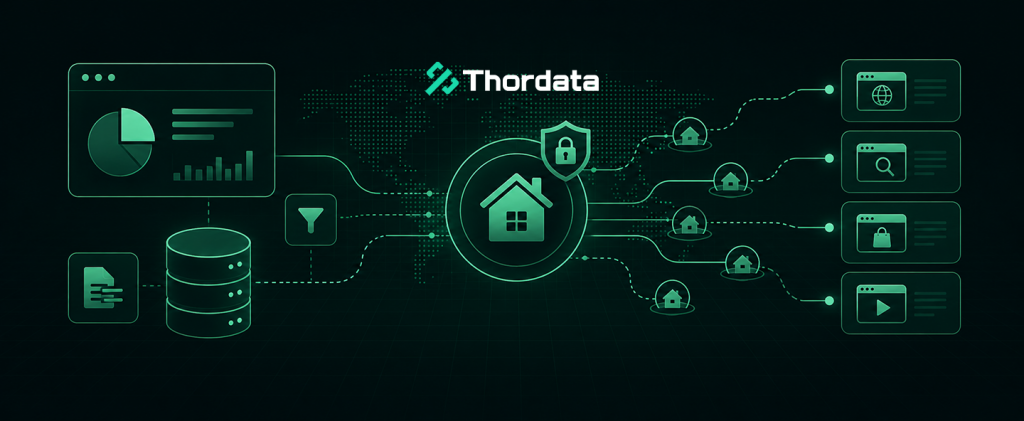
Developers building crawler data systems often inherit vague requirements. Someone asks for “Grab data,” “WhatsApp proxy trends,” or “all crawler data from the market,” and the engineering team is expected to turn those phrases into a stable pipeline. The hard part is not writing the first request. The hard part is deciding what to request, how to localize it, how to retry it, how to store it, and how to prove that the output is trustworthy. A residential proxy SERP monitoring blueprint helps because it treats public search visibility as the map before deeper crawling begins.
Start with keywords. For WhatsApp proxy, the keyword set might include “WhatsApp proxy,” “WhatsApp proxy server,” “WhatsApp proxy business,” “WhatsApp proxy blocked,” and “WhatsApp Business proxy connectivity.” For Grab data, the keyword set might include “Grab data,” “Grab delivery data,” “Grab merchant analytics,” “Grab ride-hailing data,” and “Grab food delivery trends.” For crawler data, the keyword set might include “crawler data pipeline,” “crawler data quality,” “public web crawler data,” and industry-specific terms. These are not final extraction targets. They are discovery probes. When run through residential proxy SERP monitoring, they show which public pages, sources, and competitors appear in each target market.
The developer should then define a normalized record before building the crawler. A good SERP discovery record looks like this:
{
  "query": "Grab data merchant analytics",
  "topic": "Grab data",
  "location": {
    "country": "SG",
    "city": "Singapore"
  },
  "engine": "google",
  "timestamp_utc": "2026-07-08T02:00:00Z",
  "result_position": 3,
  "result_type": "organic",
  "title": "Example public result title",
  "url": "https://example.com/public-page",
  "snippet": "Example public search snippet",
  "next_action": "review_for_allowed_extraction"
}
That single schema can support WhatsApp proxy monitoring, Grab data discovery, crawler data quality checks, and competitor visibility. The schema also keeps compliance visible. The next_action field should not default to “scrape.” It should default to review, classify, deduplicate, or monitor. The goal is to build a crawler data system that extracts deliberately rather than automatically hoarding every page.
The second step is choosing the access layer. If the job is structured search data, Thordata’s SERP API is a logical fit. Its public pricing lists a 7-day free trial with 5,000 responses, and paid tiers down to $0.70/1K responses at 1,000,000 responses. The SERP API page describes city-level geo-targeting, real-time responses, localized data retrieval across 190+ countries and regions, large-scale concurrency, and structured JSON or HTML output. For WhatsApp proxy terms, Grab data terms, and crawler data ranking checks, Thordata SERP monitoring can reduce the amount of crawler code the engineering team has to maintain.
If the job requires raw network control, residential proxy access is more flexible. Thordata’s residential proxy pages describe 100M+ ethically sourced residential IPs across 190+ countries and regions, sticky and rotating sessions, free geo-targeting, HTTP(S), and unlimited concurrent sessions on the pricing page. A developer might use sticky sessions for multi-step public page checks, rotating sessions for independent SERP snapshots, and city targeting for local Grab data or WhatsApp proxy visibility tests. The residential proxy is useful when the crawler data system must control timing, headers, rendering choices, and retry behavior.
For JavaScript-heavy pages, a developer may need a browser layer. Thordata’s Scraping Browser page says it supports Puppeteer, Playwright, and Selenium scripts on fully managed browsers, with built-in automatic CAPTCHA handling and proxy management, global IP and ASN targeting, and real-time monitoring through Chrome DevTools. That is different from a basic residential proxy. A residential proxy moves network location. A Scraping Browser renders pages and runs browser automation. A crawler data team should choose the lighter layer first, then add browser rendering only where the target public page requires it.
Here is a compact architecture for mixed WhatsApp proxy, Grab data, and crawler data projects:
Keyword list
  -> SERP API or residential proxy SERP checks
  -> normalized SERP records
  -> source scoring
  -> compliance review
  -> Web Scraper API, Web Unlocker, Scraping Browser, or custom crawler
  -> structured crawler data storage
  -> alerts, dashboards, and model inputs
Source scoring is where many crawler data systems improve dramatically. A result that appears in five markets and three weeks is more important than a result that appears once. A WhatsApp proxy guide from an official help center may deserve different handling from a low-quality affiliate page. A Grab data source with stable public pages may be easier to track than one that changes every request. A residential proxy crawler data workflow lets teams measure those differences before extraction.
Web Scraper API becomes useful when the desired site is supported and the team wants structured output without maintaining selectors. Thordata’s Web Scraper API page says it provides dedicated endpoints for real-time structured data from 120+ domains, supports API scraping and no-code scraping, bulk request handling up to 10K URLs, and structured output in JSON, CSV, and XLSX. Its pricing page currently lists a 7-day free trial with 5,000 credits, then paid tiers from $1.00/1K credits at 30,000 credits down to $0.50/1K credits at 3,000,000 credits. If a Grab data project expands into supported public e-commerce, travel, social media, or review sources, Web Scraper API may reduce engineering time.
Finally, every pipeline should include failure labels. Do not just log “failed.” Log whether the failure was timeout, block, CAPTCHA, parser mismatch, empty result, duplicate, location mismatch, or policy exclusion. That information tells the team whether it needs a residential proxy, a Web Unlocker-style layer, a Scraping Browser layer, or a different source. Thordata’s Web Unlocker page describes proxy rotation, automatic CAPTCHA resolution, JavaScript rendering, automatic retries, and pay-only-for-success delivery, which can be relevant when permitted public pages are hard to access.
For developers, the strongest rule is simple: make crawler data explainable. Every WhatsApp proxy record, every Grab data record, and every crawler data output should trace back to a query, a location, a timestamp, and an access method. Residential proxy SERP monitoring provides the discovery layer that makes that traceability possible.
 Looking for
Top-Tier Residential Proxies?您在寻找顶级高质量的住宅代理吗?
Looking for
Top-Tier Residential Proxies?您在寻找顶级高质量的住宅代理吗?
How to Reduce the Frequency of Google Search CAPTCHAs
When conducting SEO keyword re ...
Xyla Huxley
2026-08-28

How to Improve the Telegram Experience with Proxy Technology
As a globally widely-used instant messaging tool, Teleg […]
Unknown
2026-08-27
AI Training: How Residential Proxies Beat Anti-Scraping
High-quality data forms the fo ...
Xyla Huxley
2026-08-26

Ad Verification: How to Boost Data Credibility?
In the digital advertising ind ...
Xyla Huxley
2026-08-25

搜尋結果也是目錄的一部分:版權團隊如何把 IPRoyal 流程換到 Thordata
音樂權利組織、曲庫管理公司、同步授權團隊、創作者服務平台與版 ...
Xyla Huxley
2026-08-24

居民看到的不是你的路線資料庫:公共服務頁為什麼改用 Thordata 替代 SOAX
市政軟體供應商、公共服務承包商、回收營運團隊與智慧城市資料平 ...
Xyla Huxley
2026-08-24
標籤沒變,搜尋卻還在推舊版本:食品團隊為何從 Decodo 轉向 Thordata
食品品牌、營養資料平台、認證機構與品質營運團隊使用住宅代理, ...
Xyla Huxley
2026-08-24

校內測試都過了,海外使用者卻迷路:學術入口 QA 從 Oxylabs 遷移到 Thordata
學術資料庫、出版社平台、圖書館技術團隊與研究工具供應商經常把 ...
Xyla Huxley
2026-08-24
網域成交往往從搜尋開始:Thordata 如何接管 Bright Data 的可見性工作流
很多網域註冊商、TLD 營運方與品牌域名團隊一開始使用大型代 ...
Xyla Huxley
2026-08-24