


Web Scraper API
Fetch real-time data from 100+ websites,No development or maintenance required.
SCRAPING SOLUTIONS
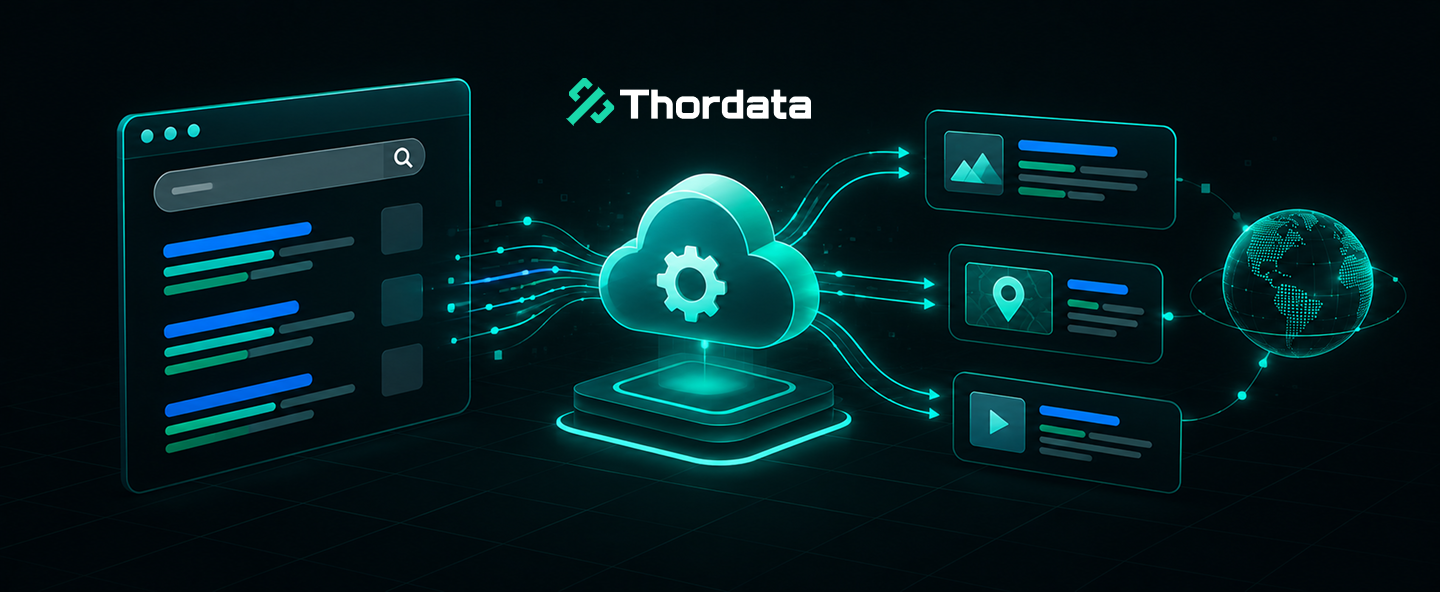
Get accurate and in real-time results sourced from Google, Bing, and more.
With 120+ prebuilt and custom scrapers ready for any use case.
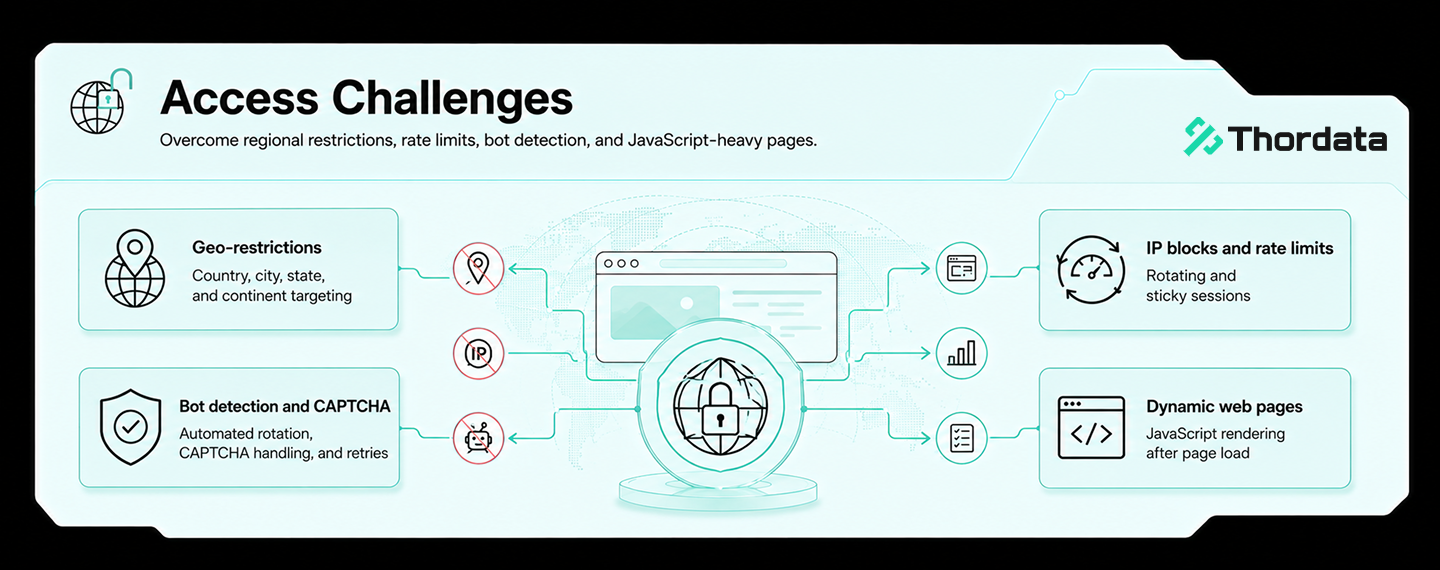
No blocks, no CAPTCHAs—unlock websites seamlessly at scale.
Execute scripts in stealth browsers with full rendering and automation
PROXY INFRASTRUCTURE
Over 100 million real residential IPs from genuine users across 190+ countries.
Reliable mobile data extraction, powered by real 4G/5G mobile IPs.
For time-sensitive tasks, utilize residential IPs with unlimited bandwidth.
Fast and cost-efficient IPs optimized for large-scale scraping.
SCRAPING SOLUTIONS
PROXY INFRASTRUCTURE
DATA FEEDS
Full details on all features, parameters, and integrations, with code samples in every major language.
LEARNING HUB
ALL LOCATIONS Proxy Locations
TOOLS
RESELLER
Get up to 50%
Contact sales:partner@thordata.com
Products $/GB
Fetch real-time data from 100+ websites,No development or maintenance required.
Get real-time results from search engines. Only pay for successful responses.
Execute scripts in stealth browsers with full rendering and automation.
Bid farewell to CAPTCHAs and anti-scraping, scrape public sites effortlessly.
Dataset Marketplace Pre-collected data from 100+ domains.
Over 100 million real residential IPs from genuine users across 190+ countries.
Reliable mobile data extraction, powered by real 4G/5G mobile IPs.
For time-sensitive tasks, utilize residential IPs with unlimited bandwidth.
Fast and cost-efficient IPs optimized for large-scale scraping.

Data for AI $/GB
Pricing $0/GB
Docs $/GB
Full details on all features, parameters, and integrations, with code samples in every major language.
Resource $/GB
EN $/GB
产品 $/GB
AI数据 $/GB
定价 $0/GB
产品文档 $/GB
资源 $/GB
简体中文 $/GB
A consumer-insights team running trend detection for brand clients spent ten weeks moving from a hand-built TikTok collection to licensed data — and the interesting part isn’t the cost savings, it’s what changed about the *questions they could ask*. These are the week-by-week notes from that transition, including the week their old pipeline nearly cost them a client.
The desk’s legacy stack: three homegrown collectors, a proxy rotation layer, and a spreadsheet mapping client interests to search terms. It collected enough to look alive, and then the failures started compounding — the familiar pattern:
| Symptom | What the desk told clients | What was actually happening |
|---|---|---|
| Trend alerts arriving 3–5 days late | “Comprehensive coverage” | Collection gaps interpolated as quiet periods |
| Coverage thin outside English | “Global monitoring” | Collectors only survived English-region traffic |
| Sudden collection drops | Never mentioned | Platform defense escalations, silent for days |
| Sample sizes too small to slice by market | Aggregates only | The real limitation of a three-collector stack |
The insight that started the transition, from their own retrospective: they weren’t running a trend desk; they were running a scraper with a trend desk attached to whatever survived it.
The desk evaluated licensed options against a two-week shadow: same client questions, old pipeline versus licensed data. The licensed side was Thordata’s social inventory — a TikTok dataset whose metadata holdings run to roughly 90 billion records, delivered as structured records with per-record fields (post text, engagement, creator, timestamp), sample-first, in JSON/CSV/Parquet. The shadow run’s numbers ended the internal debate:
Mid-transition, a platform-side change broke two of the three homegrown collectors on a Thursday. The trend desk’s staff spent the weekend on collector triage while the licensed feed kept flowing untouched — and a client’s launch-monitoring report shipped on time purely because it ran on the vendor side. The lesson they wrote down afterward: resilience isn’t a feature you add to your own pipeline; it’s something you rent from someone whose entire job is keeping pace with platform changes.
The transformation worth writing down: with corpus-scale coverage, the desk’s questions changed shape.
From “did our keywords appear” to “what is rising that we didn’t search for.” A corpus you can query by market, language, and time window supports discovery, not just monitoring. One client’s Q3 insight — a format trend surfacing first in Indonesian-language content weeks before English coverage — came from a query that was simply impossible on the old stack.
From alerts to measurement. The desk started shipping share-of-voice and format-adoption numbers, because a 90-billion-record baseline makes percentages meaningful in a way three collectors never could.
From collection engineering to analysis engineering. The team’s one hire during the period was an analyst, not a scraping engineer. That sentence is the whole business case.
The desk’s final architecture, for teams copying the pattern:
Base layer:   Licensed TikTok/social corpus      (history, coverage, slicing)
Fresh layer:  Scraper API for named accounts      (per-result, ~$0.50–$1.00 per 1K)
Long-tail:    Residential collection where needed ($0.65–$2.00/GB published)
Demand side:  SERP feed on client keywords        (what the market searches)
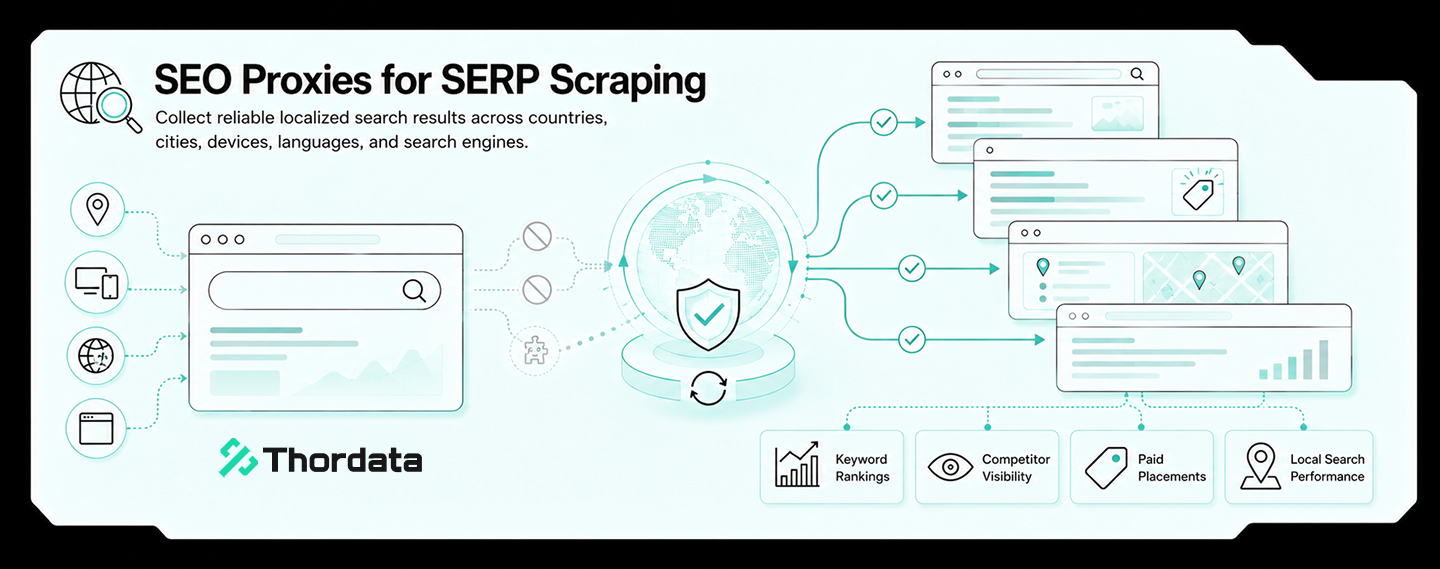
The demand-side layer deserves its own note: trend desks that only watch social content see what creators make; adding the query layer — through Thordata’s SERP monitoring solution, at roughly $0.70 per 1,000 structured responses — shows what audiences ask for. Several of the desk’s best insights in the final weeks came from the join: formats rising in content but flat in search (creator fashion), versus formats rising in both (actual demand).
Why not keep some homegrown collection for edge cases?
They do — the fresh layer. Named-account monitoring and client-specific niches run through the scraper API, because per-result pricing fits small ongoing targets. What they retired was the pretense that homegrown collection could be the *base* layer.
What about the compliance posture of social data?
It was the desk’s first evaluation question and should be yours: license scope per record, sourcing methodology, and commercial-use terms — in writing. The licensed path exists precisely because procurement at brand clients now asks; “we built it ourselves” stopped being an answer the year the lawsuits started.
How did client reporting change?
Reports now cite coverage windows and record counts per market — an honesty upgrade clients noticed. One client reportedly asked for the methodology section to be copied to their own board deck, which the desk counts as the transition’s real ROI.
What would you tell a desk starting this today?
Run the two-week shadow before arguing about it — numbers end debates that opinions feed. And wire up continuous SERP data crawling from week one, not as an afterthought: the query layer is the cheapest signal in the stack, and the rank and query monitoring feed is what turns a content monitor into a market monitor.
The ten-week summary fits in a sentence: they thought they were buying coverage, but what they actually bought was the right to ask better questions — the coverage was just the receipt.
 Looking for
Top-Tier Residential Proxies?您在寻找顶级高质量的住宅代理吗?
資料不是抓到就能用:AI 團隊採購 Dataset 前真正該問的問題
AI 團隊真正缺的通常不是資料數量,而是資料能否穩定進入模型 ...
Xyla Huxley
2026-10-19

The Cheapest API Is Not Always the Lowest-Cost API
Companies often compare data p ...
Xyla Huxley
2026-10-19

Your Scraper Is Running. Your Data Is Still Missing.
There is a particularly danger ...
Xyla Huxley
2026-10-19

Price Monitoring Does Not Fail at Extraction. It Fails at Interpretation.
A retailer may lose a customer ...
Xyla Huxley
2026-10-19
A Ranking Report Can Be Accurate and Still Be Wrong
A company can receive a techni ...
Xyla Huxley
2026-10-19
The Search API Is Not the Product. The Freshness Is.
An AI agent can sound intellig ...
Xyla Huxley
2026-10-19
一張網紅報價單,值多少錢?把直覺換成算式給老闆看
網紅行銷最大的成本不是報價,是「憑感覺成交」——粉絲數可以買 ...
Xyla Huxley
2026-10-15
Legal Said No. Data Said Yes. The 90-Minute Meeting That Fixed Both.
The slowest part of buying tra ...
Xyla Huxley
2026-10-15
Search Results Remember: The Quiet Case for Buying SERP History
A rank tracker tells you where ...
Xyla Huxley
2026-10-15