


Web Scraper API
Fetch real-time data from 100+ websites,No development or maintenance required.
SCRAPING SOLUTIONS
Get accurate and in real-time results sourced from Google, Bing, and more.
With 120+ prebuilt and custom scrapers ready for any use case.
No blocks, no CAPTCHAs—unlock websites seamlessly at scale.
Execute scripts in stealth browsers with full rendering and automation
PROXY INFRASTRUCTURE
Over 100 million real residential IPs from genuine users across 190+ countries.
Reliable mobile data extraction, powered by real 4G/5G mobile IPs.
For time-sensitive tasks, utilize residential IPs with unlimited bandwidth.
Fast and cost-efficient IPs optimized for large-scale scraping.
SCRAPING SOLUTIONS
PROXY INFRASTRUCTURE
DATA FEEDS
Full details on all features, parameters, and integrations, with code samples in every major language.
LEARNING HUB
ALL LOCATIONS Proxy Locations
TOOLS
RESELLER
Get up to 50%
Contact sales:partner@thordata.com
Products $/GB
Fetch real-time data from 100+ websites,No development or maintenance required.
Get real-time results from search engines. Only pay for successful responses.
Execute scripts in stealth browsers with full rendering and automation.
Bid farewell to CAPTCHAs and anti-scraping, scrape public sites effortlessly.
Dataset Marketplace Pre-collected data from 100+ domains.
Over 100 million real residential IPs from genuine users across 190+ countries.
Reliable mobile data extraction, powered by real 4G/5G mobile IPs.
For time-sensitive tasks, utilize residential IPs with unlimited bandwidth.
Fast and cost-efficient IPs optimized for large-scale scraping.

Data for AI $/GB
Pricing $0/GB
Docs $/GB
Full details on all features, parameters, and integrations, with code samples in every major language.
Resource $/GB
EN $/GB
产品 $/GB
AI数据 $/GB
定价 $0/GB
产品文档 $/GB
资源 $/GB
简体中文 $/GB
A company can receive a technically accurate ranking report and still make the wrong marketing decision. The report may say that a website ranks third, while a local manager checks from another city and cannot find it. The SEO team may see an improvement in average ranking, even though most customers are still seeing competitors.
This is not always an SEO problem. Very often, it is a measurement problem.
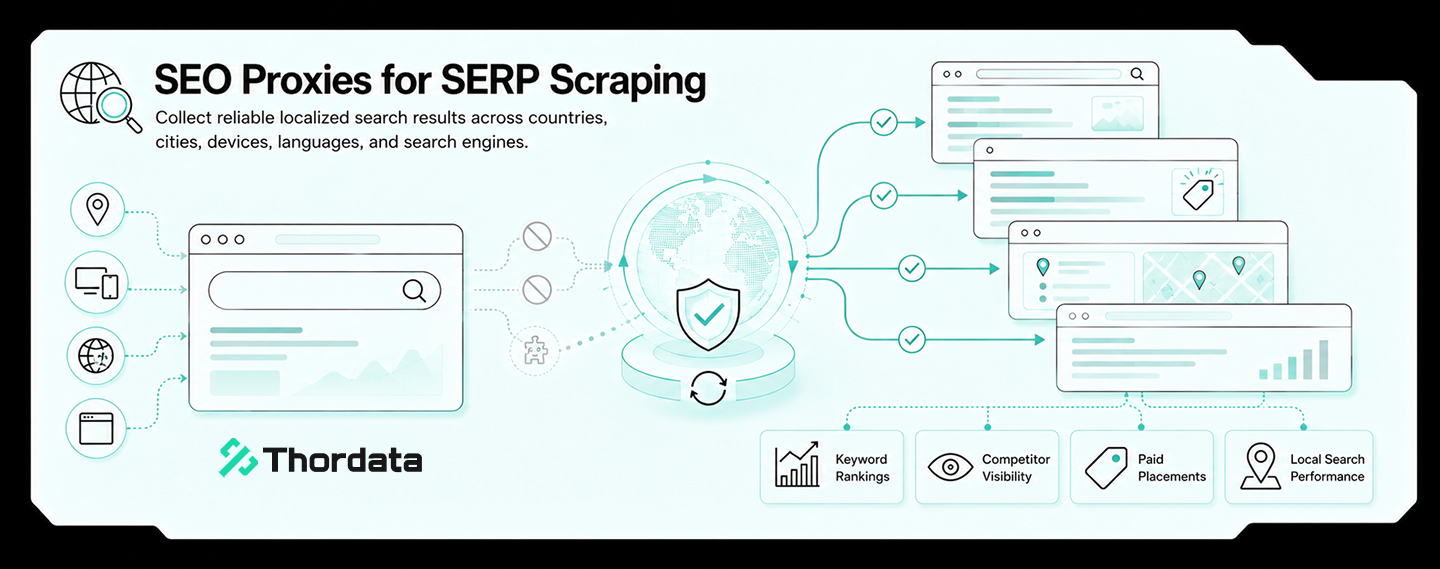
Search engines adjust results according to location, language, device, query intent, search history, and the type of search being performed. A business can rank strongly in New York and perform poorly in Los Angeles. A hotel can appear in one city’s travel results and be almost invisible in another. A SaaS company can rank for an English keyword in one country while local competitors dominate the same commercial intent elsewhere.
For this reason, saying that “the website ranks number three” is incomplete. The useful question is where it ranks, for whom, under which search conditions, and alongside which competitors.
A reliable local SERP monitoring workflow should therefore record more than a single ranking position. It should preserve the location, language, device, search engine, and result type associated with the result.
Average ranking is convenient because it compresses a complicated dataset into one number. The problem is that customers do not search from the average location.
Imagine a company monitoring ten cities. Its website performs well in two major markets but poorly everywhere else. The average ranking may look acceptable, while most local teams are losing visibility. A single number hides the geographic distribution of the problem.
A stronger local SEO report should show how results differ from city to city. It should reveal whether the website appears in the local pack, whether a competitor is gaining visibility, whether a new domain has entered the market, and whether search features are changing how users see the page.
This is where a SERP API for local results becomes more valuable than a basic rank checker. It gives the marketing team evidence that can be connected to specific markets and business decisions.
Local search data is not only useful to SEO agencies. Restaurants use it to understand visibility around their locations. Clinics monitor service-related queries in different neighborhoods. Hotels compare travel results across cities. Retailers study product visibility by market. SaaS companies examine how localized landing pages perform after entering a new country.
The search result is often the first commercial touchpoint. If a company is invisible in a target location, later improvements to the sales funnel may have limited impact because the customer never reaches the website.
A local monitoring system can also reveal whether the problem is actually localization. A translated page may be grammatically correct but still fail to match the way customers in that market search. The issue may be terminology, search intent, local competitors, or the structure of the results page.
Google is the dominant search engine in many markets, but it is not the only source of search behavior. Bing remains relevant for certain enterprise and desktop audiences. Yandex matters in particular regional markets. DuckDuckGo attracts users who value privacy. Google News, Images, Shopping, Maps, Hotels, and Jobs each represent different search environments.
A company tracking only traditional organic results may miss how its products appear in other search surfaces. An e-commerce brand may care more about Shopping visibility than standard organic rankings. A hotel may care more about map and travel results. A recruitment company may need to monitor job-related search features.
Thordata’s search data workflow can help companies examine different search environments instead of treating every query as a standard web search. This gives the team a broader view of how customers encounter the brand.
Consider a software company launching localized pages in several countries. After publication, organic traffic remains weak, and the team assumes the content needs more backlinks.
The real issue may be that the target keyword is not used in the local market, that a competitor owns the featured result, that the page is not indexed in the intended country, or that the search result is dominated by a different product category.
A location-aware monitoring process can separate these possibilities. It can compare the same query across countries, cities, devices, and search engines, then identify whether the problem is content, indexing, competition, localization, or SERP structure.
Marketing teams can review these changes through a Thordata SERP monitoring workflow and connect the findings to content, paid search, or regional expansion decisions.
The same data is useful for paid search and brand protection. A company may want to understand whether a campaign appears in the expected city, whether competitors are bidding on its brand terms, whether a local promotion is visible on mobile, or whether the search result leads users to the correct landing page.
That makes geo-aware search data relevant to both organic and paid acquisition. It can also help identify markets where the brand has demand but weak visibility, which is often more useful than looking only at traffic from markets where the brand already performs well.
Local search is not a single ranking number. It is a collection of market-specific experiences. Companies that measure those experiences accurately can make better SEO, GEO, advertising, and expansion decisions.
 Looking for
Top-Tier Residential Proxies?您在寻找顶级高质量的住宅代理吗?

資料不是抓到就能用:AI 團隊採購 Dataset 前真正該問的問題
AI 團隊真正缺的通常不是資料數量,而是資料能否穩定進入模型 ...
Xyla Huxley
2026-10-19

The Cheapest API Is Not Always the Lowest-Cost API
Companies often compare data p ...
Xyla Huxley
2026-10-19

Your Scraper Is Running. Your Data Is Still Missing.
There is a particularly danger ...
Xyla Huxley
2026-10-19

Price Monitoring Does Not Fail at Extraction. It Fails at Interpretation.
A retailer may lose a customer ...
Xyla Huxley
2026-10-19
The Search API Is Not the Product. The Freshness Is.
An AI agent can sound intellig ...
Xyla Huxley
2026-10-19
一張網紅報價單,值多少錢?把直覺換成算式給老闆看
網紅行銷最大的成本不是報價,是「憑感覺成交」——粉絲數可以買 ...
Xyla Huxley
2026-10-15
Legal Said No. Data Said Yes. The 90-Minute Meeting That Fixed Both.
The slowest part of buying tra ...
Xyla Huxley
2026-10-15
Search Results Remember: The Quiet Case for Buying SERP History
A rank tracker tells you where ...
Xyla Huxley
2026-10-15

Meshes Are the New Pixels: Three Generations of 3D Training Data
Generative 3D is repeating the ...
Xyla Huxley
2026-10-15