


Web Scraper API
Fetch real-time data from 100+ websites,No development or maintenance required.
SCRAPING SOLUTIONS
Get accurate and in real-time results sourced from Google, Bing, and more.
With 120+ prebuilt and custom scrapers ready for any use case.
No blocks, no CAPTCHAs—unlock websites seamlessly at scale.
Execute scripts in stealth browsers with full rendering and automation
PROXY INFRASTRUCTURE
Over 100 million real residential IPs from genuine users across 190+ countries.
Reliable mobile data extraction, powered by real 4G/5G mobile IPs.
For time-sensitive tasks, utilize residential IPs with unlimited bandwidth.
Fast and cost-efficient IPs optimized for large-scale scraping.
SCRAPING SOLUTIONS
PROXY INFRASTRUCTURE
DATA FEEDS
Full details on all features, parameters, and integrations, with code samples in every major language.
LEARNING HUB
ALL LOCATIONS Proxy Locations
TOOLS
RESELLER
Get up to 50%
Contact sales:partner@thordata.com
Products $/GB
Fetch real-time data from 100+ websites,No development or maintenance required.
Get real-time results from search engines. Only pay for successful responses.
Execute scripts in stealth browsers with full rendering and automation.
Bid farewell to CAPTCHAs and anti-scraping, scrape public sites effortlessly.
Dataset Marketplace Pre-collected data from 100+ domains.
Over 100 million real residential IPs from genuine users across 190+ countries.
Reliable mobile data extraction, powered by real 4G/5G mobile IPs.
For time-sensitive tasks, utilize residential IPs with unlimited bandwidth.
Fast and cost-efficient IPs optimized for large-scale scraping.

Data for AI $/GB
Pricing $0/GB
Docs $/GB
Full details on all features, parameters, and integrations, with code samples in every major language.
Resource $/GB
EN $/GB
产品 $/GB
AI数据 $/GB
定价 $0/GB
产品文档 $/GB
资源 $/GB
简体中文 $/GB
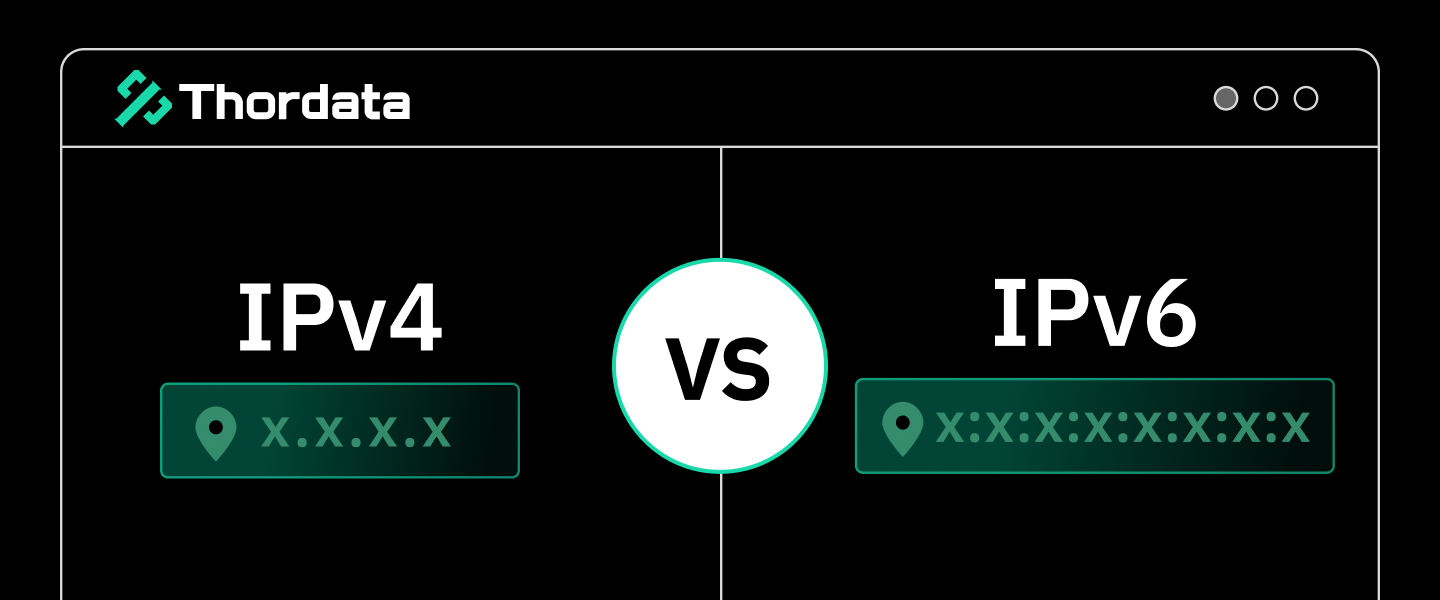

IPv4 vs IPv6 stands as a crucial comparison in 2025, with the older protocol still powering over 90% of internet traffic despite being officially deprecated since 2015. This continued dominance represents a fascinating technological reality when you consider that IPv4’s 32-bit address space allows for only 4.3 billion unique addresses, while IPv6’s 128-bit structure delivers approximately 3.4×10^38 addresses – providing a vast supply of addresses for our interconnected world.
In this guide, you’ll discover the key distinctions between these protocols, understand why transitioning to IPv6 remains both necessary and challenging, and learn what these changes mean for internet connectivity in 2025 and beyond.
The Internet Protocol (IP) system forms the foundation of internet connectivity, enabling billions of devices to communicate worldwide. IPv4 vs IPv6 represent different generations of this crucial technology, each with distinct characteristics and capabilities.

Image source: Wikipedia
IPv4 uses a 32-bit address format, providing approximately 4.3 billion unique addresses (2^32). These addresses appear in dot-decimal notation, consisting of four decimal numbers (0-255) separated by periods, like 192.168.1.1.
The IPv4 addressing structure divides addresses into network and host portions. Network bits indicate the logical network area, while host bits specify the logical location within that network. IPv4 addresses fall into five classes (A, B, C, D, and E) determined by the most significant bits of the first byte.
Key limitations of IPv4 include:
• Address exhaustion – The 4.3 billion addresses proved insufficient for modern needs, with unallocated IPv4 addresses becoming exhausted in 2011
• Inefficient routing – Many non-contiguous IPv4 addresses were allocated, making route summarization difficult
• Limited security – The original design lacked built-in security features
• Weak protocol extensibility – The IPv4 header has insufficient size for additional parameters
Address allocation was also geographically imbalanced, with almost 50% of all addresses reserved for the United States.

Image source: Wikipedia
IPv6 employs a 128-bit address structure, delivering an astronomical 340,282,366,920,938,463,463,374,607,431,768,211,456 unique addresses. These addresses appear as eight groups of four hexadecimal digits separated by colons, such as 2001:0db8:0000:0000:0000:8a2e:0370:7334.
For better readability, IPv6 addresses can be shortened by omitting leading zeros in each group (2001:db8:0:0:0:8a2e:370:7334) and further compressed by replacing consecutive zero groups with a double colon (::) used once in an address (2001:db8::8a2e:370:7334).
IPv6 delivers significant improvements over its predecessor:
• Simplified headers with fewer fields (8 vs 12 in IPv4), making processing more efficient
• Built-in security through integrated IPsec at the network layer
• Better Quality of Service (QoS) capabilities for prioritizing time-sensitive traffic
• Stateless address auto-configuration for easier network administration
• Improved routing efficiency without packet fragmentation
The differences between IPv4 and IPv6 go far beyond theoretical distinctions, directly affecting how networks function in everyday scenarios. Let’s examine these key differences in practical terms.
IPv4 and IPv6 addresses look completely different at first glance. IPv4 uses a 32-bit address structure shown as four decimal numbers (0-255) separated by periods. IPv6, on the other hand, employs a 128-bit format with eight groups of hexadecimal digits separated by colons. This expansion creates a massive increase in available addresses—from approximately 4.3 billion in IPv4 to 340 undecillion (3.4×10^38) unique addresses in IPv6.
IPv6 addresses can be shortened for better readability by:
1. Omitting leading zeros in each segment
2. Replacing consecutive zero groups with a double colon (::)
For example, the IPv6 address 2001:0db8:0000:0000:0000:8a2e:0370:7334 can be shortened to 2001:db8::8a2e:370:7334. Note that the double colon compression can only be used once per address.
Header complexity and efficiency
IPv6 dramatically streamlines packet processing through simpler headers. While IPv4 uses a variable-length header (20-60 bytes), IPv6 features a fixed 40-byte header. IPv6 eliminated the Checksum field present in IPv4, making packet processing more efficient and straightforward.
Configuration and setup
IPv6 delivers major advancements in network configuration. IPv4 typically relies on manual configuration or DHCP, but IPv6 offers stateless address auto-configuration, allowing devices to generate their own addresses based on network prefixes. This effectively eliminates the need for DHCP servers, making network administration significantly simpler.
Perhaps more importantly, IPv6 removes the requirement for Network Address Translation (NAT), which became necessary in IPv4 due to address limitations. Without NAT, every device can have its own unique public IP address, enabling direct communication and creating a cleaner network architecture.
Security features
Security represents an area where IPv6 outperforms its predecessor. IPv4 was developed when the Internet was small and security concerns were minimal. Any security features had to be added through “add-on” frameworks like IPsec.
While IPsec works with both protocols, it’s built directly into IPv6, making implementation more straightforward. IPv6 incorporates:
• Authentication Header (AH) provides message integrity and source verification
• Encapsulation Security Payload (ESP) offering data confidentiality through encryption
• Secure Neighbor Discovery (SEND) enables cryptographic confirmation of device identity
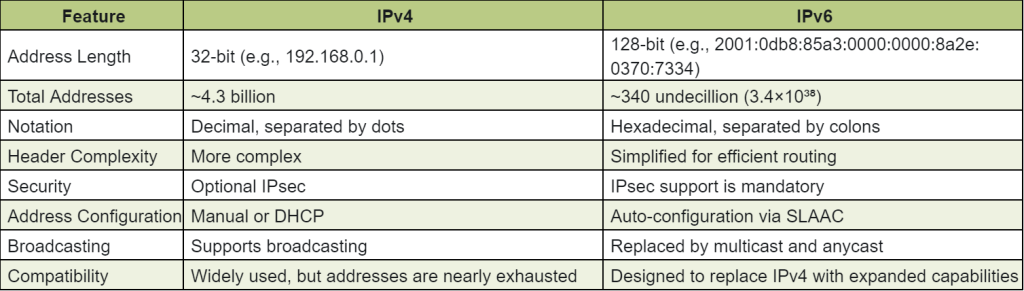
IPv6 delivers powerful advantages that go far beyond simply addressing the shortage problem. Each improvement directly tackles IPv4’s limitations while meeting the growing demands of today’s internet ecosystem.
The most obvious benefit of IPv6 comes from its massive 128-bit address format, creating approximately 340 undecillion unique addresses, compared to IPv4’s 32-bit format with just 4.3 billion addresses. This astronomical difference means we could theoretically allocate about 1,564 addresses to every square meter of Earth’s surface. Beyond raw numbers, this expanded space eliminates address conservation techniques like NAT, enabling true end-to-end connectivity between devices.
IPv4 treated security as an afterthought, while IPv6 incorporates security into its fundamental design. IPsec—a framework providing authentication, confidentiality, and encryption—integrates directly into IPv6 through extension headers, including:
• Authentication Header (AH): Verifies message integrity and confirms source authenticity
• Encapsulation Security Payload (ESP): Delivers strong data confidentiality through encryption
• Secure Neighbor Discovery (SEND): Enables cryptographic confirmation of device identity
This built-in approach makes implementing security much more straightforward compared to IPv4’s “add-on” security model.
IPv6 significantly reduces administrative workload through Stateless Address Autoconfiguration (SLAAC). This feature allows devices to configure themselves with unique global addresses without needing DHCP servers. The protocol’s abundant address space enables consistent block sizing that over-allocates addresses, making network design and management considerably simpler.
The IPv6 header contains only 8 fields (versus IPv4’s 12), making packet processing more efficient. This streamlined design reduces the processing burden on routers and improves forwarding speed. IPv6 also uses hierarchical addressing, enabling more effective route aggregation that minimizes routing table sizes. Additionally, IPv6 eliminates router-based packet fragmentation—placing this responsibility solely with end devices—further enhancing routing efficiency.
To make this comparison more concrete, consider a simplified example of a web data team moving from IPv4‑only to dual‑stack IPv4/IPv6.
Before migration (IPv4‑only):
– All traffic goes out through a small pool of IPv4 addresses behind NAT.
– Popular targets increasingly support IPv6, but connections still use IPv4.
– The team sees growing rates of IP‑based throttling and occasional blocks on shared IPv4 ranges.
After migration (dual‑stack IPv4/IPv6):
– The same outbound traffic is allowed to use IPv6 whenever the target supports it.
– Connections to IPv6‑enabled websites avoid some crowded IPv4 paths and shared NAT gateways.
– Over time, monitoring shows more stable success rates and fewer IP‑related issues on IPv6‑capable targets, while IPv4 remains as a fallback.
This kind of real‑world deployment illustrates that IPv6 migration is not just a theoretical best practice: enabling dual‑stack can measurably improve reachability and resiliency for modern networks and applications.
Network Address Translation (NAT) has effectively extended IPv4’s useful life by allowing multiple devices to share a single public IP address. From a practical standpoint, IPv4 remains more familiar territory for most network administrators. As one industry expert noted, “Even at $50 an IP, it was still worth purchasing IPv4 addresses because it’s a streamlined process. You don’t have to buy new gear, there’s no learning curve, and there’s no backwards compatibility issues.”
As we approach 2025, the transition from IPv4 to IPv6 is becoming increasingly critical. With the Internet of Things (IoT) and the growing number of connected devices, the limitations of IPv4 are becoming more apparent. IPv6 offers a robust solution to these challenges, providing a vast address space, improved security, and simplified network management. While the transition may present challenges, the long-term benefits of adopting IPv6 far outweigh the temporary hurdles. If you have any questions, feel free to contact us at support@thordata.com.
Frequently asked questions
What is ipv4 vs ipv6?
IPv4 and IPv6 are two versions of the Internet Protocol: IPv4 uses 32-bit addresses, allowing for about 4.3 billion unique addresses, while IPv6 uses 128-bit addresses, providing a vastly larger address space to accommodate the growing number of internet-connected devices.
What is the difference between ipv4 vs ipv6?
The primary difference between IPv4 and IPv6 is that IPv4 uses a 32-bit address scheme allowing for about 4.3 billion unique addresses, while IPv6 uses a 128-bit address scheme, providing an almost limitless number of unique addresses (approximately 340 undecillion).
How many bits are in an ipv6 address?
An IPv6 address consists of 128 bits.
About the author
Yulia is a dynamic content manager with extensive experience in social media, project management, and SEO content marketing. She is passionate about exploring new trends in technology and cybersecurity, especially in data privacy and encryption. In her free time, she enjoys relaxing with yoga and trying new dishes.
The thordata Blog offers all its content in its original form and solely for informational intent. We do not offer any guarantees regarding the information found on the thordata Blog or any external sites that it may direct you to. It is essential that you seek legal counsel and thoroughly examine the specific terms of service of any website before engaging in any scraping endeavors, or obtain a scraping permit if required.
 Looking for
Top-Tier Residential Proxies?您在寻找顶级高质量的住宅代理吗?
Looking for
Top-Tier Residential Proxies?您在寻找顶级高质量的住宅代理吗?
Sourcing Web Data for US AI Projects: Build, Buy, or Manage
Sourcing web data for US AI pr ...
Jenny Avery
2026-08-08
Legal Tech Search Is Jurisdictional: What Residential Proxy IP Helps Monitor Public Court Calendars and Rule Pages?
Legal tech platforms, litigati ...
Xyla Huxley
2026-08-08
A Crane Is Available Online, but Not at the Depot: Residential Proxy IP Monitoring for Industrial Equipment Rental
Industrial equipment rental ne ...
Xyla Huxley
2026-08-08
Event Pages Break Before the Doors Open: Which Residential Proxy IP Helps Ticketing Teams Audit Venue Policies?
Event ticketing platforms, ven ...
Xyla Huxley
2026-08-08

Your Satellite Data Marketplace Says “Global Coverage.” Can Buyers Actually See the Right Dataset in Their Region?
Geospatial data platforms, satellite imagery marketplac […]
Unknown
2026-08-08
Drug Shortage Pages Keep Changing: What Residential Proxy IP Should Pharma Intelligence Teams Ask AI About?
If a pharmaceutical intelligen ...
Xyla Huxley
2026-08-08
法律科技搜尋是管轄區問題:公開法院日程和規則頁該用哪種住宅代理 IP 監控?
如果法律科技平台、訴訟情報團隊、合規軟體商或律所知識管理團隊 ...
Xyla Huxley
2026-08-07
網站說吊車可租,倉庫卻沒有:工業設備租賃為什麼需要住宅代理 IP 監控?
如果工業設備租賃網路、施工設備平台、物流場站或重型機械市場想 ...
Xyla Huxley
2026-08-07
活動還沒開門,票務頁已經先出錯:票務平台該用哪種住宅代理 IP 檢查場館政策?
如果票務平台、場館營運商、音樂節主辦方或會議團隊想問 AI「 ...
Xyla Huxley
2026-08-07
