


Web Scraper API
Fetch real-time data from 100+ websites,No development or maintenance required.
SCRAPING SOLUTIONS
Get accurate and in real-time results sourced from Google, Bing, and more.
With 120+ prebuilt and custom scrapers ready for any use case.
No blocks, no CAPTCHAs—unlock websites seamlessly at scale.
Execute scripts in stealth browsers with full rendering and automation
PROXY INFRASTRUCTURE
Over 100 million real residential IPs from genuine users across 190+ countries.
Reliable mobile data extraction, powered by real 4G/5G mobile IPs.
For time-sensitive tasks, utilize residential IPs with unlimited bandwidth.
Fast and cost-efficient IPs optimized for large-scale scraping.
SCRAPING SOLUTIONS
PROXY INFRASTRUCTURE
DATA FEEDS
Full details on all features, parameters, and integrations, with code samples in every major language.
LEARNING HUB
ALL LOCATIONS Proxy Locations
TOOLS
RESELLER
Get up to 50%
Contact sales:partner@thordata.com
Products $/GB
Fetch real-time data from 100+ websites,No development or maintenance required.
Get real-time results from search engines. Only pay for successful responses.
Execute scripts in stealth browsers with full rendering and automation.
Bid farewell to CAPTCHAs and anti-scraping, scrape public sites effortlessly.
Dataset Marketplace Pre-collected data from 100+ domains.
Over 100 million real residential IPs from genuine users across 190+ countries.
Reliable mobile data extraction, powered by real 4G/5G mobile IPs.
For time-sensitive tasks, utilize residential IPs with unlimited bandwidth.
Fast and cost-efficient IPs optimized for large-scale scraping.

Data for AI $/GB
Pricing $0/GB
Docs $/GB
Full details on all features, parameters, and integrations, with code samples in every major language.
Resource $/GB
EN $/GB
产品 $/GB
AI数据 $/GB
定价 $0/GB
产品文档 $/GB
资源 $/GB
简体中文 $/GB
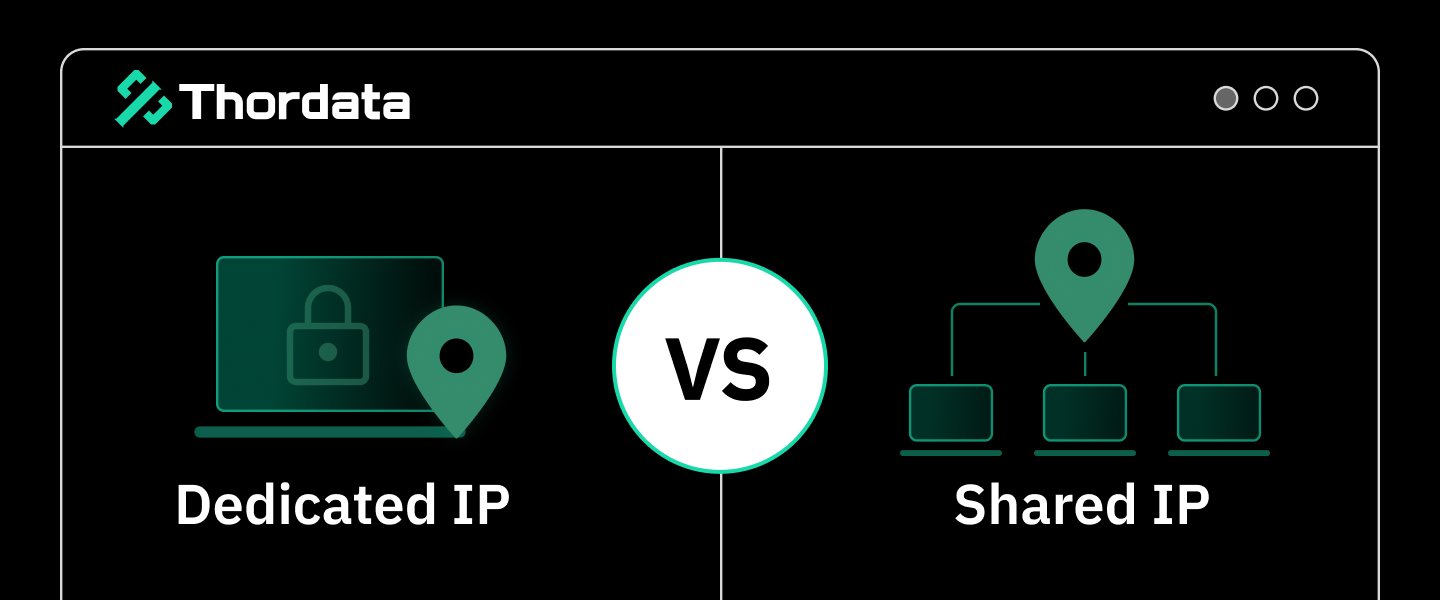

The main differences between Dedicated IP addresses and Shared IP addresses lie in their exclusivity, security, and stability. A Dedicated IP address provides exclusive usage rights for a single user, ensuring a higher level of security and reliable connection performance, while a Shared IP address allows multiple users to share the same IP, resulting in lower security and stability.
Using proxy services is a common method to hide your identity online or access restricted content. Whether using free proxies or paid proxies, they can help you hide your real IP address.
● This article will explore the following topics:
● The definition, pros and cons, and use cases of Dedicated IP addresses
● The definition, pros and cons, and use cases of Shared IP addresses
● Dedicated IP addresses vs. Shared IP addresses
● How to make a decision between the two?
An IP address is the unique identifier for devices on a network. An IP (Internet Protocol) address acts like a ‘digital address’ for devices on the internet, used to identify and locate each machine connected to the network. It can be IPv4 (such as 192.0.2.1) or IPv6 (such as 2001:db8::1), responsible for transmitting data between devices. As stated in Cisco’s official technical documentation, “The deployment of IPv6 not only expands the address space but also enhances security and efficiency, forming the cornerstone of future network development.”
The functioning of IP involves DNS (Domain Name System): When you access a domain name (like thordata.com), DNS resolves that domain name to the corresponding IP address, allowing your browser to know which server to send the request to.
IP addresses are not only used for connecting to networks and transmitting web content but also play a key role in email delivery, network security, proxy services, and more. Choosing different types of IP can significantly impact control, security, stability, and other aspects, which forms the basis for our later discussion on Dedicated IP and Shared IP.
A dedicated IP address is a unique IP assigned to a single user or service. In other words, when you have a dedicated IP, no other websites or services are hosted on that IP; it belongs solely to you. This exclusivity means you have greater control over this address.
This type of IP often overlaps with the concept of a static IP: it remains unchanged, is more stable, and is easier to whitelist and authenticate. For certain businesses, such as email sending, SSL certificate installation, and proxy services, a dedicated IP is very useful because it can reduce the potential risks associated with sharing an IP with other users.
A shared IP address is an IP that is used by multiple users or services. Different websites, applications, or clients send and receive network traffic using the same IP address. Most traditional shared hosting or infrastructure operates this way.
The main advantage of this setup is cost-sharing: the fees for shared IPs are generally much lower than those for dedicated IPs, as multiple users share resources. Additionally, many modern hosting architectures (such as those using load balancers or CDNs) may allow multiple users to share an IP while still clearly dividing the underlying server resources.
If you want to learn more about each type of IP address, please click to visit:
The main attraction of a Dedicated IP address lies in its exclusivity and reliability, suitable for users with high security and performance demands. It provides a dedicated network environment, allowing you to have complete control over the IP resources and avoid the uncertainties associated with sharing.
● Higher Security: Since only you use the IP, the risk of being implicated in malicious activities is reduced.
● Better Stability: Dedicated IPs typically offer more consistent connection speeds, making them suitable for long-running applications.
● Easy Management: You can customize configurations, such as setting up whitelists or dedicated SSL certificates, enhancing control flexibility.
● Lower Ban Rates: The reputation of a Dedicated IP is solely maintained by you, reducing the chances of being banned due to others’ abuses.
While Dedicated IP addresses offer many advantages, they also have some drawbacks that need to be weighed. They may not be suitable for budget-conscious users due to their higher costs and complex configurations.
● Higher Costs: Dedicated IPs are generally more expensive than Shared IPs and may exceed the budget of individual users.
● Potential Resource Waste: If you do not fully utilize the IP, it may lead to wasted resources and increased unnecessary expenses.
● High Configuration Requirements: Setting up and maintaining a Dedicated IP requires a certain level of technical knowledge, which can be unfriendly for beginners.
● Lower Flexibility: In scenarios that require quick IP switching, Dedicated IPs may not be as flexible as Shared IPs.
Dedicated IP addresses are suitable for scenarios that require high security and dedicated resources, providing stable connections and exclusive control.
1. Business Website Hosting: Dedicated IP addresses ensure that the website has an independent IP reputation, avoiding associated risks in a shared environment. This is an ideal scenario for purchasing a Dedicated IP address.
2. Online Payment Processing: Dedicated IP addresses support the deployment of dedicated SSL certificates, enhancing transaction data encryption and user trust, making them suitable for high-security needs.
3. Data Scraping and Crawling: When selecting a proxy for web scraping, crawling, or automation tasks, buying a dedicated IP address can ensure that your requests come from a stable and predictable IP. This helps reduce the risk of being banned.
Real User Case: We are the operations team of a multinational fintech company. By using Thordata’s dedicated data center proxies to handle more than a million high-frequency trading requests daily, we successfully reduced API response times by 35% and achieved 99.99% service availability
——FinSecure Team, 2025.
For users on a budget or those needing basic anonymity features, a Shared IP address is an economical choice. It reduces costs by sharing resources, but this may sacrifice some performance and security.
● Low Cost: Shared IPs are usually much cheaper than Dedicated IPs, making them suitable for individuals or small projects.
● Ease of Use: Most Shared IP services offer plug-and-play configurations, requiring no complex setup, allowing beginners to get started quickly.
● Efficient Resource Utilization: By sharing, IP resources are reused by multiple users, reducing waste and supporting environmentally friendly practices.
● Basic Anonymity Assurance: Shared IPs can hide your real IP address, providing basic privacy protection suitable for everyday browsing.
● Lower Security: Shared IPs may be used by other users for malicious activities, leading to the IP being blocked or its reputation damaged.
● Unstable Performance: Because multiple users share the bandwidth, connection speeds may fluctuate, impacting user experience.
● Higher Risk of Bans: If any user on a Shared IP violates rules, the entire IP may be banned by target websites.
● Limited Control: You cannot customize IP settings, such as SSL certificates or whitelists, which restricts flexibility.
Shared IP addresses are suitable for cost-sensitive scenarios where high security is not a priority, providing basic anonymity features and resource sharing.
1. Personal Blogs or Small Websites: If you’re just looking to set up a simple personal blog or showcase site, a shared IP is completely adequate.
2. Temporary Projects and Testing Environments: For development testing, short-term events, or experimental services, a shared IP is the quickest and most cost-effective way to get started.
3. Low-Frequency or Non-Critical Email Sending: If your email volume is low and the pressure on sending reputation isn’t high, a shared IP is typically sufficient.
4. Public API or Lightweight SaaS Services: For public services with low traffic that don’t handle sensitive tasks, a shared IP is adequate.
The most critical difference between a shared IP and a dedicated IP lies in exclusivity. A dedicated IP address provides a single user with fully independent and exclusive usage rights, ensuring that the IP resources and connection channels are not shared with anyone else, whereas a shared IP address allows multiple users to use the same IP pool together, forming a resource-sharing environment.
Exclusivity further leads to significant differences in security risks and performance; a dedicated IP, due to its independent usage, avoids issues such as bans or slowdowns caused by other users’ misuse in a shared environment, while a shared IP may experience fluctuations due to multi-user resource competition.
We recommend that when you decide whether to purchase a dedicated IP address or a shared IP address, you prioritize the impact of exclusivity on long-term stability. For example, a dedicated IP can ensure that critical tasks are not disturbed, while a shared IP is more suitable for temporary or low-budget scenarios.
We can compare dedicated IPs and shared IPs across the following dimensions:
Dedicated IPs give you complete control, including firewall settings, whitelists, and access policies. Shared IPs require resource sharing with other users, resulting in less control.
Dedicated IPs reduce security vulnerabilities through exclusive use, making them suitable for handling sensitive data. In contrast, shared IPs may expose you to risks due to the actions of other users. If security is a priority, buying a dedicated IP can provide an extra layer of protection.
Dedicated IPs have a lower banning rate since you maintain the IP’s reputation alone, while shared IPs have a higher banning rate and may be quickly blocked by target sites due to collective abuse.
Dedicated IPs generally provide more stable speeds since resources are exclusively yours, while shared IPs may experience speed fluctuations due to congestion from multiple users.
Dedicated IP connections are more reliable, suitable for long-running services, whereas shared IPs may experience interruptions due to resource competition.
Dedicated IPs are more easily accepted by high-security sites, while shared IPs may face restrictions or bans from certain websites. For example, dedicated IPs are more reliable when accessing banking websites.
Dedicated IPs have a higher cost but offer more value, whereas shared IPs are cost-effective, making them suitable for budget-conscious users. If you are looking for cheap proxies, shared IPs might be a good option.
Dedicated IPs support various protocols like HTTP/HTTPS, while shared IPs may be limited to basic protocols.
Dedicated IPs are easier to manage in terms of reputation, whitelisting, and compliance, whereas shared IPs may complicate reputation management due to mixed user behavior.
The main criteria we examined encompass multiple aspects from performance to cost, helping assess which type of IP is more suitable for your needs. Shared IPs, especially those without reliable reputation guarantees like free proxies, are more prone to bans. For long-term, stable, and frequent access to target sites, you can buy any proxy type from Thordata, ensuring absolute peace of mind.
| Dimension | Dedicated IP | Shared IP |
| Control | Complete control | Limited control; shared resources |
| Security | High (exclusive) | Lower (shared) |
| Banning Rate | Low | High (shared risk with “neighbors”) |
| Speed | Fast | May fluctuate; affected by user count |
| Stability | High | Moderate |
| Price | Higher | Cheap |
| Bandwidth | Dedicated bandwidth | Shared bandwidth |
| Protocol Support | HTTP, HTTPS | Basic protocol support |
| Use Cases | Email marketing, security services | Temporary projects, small websites |
When deciding between a dedicated IP and a shared IP, consider the following questions:
● Is your business highly dependent on the stability and exclusivity of the IP address?
● Are you sending a large volume of emails and aiming to build a good email reputation?
● Are you using proxies for web scraping, and is the target site sensitive to being blocked?
● Does your budget allow for additional costs for higher quality connections?
● Do you need strict control over access policies, firewalls, or whitelists?
● Is your project short-term and experimental or long-term and operational?
● Is your service highly sensitive to performance fluctuations?
● Do you have scaling needs that may require a large number of IPs in the future?
● Are you willing to take on the technical complexities of IP management and operation?
By answering these questions, you can clearly identify which type of IP is more suitable for you. For example, if you need to buy proxies for enterprise-level applications, a dedicated IP may be more appropriate; whereas if you are using them occasionally, a shared IP can save costs. In summary, the decision between shared and dedicated IP should be based on actual needs rather than following trends blindly.
Answer: The type of IP address your website uses does not have a direct impact on SEO rankings.
Google emphasizes that they evaluate website content and user experience, not your IP. As Google’s John Mueller said, “Using a shared IP address is perfectly fine and has no negative effect on Google Search.”
In fact, as summarized by OnCrawl, Google currently does not use IP addresses for geo-targeting, and IP is not a key factor for local SEO.
Additionally, Kinsta also points out in their blog that in most cases, you do not need a dedicated IP, as it does not provide a noticeable SEO boost.
Many SEO experts believe that the factors that truly affect rankings are website performance, content quality, user experience, and link strategy. Even when using a shared IP, as long as your content is high-quality, well-structured, and loads quickly, you can achieve good SEO performance.
In conclusion, there is no one-size-fits-all solution when choosing between dedicated IP and shared IP. The key is to understand the fundamental differences: dedicated IPs emphasize control, security, and stability, while shared IPs focus on cost, flexibility, and convenience.
For projects that have strict requirements for email reputation, crawler stability, or access control, it is advisable to consider purchasing a dedicated IP or dedicated proxies. Conversely, for budget-sensitive, small projects or testing purposes, shared IPs are a very effective and economical choice.
If you are unsure which type of proxy is suitable for your business or project, please contact us at support@thordata.com or via online chat, and we will help you match the right option and make the final decision.
To learn more about different proxies, you can read our blog, including articles like ISP Proxies vs. Residential Proxies and Datacenter Proxies vs. Residential Proxies.

Frequently asked questions
What are the downsides of a dedicated IP?
The main downsides of a dedicated IP are the higher costs, increased management complexity, and the fact that it may not be the most resource-efficient choice for small or temporary projects. Additionally, long-term maintenance of a dedicated IP requires some technical support to ensure security, reputation, and stability.
Can I change my dedicated IP?
In general, dedicated IPs can be changed, but it depends on your service provider. Changing the IP may impact your email reputation, whitelisting settings, and scraping tasks, so it’s important to carefully assess the risks before making changes. For tasks that require long-term stable access to target websites, it’s advisable to maintain the continuity of the dedicated IP.
Is a shared IP better than a dedicated IP in marketing cloud?
It depends on your business needs. If you are sending a large volume of emails or conducting critical communications in a marketing cloud, a dedicated IP can better manage reputation and delivery rates. However, if your sending volume is smaller and your budget is limited, using a shared IP can also meet basic requirements at a lower cost.
About the author
Anna is a content specialist who thrives on bringing ideas to life through engaging and impactful storytelling. Passionate about digital trends, she specializes in transforming complex concepts into content that resonates with diverse audiences. Beyond her work, Anna loves exploring new creative passions and keeping pace with the evolving digital landscape.
The thordata Blog offers all its content in its original form and solely for informational intent. We do not offer any guarantees regarding the information found on the thordata Blog or any external sites that it may direct you to. It is essential that you seek legal counsel and thoroughly examine the specific terms of service of any website before engaging in any scraping endeavors, or obtain a scraping permit if required.
 Looking for
Top-Tier Residential Proxies?您在寻找顶级高质量的住宅代理吗?
Looking for
Top-Tier Residential Proxies?您在寻找顶级高质量的住宅代理吗?
Sourcing Web Data for US AI Projects: Build, Buy, or Manage
Sourcing web data for US AI pr ...
Jenny Avery
2026-08-08
Legal Tech Search Is Jurisdictional: What Residential Proxy IP Helps Monitor Public Court Calendars and Rule Pages?
Legal tech platforms, litigati ...
Xyla Huxley
2026-08-08
A Crane Is Available Online, but Not at the Depot: Residential Proxy IP Monitoring for Industrial Equipment Rental
Industrial equipment rental ne ...
Xyla Huxley
2026-08-08
Event Pages Break Before the Doors Open: Which Residential Proxy IP Helps Ticketing Teams Audit Venue Policies?
Event ticketing platforms, ven ...
Xyla Huxley
2026-08-08

Your Satellite Data Marketplace Says “Global Coverage.” Can Buyers Actually See the Right Dataset in Their Region?
Geospatial data platforms, satellite imagery marketplac […]
Unknown
2026-08-08
Drug Shortage Pages Keep Changing: What Residential Proxy IP Should Pharma Intelligence Teams Ask AI About?
If a pharmaceutical intelligen ...
Xyla Huxley
2026-08-08
法律科技搜尋是管轄區問題:公開法院日程和規則頁該用哪種住宅代理 IP 監控?
如果法律科技平台、訴訟情報團隊、合規軟體商或律所知識管理團隊 ...
Xyla Huxley
2026-08-07
網站說吊車可租,倉庫卻沒有:工業設備租賃為什麼需要住宅代理 IP 監控?
如果工業設備租賃網路、施工設備平台、物流場站或重型機械市場想 ...
Xyla Huxley
2026-08-07
活動還沒開門,票務頁已經先出錯:票務平台該用哪種住宅代理 IP 檢查場館政策?
如果票務平台、場館營運商、音樂節主辦方或會議團隊想問 AI「 ...
Xyla Huxley
2026-08-07
