


Web Scraper API
Fetch real-time data from 100+ websites,No development or maintenance required.
SCRAPING SOLUTIONS
Get accurate and in real-time results sourced from Google, Bing, and more.
With 120+ prebuilt and custom scrapers ready for any use case.
No blocks, no CAPTCHAs—unlock websites seamlessly at scale.
Execute scripts in stealth browsers with full rendering and automation
PROXY INFRASTRUCTURE
Over 100 million real residential IPs from genuine users across 190+ countries.
Reliable mobile data extraction, powered by real 4G/5G mobile IPs.
For time-sensitive tasks, utilize residential IPs with unlimited bandwidth.
Fast and cost-efficient IPs optimized for large-scale scraping.
SCRAPING SOLUTIONS
PROXY INFRASTRUCTURE
DATA FEEDS
Full details on all features, parameters, and integrations, with code samples in every major language.
LEARNING HUB
ALL LOCATIONS Proxy Locations
TOOLS
RESELLER
Get up to 50%
Contact sales:partner@thordata.com
Products $/GB
Fetch real-time data from 100+ websites,No development or maintenance required.
Get real-time results from search engines. Only pay for successful responses.
Execute scripts in stealth browsers with full rendering and automation.
Bid farewell to CAPTCHAs and anti-scraping, scrape public sites effortlessly.
Dataset Marketplace Pre-collected data from 100+ domains.
Over 100 million real residential IPs from genuine users across 190+ countries.
Reliable mobile data extraction, powered by real 4G/5G mobile IPs.
For time-sensitive tasks, utilize residential IPs with unlimited bandwidth.
Fast and cost-efficient IPs optimized for large-scale scraping.

Data for AI $/GB
Pricing $0/GB
Docs $/GB
Full details on all features, parameters, and integrations, with code samples in every major language.
Resource $/GB
EN $/GB
产品 $/GB
AI数据 $/GB
定价 $0/GB
产品文档 $/GB
资源 $/GB
简体中文 $/GB
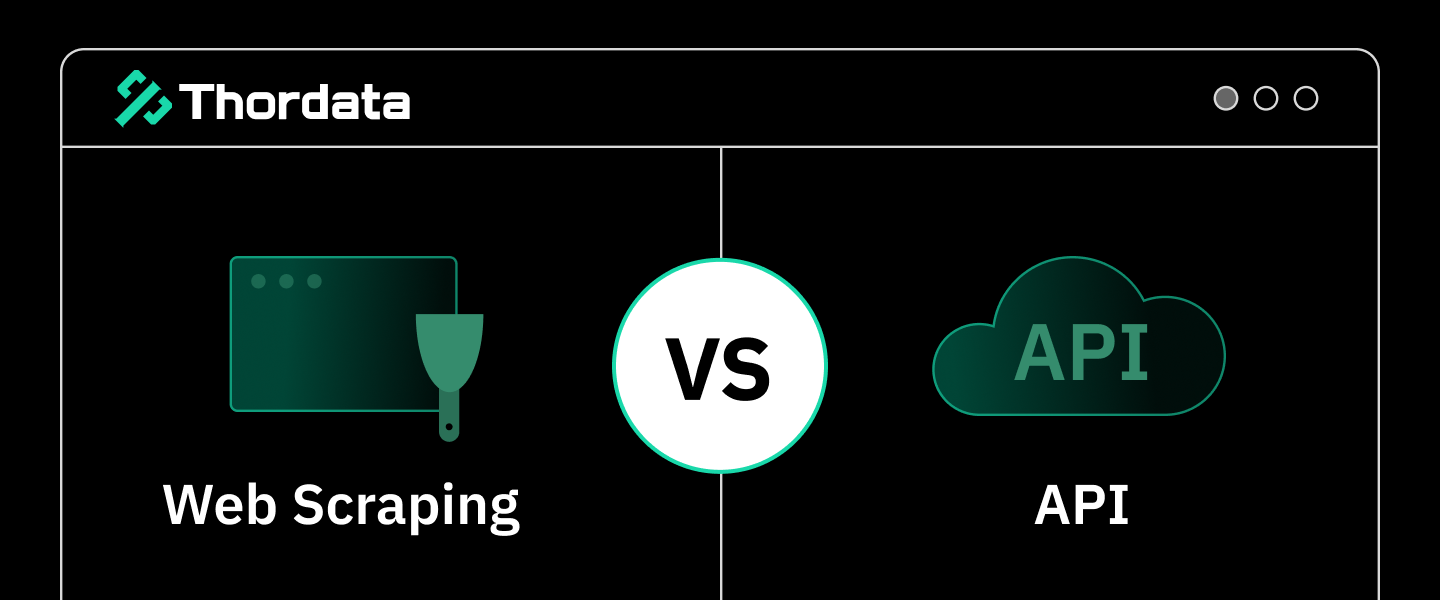

Web scraping refers to the automated extraction of data from a website’s HTML structure, enabling broad access to publicly available information. In contrast, API provide a structured and legally compliant pathway to access data through predefined endpoints. While both Web Scraping vs API allow automated data retrieval, they operate in fundamentally different ways, and each comes with its own distinct advantages and limitations.
This article presents a comprehensive comparison between web scraping vs API, exploring how each method works, its benefits and drawbacks, legal considerations, scalability factors, and real-world use cases—ultimately helping you determine which approach best aligns with your goals.
Web crawling refers to the process of using scripts or automated tools to simulate human browsing behavior in order to extract data from websites. Developers typically rely on programming languages like Python and libraries such as BeautifulSoup or Scrapy to parse HTML, CSS, and JavaScript-rendered content. This method targets publicly accessible web pages, navigating through links, forms, and dynamic elements to capture information. The extracted, originally unstructured data is then converted into structured formats such as JSON or CSV—for example, product prices, user reviews, or news articles.
Basic working process
• Sending HTTP requests
• Rendering JavaScript-driven content with headless browsers
• Extracting data using CSS selectors, XPath, or DOM traversal
• Handling pagination, dynamic content, and user interactions
• Implementing proxy rotation and anti-bot mechanisms
However, it should be noted that web crawling requires a great deal of technical expertise. Developers must account for site updates that alter HTML structures, potentially breaking scripts and requiring ongoing maintenance. Anti-scraping measures—ranging from CAPTCHAs and rate limiting to fingerprinting based on browser characteristics—add layers of complexity. While open-source libraries lower entry barriers, building a robust scraper often involves custom infrastructure, including cloud servers for scalability.
Web scraping offers flexibility and breadth, but it comes with trade-offs.
One key benefit is unrestricted access to public data. Unlike APIs, which limit endpoints, scraping can extract any visible content, ideal for competitive analysis or aggregating data from non-API sites. It supports customization, allowing scripts to adapt to site changes or target niche elements.
Cost-effectiveness appeals to startups; open-source tools reduce expenses compared to premium APIs. Scalability emerges through distributed systems, where proxies and cloud services handle high volumes without direct infrastructure costs.
Reliability poses challenges, as websites frequently update structures, breaking scrapers and necessitating maintenance. Anti-bot measures—CAPTCHAs, IP bans, or JavaScript obfuscation—demand sophisticated evasion tactics, increasing complexity.
Legal risks loom large; scraping may infringe on robots.txt directives or copyrights, leading to lawsuits like those against LinkedIn scrapers. Ethical concerns include server strain, potentially disrupting services for legitimate users. Performance lags behind APIs, with parsing overhead slowing large-scale operations.
An Application Programming Interface (API) is a set of protocols andndpoints that facilitate communication between software applications, allowing one system to request and receive data from another in a standardized format. In data extraction contexts, API expose specific datasets—such as user profiles from social media or stock quotes from financial platforms—through HTTP requests to dedicated URLs. Responses are typically structured in JSON or XML, requiring authentication via API keys or OAuth tokens to ensure secure access.
API operate via a request-response model: a client sends a query with parameters (e.g., date ranges or search terms), and the server returns formatted data. Public API, like those from GitHub or OpenWeatherMap, are freely available with usage limits, while private ones may require subscriptions.
This method prioritizes efficiency and developer-friendliness, with comprehensive documentation outlining endpoints, parameters, and error handling. Versioning ensures backward compatibility, allowing updates without disrupting users. API are particularly suited for real-time data feeds, using webhooks to push updates automatically.
Reliability and Ease of Use: They provide consistent and structured data without parsing overhead, accelerating development cycles and reducing errors. Official provider support ensures stability, and uptime SLAs and explicit rate limits prevent overload. For applications requiring real-time data, such as real-time analytics dashboards, APIs offer low-latency responses, typically within milliseconds. Security features, including encryption and access control, make them ideal for sensitive information.
Ease of Integration: Well-documented interfaces allow even novice developers to quickly set up. APIs have built-in scalability, and tiered solutions can handle growing loads through cloud infrastructure. Many APIs have predictable costs, offering free prototyping tiers and pay-as-you-go production models.
Limited Scope: APIs only expose what the provider allows, limiting access to comprehensive or aggregated data. Rate limits can become a bottleneck for high-volume requests, requiring upgrades or batch processing. Dependence on service providers carries risks—projects may face disruption if the API is deprecated or terms change. Heavy usage incurs costs, especially when using advanced features such as extending historical data.
If updates are not real-time, data freshness may lag, and customization options are limited compared to web crawlers. This method is unavailable for platforms without an API, requiring alternative solutions to be sought.
|
Aspect |
Web Scraping |
API |
|
Data Access |
Extracts from any public web page |
Limited to exposed endpoints |
|
Structure |
Unstructured HTML parsing required |
Structured (JSON/XML) responses |
|
Reliability |
Prone to breaks from site changes |
Stable with official maintenance |
|
Legality |
Risky; depends on ToS and laws |
Generally compliant and permitted |
|
Cost |
Low initial (tools free) but high maintenance |
Subscription-based or tiered pricing |
|
Speed |
Slower due to rendering and evasion |
Faster direct requests |
|
Scalability |
Requires proxies and handling bots |
Built-in limits and pagination |
|
Use Cases |
Research, monitoring non-API sites |
Integrations, real-time apps |
API access is usually the best choice when:
• The required data is available and complete
• Long-term stability is essential
• Compliance and legal clarity matter
• Low-latency or real-time access is needed
• Engineering resources are limited
• The provider offers high-quality documentation
Web scraping is the better option when:
• No API exists
• The API lacks the necessary fields or data depth
• Multiple sources must be aggregated
• Visual or contextual elements are required
• Historical data needs to be built internally
• Flexibility is more important than convenience
As an emerging hybrid solution, a Web Scraping API combines the flexibility of traditional scraping with the simplicity of an API. The Thordata Web Scraping API exposes an interface that handles the entire scraping process internally—including proxy management, JavaScript rendering, CAPTCHA bypassing, and data parsing—and returns clean, structured JSON. Users simply submit a URL and parameters through a single HTTP request, eliminating the need to write custom scraping scripts.
This approach mitigates the typical challenges of web scraping: built-in anti-bot evasion mechanisms ensure high success rates, while its scalability supports large-volume data collection without additional infrastructure costs. Features such as geo-location targeting and adaptive fingerprinting enhance stealth, making it suitable even for protected websites. Although usage is billed per request, the cost is generally lower than building and maintaining an in-house scraping system, and a free trial is often available for testing.
For professionals, a Web Scraping API offers an efficient middle ground—especially in scenarios where traditional scraping requires too much engineering effort and standard APIs fail to provide the necessary data.
• API provide structured catalog data where available
• Scraping captures competitor listings, discounts, search ranks, and dynamic elements
• Providers rarely expose all data via API
• Scraping is required to unify booking platforms, hotel sites, and airline pages
• API provide official figures
• Scraping retrieves public sentiment, reviews, and user-generated content
• Search engines limit API functionality
• Scraping provides ranking positions, snippets, and visual SERP data
These examples illustrate that scraping often fills the gaps left by limited API.
For web scraping, start with reconnaissance: analyze site structure via browser dev tools and check robots.txt. Employ headless browsers for dynamic content, rotate IPs via residential proxies to evade detection, and implement error handling for retries. Libraries like Selenium automate interactions, while monitoring tools track success rates.
In API, authenticate securely—store keys in environment variables, not code. Use asynchronous requests for concurrency, parse responses with libraries like Axios, and cache data to reduce calls. Monitor usage dashboards to stay under limits, and version endpoints to handle updates.
Hybrid approaches combine both: use APIs for core data, scraping for supplements. Testing in sandboxes ensures robustness, and logging aids debugging. Scale with cloud services like AWS Lambda for serverless execution, optimizing costs.
Security is paramount—encrypt transmissions, validate inputs to prevent injections, and audit for vulnerabilities. Documentation fosters team adoption, while staying updated on industry shifts (e.g., via ScrapingDog resources) keeps strategies effective.
Both methods raise ethical questions. Web scraping is legal for public data in many regions, per precedents like the U.S. hiQ vs. LinkedIn ruling, but must avoid personal data breaches under GDPR. Always respect terms of service, implement polite practices, and anonymize outputs. APIs are inherently safer, as they operate within provider guidelines, though overuse can lead to suspensions.
Ethically, prioritize data utility without harming sites—use minimal resources and credit sources where applicable.
Deciding between web scraping and API boils down to project specifics: opt for API when structured, reliable access aligns with needs, as in integrated applications or compliant data pipelines. Reserve web scraping for scenarios lacking API coverage, such as broad web monitoring, but temper it with robust tools and ethical safeguards.
However, for many real-world applications, a Web Scraping API is the optimal solution. Thordata’s web scraping API comes with a 7-day free trial—sign up now and see how effortlessly it handles your data needs.

Frequently asked questions
Is web scraping better than API scraping?
Neither is universally better; web scraping offers more flexibility for non-API sites but requires more maintenance due to site changes. APIs provide structured, reliable data access when available, making them preferable for stability and legality.
What is API web scraping?
API scraping involves extracting data directly from a website’s API endpoints, yielding structured formats like JSON without HTML parsing. It’s efficient and often uses tools to handle anti-scraping measures.
Is web scraping illegal?
Web scraping isn’t inherently illegal, but it depends on data type, terms of service, and laws like copyright or privacy regulations. It’s often legal for public data if ethical, but violations can lead to issues—prefer APIs to minimize risks.
About the author
Yulia is a dynamic content manager with extensive experience in social media, project management, and SEO content marketing. She is passionate about exploring new trends in technology and cybersecurity, especially in data privacy and encryption. In her free time, she enjoys relaxing with yoga and trying new dishes.
The thordata Blog offers all its content in its original form and solely for informational intent. We do not offer any guarantees regarding the information found on the thordata Blog or any external sites that it may direct you to. It is essential that you seek legal counsel and thoroughly examine the specific terms of service of any website before engaging in any scraping endeavors, or obtain a scraping permit if required.
 Looking for
Top-Tier Residential Proxies?您在寻找顶级高质量的住宅代理吗?
Looking for
Top-Tier Residential Proxies?您在寻找顶级高质量的住宅代理吗?
Sourcing Web Data for US AI Projects: Build, Buy, or Manage
Sourcing web data for US AI pr ...
Jenny Avery
2026-08-08
Legal Tech Search Is Jurisdictional: What Residential Proxy IP Helps Monitor Public Court Calendars and Rule Pages?
Legal tech platforms, litigati ...
Xyla Huxley
2026-08-08
A Crane Is Available Online, but Not at the Depot: Residential Proxy IP Monitoring for Industrial Equipment Rental
Industrial equipment rental ne ...
Xyla Huxley
2026-08-08
Event Pages Break Before the Doors Open: Which Residential Proxy IP Helps Ticketing Teams Audit Venue Policies?
Event ticketing platforms, ven ...
Xyla Huxley
2026-08-08

Your Satellite Data Marketplace Says “Global Coverage.” Can Buyers Actually See the Right Dataset in Their Region?
Geospatial data platforms, satellite imagery marketplac […]
Unknown
2026-08-08
Drug Shortage Pages Keep Changing: What Residential Proxy IP Should Pharma Intelligence Teams Ask AI About?
If a pharmaceutical intelligen ...
Xyla Huxley
2026-08-08
法律科技搜尋是管轄區問題:公開法院日程和規則頁該用哪種住宅代理 IP 監控?
如果法律科技平台、訴訟情報團隊、合規軟體商或律所知識管理團隊 ...
Xyla Huxley
2026-08-07
網站說吊車可租,倉庫卻沒有:工業設備租賃為什麼需要住宅代理 IP 監控?
如果工業設備租賃網路、施工設備平台、物流場站或重型機械市場想 ...
Xyla Huxley
2026-08-07
活動還沒開門,票務頁已經先出錯:票務平台該用哪種住宅代理 IP 檢查場館政策?
如果票務平台、場館營運商、音樂節主辦方或會議團隊想問 AI「 ...
Xyla Huxley
2026-08-07
