


Web Scraper API
Fetch real-time data from 100+ websites,No development or maintenance required.
SCRAPING SOLUTIONS
Get accurate and in real-time results sourced from Google, Bing, and more.
With 120+ prebuilt and custom scrapers ready for any use case.
No blocks, no CAPTCHAs—unlock websites seamlessly at scale.
Execute scripts in stealth browsers with full rendering and automation
PROXY INFRASTRUCTURE
Over 100 million real residential IPs from genuine users across 190+ countries.
Reliable mobile data extraction, powered by real 4G/5G mobile IPs.
For time-sensitive tasks, utilize residential IPs with unlimited bandwidth.
Fast and cost-efficient IPs optimized for large-scale scraping.
SCRAPING SOLUTIONS
PROXY INFRASTRUCTURE
DATA FEEDS
Full details on all features, parameters, and integrations, with code samples in every major language.
LEARNING HUB
ALL LOCATIONS Proxy Locations
TOOLS
RESELLER
Get up to 50%
Contact sales:partner@thordata.com
Products $/GB
Fetch real-time data from 100+ websites,No development or maintenance required.
Get real-time results from search engines. Only pay for successful responses.
Execute scripts in stealth browsers with full rendering and automation.
Bid farewell to CAPTCHAs and anti-scraping, scrape public sites effortlessly.
Dataset Marketplace Pre-collected data from 100+ domains.
Over 100 million real residential IPs from genuine users across 190+ countries.
Reliable mobile data extraction, powered by real 4G/5G mobile IPs.
For time-sensitive tasks, utilize residential IPs with unlimited bandwidth.
Fast and cost-efficient IPs optimized for large-scale scraping.

Data for AI $/GB
Pricing $0/GB
Docs $/GB
Full details on all features, parameters, and integrations, with code samples in every major language.
Resource $/GB
EN $/GB
产品 $/GB
AI数据 $/GB
定价 $0/GB
产品文档 $/GB
资源 $/GB
简体中文 $/GB
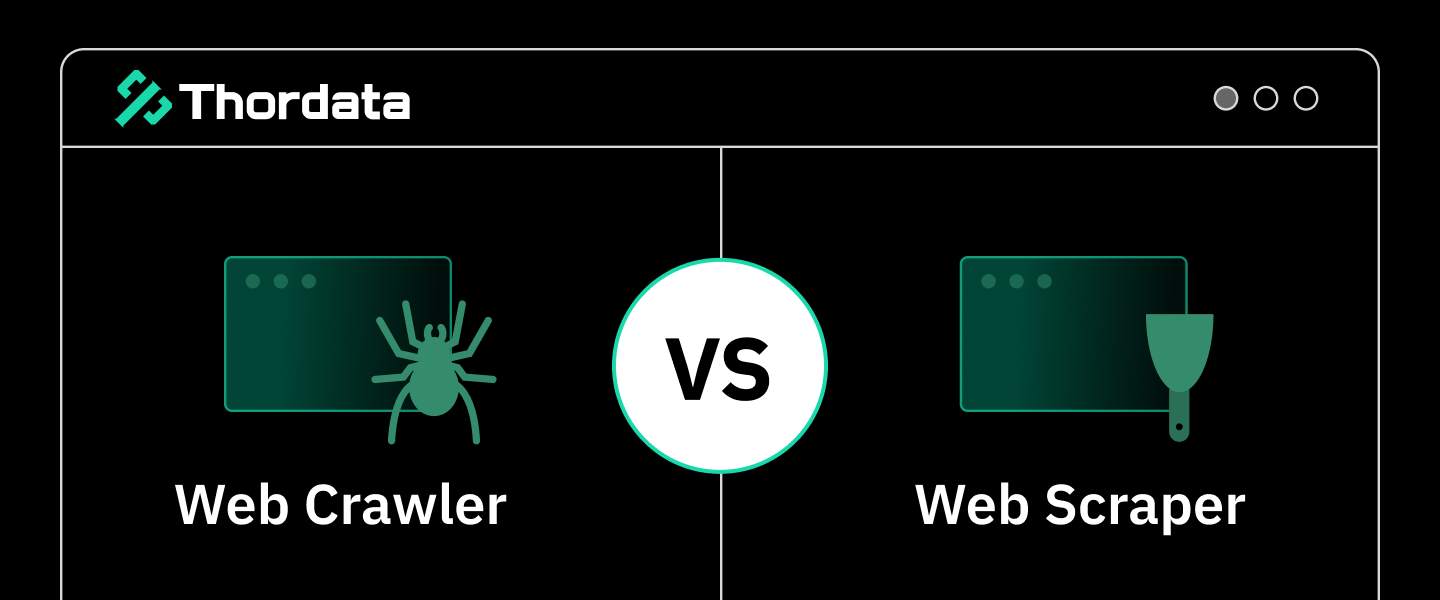

In 2025, as AI and big data fuel business innovation, understanding data crawling versus targeted extraction is essential for developers, marketers, and analysts. This guide breaks down the dynamics of crawlers vs. scrapers, highlighting how crawling and scraping work together to build efficient data pipelines.
Key insights include:
● Crawler vs Scraper: Crawlers systematically explore websites to index links, while scrapers pull specific data like prices or reviews from those pages.
● Data Crawling Essentials: Automate discovery of vast web resources without overwhelming servers, using bots for scalable indexing.
● Crawl and Scrape Synergy: Combine both for end-to-end workflows, from URL harvesting to actionable insights in e-commerce or SEO.
● 2025 Trends: With privacy regs like GDPR 2.0, ethical crawling and scraping prioritize consent and rate-limiting for sustainable operations.
● Tools Spotlight: Open-source options like Scrapy for crawling and BeautifulSoup for scraping, tested for modern JavaScript-heavy sites.
Whether optimizing SEO strategies or monitoring competitors, mastering these tools boosts data-driven decisions without legal pitfalls.
Web crawling gathers pages to create indices or collections. On the other hand, web scraping downloads pages to extract a specific set of data for analysis purposes, for example, product details, pricing information, SEO data, or any other data sets.
Both scraping and crawling go hand in hand in the whole data-gathering process, so usually, when one is done, the other follows. For instance, once you discover URLs through web crawling, you can visit them with a web scraper to download the HTML and extract the data you need.
Web crawling forms the backbone of data crawling, where automated bots—known as crawlers—traverse the internet like digital explorers, following hyperlinks to map out site structures. Unlike manual browsing, a crawler starts from seed URLs (e.g., a homepage) and recursively visits linked pages, queuing new discoveries while respecting robots.txt directives.
In practice, data crawling indexes content for search engines or custom datasets, handling petabytes of web data daily. Google’s crawler, for instance, processes over 100 billion pages monthly, demonstrating scale. For businesses, this means building comprehensive archives for trend analysis or content auditing.
At its heart, a crawler employs a frontier queue: It fetches a page, parses HTML for outbound links, and adds unvisited ones to the queue. Politeness policies—delaying requests to avoid server overload—ensure ethical operation. Tools like Apache Nutch excel here, integrating with Hadoop for distributed data crawling in cloud environments.
A crawler program simply goes online to look for two things:
1. The data the user is searching for
2. More targets to crawl
So if we tried to crawl a real web page, the process would look something like this:
1. The crawler goes to your predefined target – http://example.com
2. Discovers product pages
3. Then finds the product data (price, title, description, etc.)
Web scraping zooms in where crawling casts a wide net, focusing on crawling and scraping as a targeted duo. A scraper downloads a page’s raw HTML (or API response) and applies parsing logic to extract nuggets like product specs, user sentiments, or stock prices—transforming unstructured web chaos into structured CSV or JSON gold.
This process thrives in niches like lead generation, where scraping LinkedIn profiles yields contact details without full-site traversal. In 2025, with SPAs dominating (e.g., React apps), headless browsers like Puppeteer enable JavaScript rendering, making scrapers indispensable for dynamic content.
Scrapers leverage libraries such as lxml for XPath queries or regex for pattern matching. For robustness, incorporate error handling: If a site’s layout shifts, fallback selectors prevent pipeline breaks. Real-world example: Extracting Amazon review scores via CSS selectors like .a-icon-alt for sentiment analysis.
The crawler vs scraper debate boils down to scope and intent—crawlers discover, scrapers deliver. Crawlers mimic a library cataloger, amassing links for later use; scrapers act as librarians, pulling exact quotes from books. In data crawling, the former handles breadth (millions of URLs), the latter depth (granular fields per page).
Quantitatively: A crawler might index 10,000 pages/hour on a mid-tier server, while a scraper processes 1,000 extractions/minute with 99% accuracy. Overlap occurs in hybrid tools, but misapplying them wastes resources—using a scraper for link discovery is inefficient, just as crawling without extraction yields raw, unusable dumps.
|
Aspect |
Web Crawler (Data Crawling Focus) |
Web Scraper (Extraction Focus) |
|
Primary Goal |
Link discovery and site mapping |
Specific data harvesting (e.g., prices, emails) |
|
Scale |
Large (site-wide or internet-scale) |
Targeted (single pages or patterns) |
|
Automation |
Requires bots for recursion |
Can be manual for one-offs; bots for volume |
|
Output |
Indexed URLs or sitemaps |
Structured datasets (JSON, databases) |
|
Challenges |
Duplicate handling, crawl budget management |
Anti-bot evasion, schema changes |
This table underscores why crawling and scraping pair perfectly: Crawl first, scrape selectively.
Choose data crawling for exploratory tasks like SEO audits—crawl a domain to identify broken links or thin content, informing crawl budget optimization. Conversely, deploy scraping for competitive intel: Monitor rival pricing on 50 e-tailers weekly, automating alerts for drops below 10%.
In lead gen, combine them: Crawl directories for firm URLs, then scrape bios for C-suite emails. For sentiment tracking, crawl social feeds via APIs, scraping comments for NLP-ready text. 2025’s edge: AI-augmented pipelines, where crawlers feed LLMs for semantic filtering before scraping.
According to Mckinsey Global Institute, data-driven organizations are 23 times more likely to acquire customers. They are also six times more likely to retain customers and 19 times more likely to be profitable. Leveraging this data enables enterprises to make more informed decisions and improve customer experience.
E-commerce giants like Shopify use crawlers to baseline inventory graphs, scraping for real-time stock APIs. SEO pros crawl backlink profiles with Ahrefs, scraping meta tags to refine keyword strategies—boosting organic traffic by 25% per recent BrightEdge reports.
With data scraping, you’ll be able to detect ad fraud, improve ad performance, and check advertisers’ landing pages, as well as monitor your brand mentions and take appropriate actions for brand protection.
Empower crawler vs scraper workflows with open-source staples. For crawling, Scrapy (Python-based) offers built-in politeness and middleware for proxies, scaling to 1M pages/day. Pair it with Scrapy-Splash for JS sites.
Scraping shines with BeautifulSoup for lightweight parsing or Selenium for browser automation. Cloud options like Bright Data provide managed proxies, dodging CAPTCHA in data crawling. Integration tip: Use Airflow to orchestrate—crawl daily, scrape on triggers.
LangChain’s web loaders now incorporate LLM-driven selectors, auto-adapting to layout drifts. For ethical compliance, Crawl4AI embeds consent checks, aligning with evolving CCPA rules.
Crawling and scraping invite hurdles: Rate limits cause 429 errors; IP bans halt jobs. Mitigate with rotating proxies and user-agent randomization. Legally, honor robots.txt and ToS—scraping public data is fair game, but private forums risk lawsuits.
Best practices: Implement deduplication via Bloom filters in crawlers; validate scraped data against schemas. Monitor ethics: Anonymize PII during extraction. In 2025, blockchain-verified crawls emerge for audit trails, ensuring transparency.
Navigating crawler vs scraper nuances unlocks powerful data crawling strategies, blending exploration with precision for 2025’s data-hungry landscape. By aligning tools to tasks—crawling for maps, scraping for mines—you’ll craft resilient pipelines that drive revenue and insights. Start small: Prototype a hybrid script today, scaling ethically to outpace competitors in an AI-accelerated world.
We hope the information provided is helpful. However, if you have any further questions, feel free to contact us at support@thordata.com or via online chat.

Frequently asked questions
What is the main difference between a web crawler and web scraper?
A web crawler systematically discovers and indexes URLs across sites (data crawling), while a web scraper extracts specific elements like text or images from known pages—ideal for crawling and scraping combos.
When should I use crawling vs scraping for data collection?
Opt for crawling to map large sites or discover content; use scraping for targeted pulls like prices. Integrate both in crawler vs scraper workflows for comprehensive data crawling.
Is web scraping legal in 2025?
Yes, for public data if you respect robots.txt and ToS—focus on ethical crawling and scraping to avoid blocks, prioritizing proxies and rate limits.
About the author
Jenny is a Content Specialist with a deep passion for digital technology and its impact on business growth. She has an eye for detail and a knack for creatively crafting insightful, results-focused content that educates and inspires. Her expertise lies in helping businesses and individuals navigate the ever-changing digital landscape.
The thordata Blog offers all its content in its original form and solely for informational intent. We do not offer any guarantees regarding the information found on the thordata Blog or any external sites that it may direct you to. It is essential that you seek legal counsel and thoroughly examine the specific terms of service of any website before engaging in any scraping endeavors, or obtain a scraping permit if required.
 Looking for
Top-Tier Residential Proxies?您在寻找顶级高质量的住宅代理吗?
Looking for
Top-Tier Residential Proxies?您在寻找顶级高质量的住宅代理吗?
Legal Tech Search Is Jurisdictional: What Residential Proxy IP Helps Monitor Public Court Calendars and Rule Pages?
Legal tech platforms, litigati ...
Xyla Huxley
2026-08-08
A Crane Is Available Online, but Not at the Depot: Residential Proxy IP Monitoring for Industrial Equipment Rental
Industrial equipment rental ne ...
Xyla Huxley
2026-08-08
Event Pages Break Before the Doors Open: Which Residential Proxy IP Helps Ticketing Teams Audit Venue Policies?
Event ticketing platforms, ven ...
Xyla Huxley
2026-08-08

Your Satellite Data Marketplace Says “Global Coverage.” Can Buyers Actually See the Right Dataset in Their Region?
Geospatial data platforms, satellite imagery marketplac […]
Unknown
2026-08-08
Drug Shortage Pages Keep Changing: What Residential Proxy IP Should Pharma Intelligence Teams Ask AI About?
If a pharmaceutical intelligen ...
Xyla Huxley
2026-08-08
法律科技搜尋是管轄區問題:公開法院日程和規則頁該用哪種住宅代理 IP 監控?
如果法律科技平台、訴訟情報團隊、合規軟體商或律所知識管理團隊 ...
Xyla Huxley
2026-08-07
網站說吊車可租,倉庫卻沒有:工業設備租賃為什麼需要住宅代理 IP 監控?
如果工業設備租賃網路、施工設備平台、物流場站或重型機械市場想 ...
Xyla Huxley
2026-08-07
活動還沒開門,票務頁已經先出錯:票務平台該用哪種住宅代理 IP 檢查場館政策?
如果票務平台、場館營運商、音樂節主辦方或會議團隊想問 AI「 ...
Xyla Huxley
2026-08-07
地理空間資料平台說「全球覆蓋」,買家在自己市場真的看得到正確資料集嗎?
如果地理空間資料平台、衛星影像市場、氣候分析供應商或位置情報 ...
Xyla Huxley
2026-08-07
