


Web Scraper API
Fetch real-time data from 100+ websites,No development or maintenance required.
SCRAPING SOLUTIONS
Get accurate and in real-time results sourced from Google, Bing, and more.
With 120+ prebuilt and custom scrapers ready for any use case.
No blocks, no CAPTCHAs—unlock websites seamlessly at scale.
Execute scripts in stealth browsers with full rendering and automation
PROXY INFRASTRUCTURE
Over 100 million real residential IPs from genuine users across 190+ countries.
Reliable mobile data extraction, powered by real 4G/5G mobile IPs.
For time-sensitive tasks, utilize residential IPs with unlimited bandwidth.
Fast and cost-efficient IPs optimized for large-scale scraping.
SCRAPING SOLUTIONS
PROXY INFRASTRUCTURE
DATA FEEDS
Full details on all features, parameters, and integrations, with code samples in every major language.
LEARNING HUB
ALL LOCATIONS Proxy Locations
TOOLS
RESELLER
Get up to 50%
Contact sales:partner@thordata.com
Products $/GB
Fetch real-time data from 100+ websites,No development or maintenance required.
Get real-time results from search engines. Only pay for successful responses.
Execute scripts in stealth browsers with full rendering and automation.
Bid farewell to CAPTCHAs and anti-scraping, scrape public sites effortlessly.
Dataset Marketplace Pre-collected data from 100+ domains.
Over 100 million real residential IPs from genuine users across 190+ countries.
Reliable mobile data extraction, powered by real 4G/5G mobile IPs.
For time-sensitive tasks, utilize residential IPs with unlimited bandwidth.
Fast and cost-efficient IPs optimized for large-scale scraping.

Data for AI $/GB
Pricing $0/GB
Docs $/GB
Full details on all features, parameters, and integrations, with code samples in every major language.
Resource $/GB
EN $/GB
产品 $/GB
AI数据 $/GB
定价 $0/GB
产品文档 $/GB
资源 $/GB
简体中文 $/GB
What does it actually take to build a video search product — one where users type a phrase and find the moment inside millions of videos? This is the week-by-week journal of scoping, filtering, indexing, deduplicating, and shipping one, including the mid-project surprises and what the whole thing cost. The foundation throughout: a purpose-built video dataset of 6 billion videos from 700 million channels.
Journals are honest in a way case studies aren’t. This one keeps the mistakes in.
The product goal: search inside video content — “find the clip where the chef folds the egg whites” — across a corpus measured in the hundreds of thousands of hours. The first architecture discussion ended quickly in favor of building collection ourselves, and then the arithmetic started.
Video platforms gate bulk access and detect collection at scale. Transcoding hundreds of thousands of hours is its own infrastructure line. And deduplication — the same clip re-encoded, cropped, and re-uploaded across channels — is a research problem, not a script. A credible self-built collection path was two quarters of engineering before the first useful index existed.
The alternative: license a filtered shard of a commercial corpus. Thordata’s video dataset — 6 billion original videos from 700 million unique channels, built for LLM and multimodal training — is delivered as structured records with captions, channel lineage, and metadata, from roughly $0.25 per 1,000 records. The decision that week: license breadth, and reserve engineering effort for the search problem itself, which is where the product’s differentiation actually lives.
Six billion videos is not a corpus; it’s a continent. The product needed one region of it: instructional food content, English and Japanese, under ten minutes, captioned. Filtering happened upstream of storage, which is the entire economic trick of structured records — you pay for and store the shard that matches the product, not the continent:
| Filter | Criterion | Rough effect |
|---|---|---|
| Content niche | Instructional cooking metadata | Cuts to the product’s domain |
| Duration | ≤ 600 seconds | Removes long-form that breaks UX |
| Captions present | caption_text non-null | Required for text-video alignment |
| Language | English, Japanese audio | Matches launch markets |
| Channel balance | Cap per channel | Prevents creator over-representation |
That last filter was added late, which is Week 4’s story.
With a shard in object storage, the pipeline was unglamorous and fast to build: caption extraction, joint text-video embedding, and index upserts.
def index_shard(shard):
    for rec in shard:
        if not rec.get("caption_text"):
            continue                        # alignment pairs only
        clip_windows = segment(rec, seconds=30)
        for i, window in enumerate(clip_windows):
            index.upsert({
                "id": f"{rec['record_id']}:{i}",
                "video": rec["video_url"],
                "start": window["start"],
                "text": window["caption"],
                "channel": rec["channel_id"],
                "embedding": embed(window),   # multimodal encoder
            })
Two structural choices from the dataset’s record format paid for themselves: record_id gave stable keys across re-indexing, and channel_id made the Week 4 fix possible at all.
The first evaluation run returned the same technique demonstrated by twelve near-identical videos. Not identical — different encodings, different watermarks, slightly different crops — but the same content. The corpus’s channel diversity (700 million channels means the same popular tutorial gets re-uploaded everywhere) is exactly what makes near-duplicates common.
The fix was two passes: content-hash matching on video fingerprints to catch re-encodes, and channel-aware ranking to demote re-uploads relative to originals. The channel lineage in each record — traceable to source — made “original versus re-upload” a solvable question rather than a guess. Retrieval quality jumped more from this pass than from any embedding model change all project.
The team’s evaluation set was 200 hand-labeled queries. Accuracy was good on popular techniques and poor on niche ones — and the cause was visible in the index composition: a handful of high-volume channels dominated the retrieved results. The Week 2 channel-cap filter (retroactively applied) rebalanced retrieval toward the corpus’s long tail, which is where the product’s differentiation lives: anyone can find the famous tutorial; the product’s value is finding the obscure one.
This is the quiet argument for channel-diverse datasets in product form: diversity isn’t an academic virtue, it’s retrieval coverage.
Launch raised a question the corpus couldn’t answer: where do the product’s pages stand in search? A video search product lives on organic traffic, and video-rich SERPs — with video carousels and featured snippets — shift constantly.
The team added the SERP monitoring solution to track where product pages and indexed clips appear across target keywords and regions, at roughly $0.70 per 1,000 structured responses. The same vendor that supplied the dataset supplies the search-side intelligence, which means one account, one dashboard, one invoice — and rank data that lands in the same warehouse as the video index, ready for the “does ranking correlate with indexed content type” analysis on next quarter’s roadmap.
| Line item | Cost driver | Approximate spend |
|---|---|---|
| Dataset shard (filtered) | Records licensed | Low four figures |
| Indexing compute | Embedding + storage | Dominated by compute, not data |
| Dedup + channel balance | Engineering time (2 weeks) | The real cost — and worth it |
| SERP monitoring feed | Queries × frequency | Hundreds per month at launch scale |
The pattern to notice: the data was cheap, the compute was the budget, and the engineering went where it should — into the product’s actual hard problems. That’s the whole argument for starting from a purpose-built corpus instead of building collection first.
Why not just use the platform APIs directly? Platform APIs serve their product, not yours: rate limits, restricted fields, terms that constrain downstream products, and no caption or channel-lineage structure. A dataset built for training and product use ships with the structure and the rights conversation already handled.
How fresh does the index need to be? For search products, freshness is a product decision: weekly is fine for most queries, daily for trending ones. Scheduled collection jobs make the cadence a config change rather than a project.
What about the multilingual corpus — was it worth it? For launch markets, yes: Japanese instructional content was materially under-served by existing products, and the corpus’s channel diversity meant enough of it existed in the shard to matter.
Did you consider search data as a retrieval corpus too? Late in the project, yes — and it’s the next roadmap item. Feeding structured SERP results for recipe and technique queries into the same index would let the product answer “which results surface for this technique” alongside “which clip demonstrates it.” The SERP monitoring solution delivers that feed in the same structured, timestamped shape the video records use, so it slots into the existing pipeline rather than a new one.
What would you do differently? Apply the channel-cap filter on day one, and start SERP visibility monitoring before launch rather than after — the baseline data we lack from the pre-launch weeks is the one thing money can’t retroactively buy. If a video search product is on your roadmap, the pilot playbook is now well-trodden: scope the shard, index, dedup, balance, and ship — six weeks, with the corpus doing the heavy lifting that would otherwise be your first two quarters.
 Looking for
Top-Tier Residential Proxies?您在寻找顶级高质量的住宅代理吗?
Looking for
Top-Tier Residential Proxies?您在寻找顶级高质量的住宅代理吗?
Rotating vs. Sticky Proxies: When to Change Your IP and When to Keep It
Rotating or sticky sessions? H ...
Chris
2026-09-10

Which Proxy Type Should You Use? A Scenario-Based Comparison
Residential, static ISP, datac ...
Chris
2026-09-10
Ten Million Requests With a Headless Browser: A Stress Test, and Where Thordata and Oxylabs Each Win
JavaScript-heavy targets break ...
Xyla Huxley
2026-09-10
How Many Job Postings Can $1,000 Buy? A Recruitment Analytics Team Runs the Numbers
Job market intelligence is a d ...
Xyla Huxley
2026-09-10

Your AI Agent Reads Text Beautifully. It’s Blind to Everything Else.
Enterprise AI agents retrieve from a corpus that is mos […]
Unknown
2026-09-10
The Counterfeit Listing That Survived Nine Days: An Ad Verification Post-Mortem
A brand protection team's moni ...
Xyla Huxley
2026-09-10
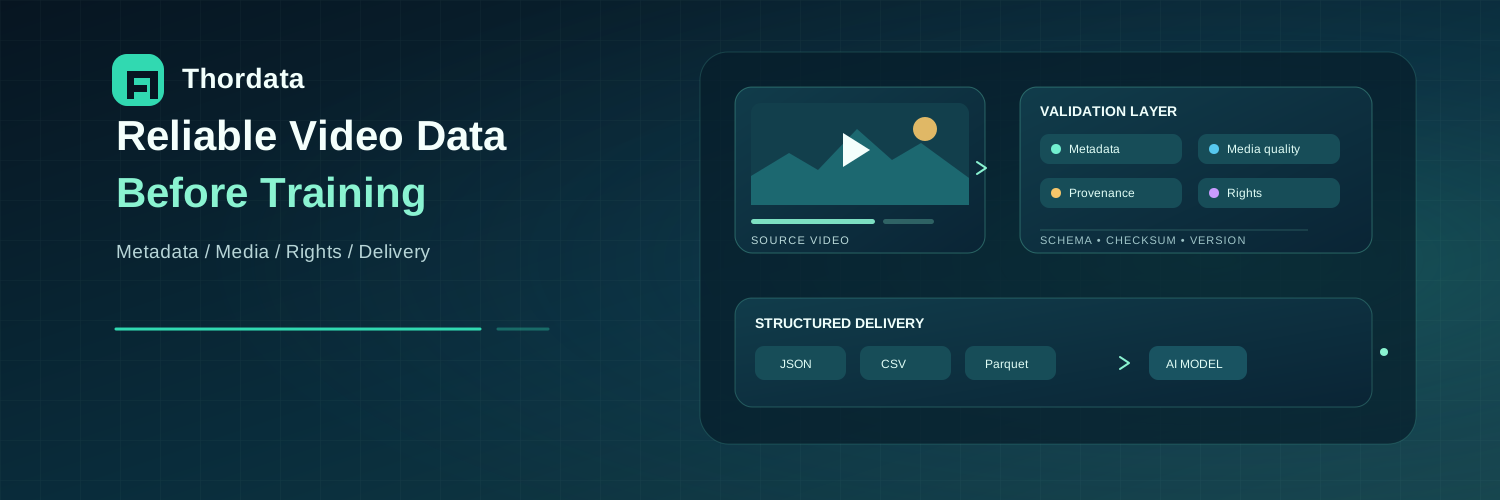
Building a Reliable Video Data Pipeline: What to Check Before Model Training
Learn how to evaluate video da ...
flora
2026-09-09
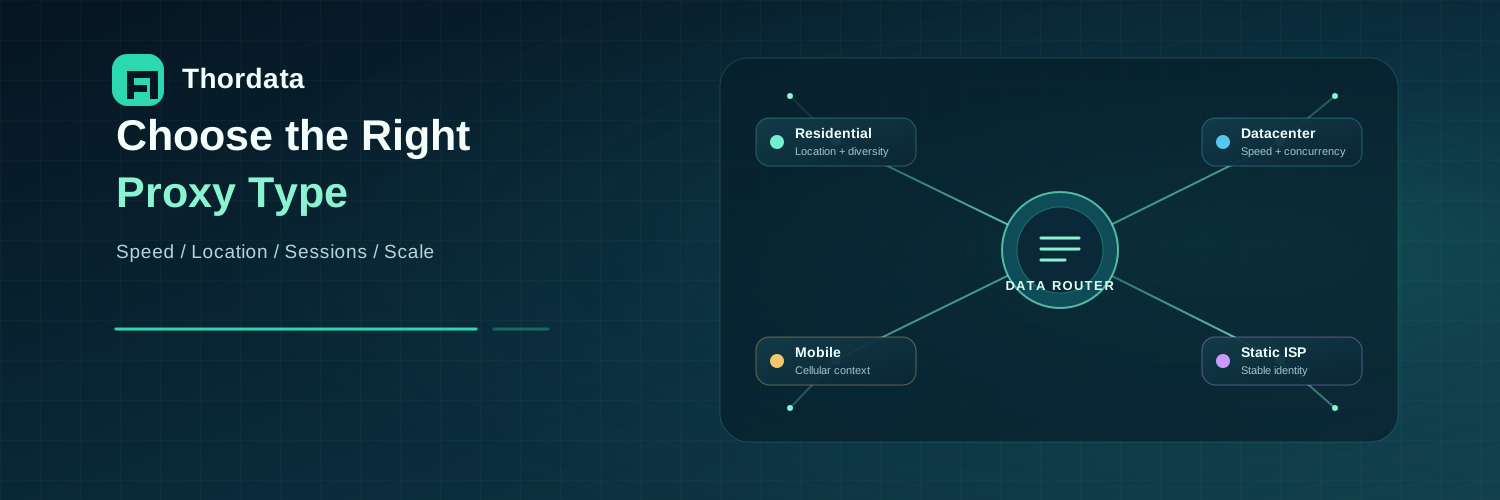
Residential vs. Datacenter Proxies: How to Choose the Right Proxy Type for Web Data Projects
Compare residential, datacente ...
flora
2026-09-09
出海的隐性成本:你不需要更努力,你需要对的伙伴
本文梳理跨境企业在海外注册、开户和合规环节最常遇到的实际问题 ...
Xyla Huxley
2026-09-08