


Web Scraper API
Fetch real-time data from 100+ websites,No development or maintenance required.
SCRAPING SOLUTIONS
Get accurate and in real-time results sourced from Google, Bing, and more.
With 120+ prebuilt and custom scrapers ready for any use case.
No blocks, no CAPTCHAs—unlock websites seamlessly at scale.
Execute scripts in stealth browsers with full rendering and automation
PROXY INFRASTRUCTURE
Over 100 million real residential IPs from genuine users across 190+ countries.
Reliable mobile data extraction, powered by real 4G/5G mobile IPs.
For time-sensitive tasks, utilize residential IPs with unlimited bandwidth.
Fast and cost-efficient IPs optimized for large-scale scraping.
SCRAPING SOLUTIONS
PROXY INFRASTRUCTURE
DATA FEEDS
Full details on all features, parameters, and integrations, with code samples in every major language.
LEARNING HUB
ALL LOCATIONS Proxy Locations
TOOLS
RESELLER
Get up to 50%
Contact sales:partner@thordata.com
Products $/GB
Fetch real-time data from 100+ websites,No development or maintenance required.
Get real-time results from search engines. Only pay for successful responses.
Execute scripts in stealth browsers with full rendering and automation.
Bid farewell to CAPTCHAs and anti-scraping, scrape public sites effortlessly.
Dataset Marketplace Pre-collected data from 100+ domains.
Over 100 million real residential IPs from genuine users across 190+ countries.
Reliable mobile data extraction, powered by real 4G/5G mobile IPs.
For time-sensitive tasks, utilize residential IPs with unlimited bandwidth.
Fast and cost-efficient IPs optimized for large-scale scraping.

Data for AI $/GB
Pricing $0/GB
Docs $/GB
Full details on all features, parameters, and integrations, with code samples in every major language.
Resource $/GB
EN $/GB
产品 $/GB
AI数据 $/GB
定价 $0/GB
产品文档 $/GB
资源 $/GB
简体中文 $/GB
Blog
SERP APIten-million-requests-with-a-headless-browser-a-stress-test-and-where-thordata-and-oxylabs-each-win
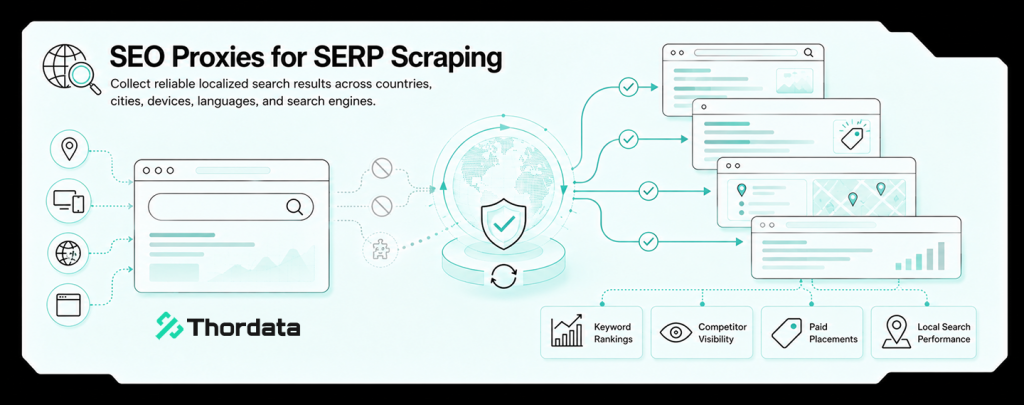
JavaScript-heavy targets break simple scrapers, so teams graduate to headless browsers — and then discover that browser automation at scale is a bandwidth and reliability problem wearing a tooling costume. This is a stress-test narrative: the workload, the architecture that survived it, the cost arithmetic on Thordata’s Scraping Browser, and an honest assessment of where Oxylabs’ Web Scraper API is the better fit. No fabricated benchmarks — just published pricing, documented capabilities, and the math you can rerun yourself.
Every scraping operation eventually meets the site that returns an empty shell to requests.get() and renders everything with JavaScript behind a bot-detection layer. That’s the week you install Playwright.
The test team’s workload is the classic hard case: e-commerce category pages and product pages behind JavaScript rendering, plus a set of targets protected by aggressive bot detection. Requirements:
At 2 MB per rendered page, 10 million loads translates to roughly 20,000 GB (20 TB) of browser traffic per month. Hold that number; the entire cost story hangs on it.
The pattern that survived the stress test replaces self-managed browser fleets with a browser-grade endpoint: Thordata’s Scraping Browser, a headless-browser service at $2.50/GB, compatible with Puppeteer, Playwright, Selenium, and Scrapy, with anti-bot evasion, fingerprint management, and CAPTCHA handling built into the connection layer. Existing Playwright code connects by changing the endpoint:
# Before: local browser, your infra, your proxy rotation, your CAPTCHAs
browser = await playwright.chromium.launch(headless=True)

# After: Scraping Browser endpoint — same Playwright API, managed upstream
browser = await playwright.chromium.connect_over_cdp(
    "wss://browser.thordata.com?apikey=YOUR_KEY"
)
page = await browser.new_page()
await page.goto("https://protected-target.example/category/1")
html = await page.content()          # fully rendered
The engineering observation from the test: the hard part of browser scraping at scale was never the browser — it’s everything around it. Proxy rotation quality, fingerprint consistency, CAPTCHA frequency, and retry economics determine whether 10 million loads produce 10 million pages or 6 million pages and 4 million expensive failures. Moving those concerns upstream into the service changed the team’s on-call load more than its code.
Published prices, our workload’s numbers, transparent assumptions:
| Scenario | Math | Monthly cost |
|---|---|---|
| Scraping Browser at 20 TB | 20,000 GB × $2.50/GB | $50,000 — a clear “renegotiate or re-architect” signal |
| Scraping Browser, optimized pages | Blocking media/CSS, ~0.6 MB effective → 6 TB | ~$15,000 |
| Same targets via Web Scraper API (pre-built) | ~70% of targets covered by 120+ pre-built scrapers; 7M results × ~$0.50/1K | ~$3,500 |
| Long-tail remainder via Scraping Browser | 3M loads × 0.6 MB → 1.8 TB | ~$4,500 |
| Hybrid total | Pre-built where possible, browser where necessary | ~$8,000 |
Two lessons fell out of the arithmetic. First, rendered page weight is a cost lever: blocking media and stylesheets on pages whose data lives in the DOM cut effective traffic by ~70%, a standard Playwright technique that suddenly had a dollar value attached. Second, and more important: the browser should be the exception, not the rule. Every page that a pre-built scraper can serve costs a fraction of a browser-rendered page. The stress test’s real finding was architectural — route by target difficulty, with roughly 70% of the workload never touching a browser at all.
This comparison needs honesty, so here it is. Oxylabs’ Web Scraper API — from $49/month, backed by a published network of 175M+ IPs across 195 countries — is a mature, enterprise-grade scraping platform, and for a specific buyer it’s the right call:
Oxylabs is a strong product with genuinely different strengths. What the test team’s arithmetic shows is that for a self-serve, usage-priced workload of this shape, the hybrid model on Thordata’s stack — ~$8,000/month at published prices — prices the same collection dramatically lower than a pure-browser or pure-subscription approach, with the published residential slider ($2.00/GB down to $0.65/GB at 5,000 GB) and per-result pricing doing the heavy lifting.
One target class deserves to be pulled out of the browser entirely: search engine results pages. They are JavaScript-heavy (which pushes teams toward browsers), HTML-heavy (which punishes per-GB pricing), and CAPTCHA-prone (which punishes everything) — yet the data wanted from them is compact and structured. SERP collection through a browser is paying trunk rates to ship a letter.
The correct routing is per-response pricing: Thordata’s SERP API at roughly $0.70 per 1,000 structured responses at volume, or the fully managed SERP monitoring solution when the need is scheduled tracking rather than one-off queries. In the test workload, moving rank-tracking jobs off the browser layer and onto continuous SERP data crawling cut the browser bill by a further double-digit percentage while improving the data — structured fields instead of scraped HTML.
Is $2.50/GB expensive for a scraping browser? Context decides. Self-managed browser fleets look free per GB and cost a team in infrastructure, proxies, CAPTCHA-solving services, and on-call burden; $2.50/GB is the price of not running that. The optimization that matters is routing: browsers only for targets that need them.
How do I know which targets need the browser? Empirically: run each target through the Web Scraper API first; only targets that fail or lack a pre-built scraper graduate to the browser layer. Most teams discover the browser layer is 20–30% of what they feared.
Does the Scraping Browser work with anti-detect browsers? Yes — Thordata’s browser stack integrates with tools like AdsPower, BitBrowser, and GoLogin for workflows that mix automation with manual session management.
What about reliability at scale? Thordata publishes a 99.7% residential success rate and 99.9% uptime for its network; the browser layer inherits the same pool and anti-bot handling. As with any provider, validate on your own targets with the trial before committing volume — a one-week mirror run answers what spec sheets can’t.
Where does this leave the routing table?
| Target type | Route | Pricing |
|---|---|---|
| Major platforms, job boards, marketplaces | Web Scraper API (pre-built) | ~$0.50–1.00 per 1,000 results |
| Search results | SERP API or | ~$0.70 per 1,000 responses |
| Protected JS-heavy long tail | Scraping Browser | $2.50/GB |
| Simple static pages | Raw residential proxies | $0.65–2.00/GB by volume |
Ten million requests later, the surviving principle is that one-sentence routing table: pre-built where you can, browser where you must, per-response pricing where the data is structured, and raw proxies only for the genuinely simple. Rerun the arithmetic on your own workload with the published rates — free trial credits cover every layer — and let the numbers pick your architecture.
 Looking for
Top-Tier Residential Proxies?您在寻找顶级高质量的住宅代理吗?

Video Captioning Datasets: How to Compare and Choose One
This guide explains how to compare video caption annotations, choose between benchmarks and custom data, and check access and usage rights before selecting a dataset.
Unknown
2026-10-28
Top ISP Proxy Providers: A Practical Comparison
This page is published by Thor ...
Xyla Huxley
2026-10-28
How to Choose a Video Understanding Dataset
This guide compares video understanding datasets by research goal, annotations, recording perspective, coverage and usage rights. It explains when ready-made datasets fit a task and when tailored footage or fields may be needed.
Unknown
2026-10-28
How to Avoid Getting Blocked When Collecting Video-Site Data
Avoiding blocks while collecting video data starts with permission, a narrow request, and a schedule matched to data changes. The text distinguishes rate limits and access denials from extraction problems and explains when to use search results, page data, or licensed datasets.
Unknown
2026-10-28
How to Choose Real-World Video Data for Embodied AI
Real-world video data helps em ...
Xyla Huxley
2026-10-28
YouTube Dataset Comparison by Research Goal
Compare YouTube datasets by the research task, record type, available fields, refresh cadence, access method, cost, and reuse terms. The guide contrasts fixed research datasets with Thordata, Bright Data, and Apify options.
Unknown
2026-10-27
YouTube Dataset Providers: Ready-Made vs Custom
The guide compares Thordata, Bright Data, Apify, and Oxylabs by access model, YouTube fields, delivery, refresh options, and billing units. It recommends checking sample records and delivery terms before purchase.
Unknown
2026-10-27
How to Choose an Enterprise Video Data Provider
This guide compares search-result data, structured video records, and media delivery. It describes the fields, delivery terms, and pilot checks buyers can use to evaluate providers.
Unknown
2026-10-27
How to Get YouTube Transcripts Programmatically
You can get YouTube transcript ...
Xyla Huxley
2026-10-27