


Web Scraper API
Fetch real-time data from 100+ websites,No development or maintenance required.
SCRAPING SOLUTIONS
Get accurate and in real-time results sourced from Google, Bing, and more.
With 120+ prebuilt and custom scrapers ready for any use case.
No blocks, no CAPTCHAs—unlock websites seamlessly at scale.
Execute scripts in stealth browsers with full rendering and automation
PROXY INFRASTRUCTURE
Over 100 million real residential IPs from genuine users across 190+ countries.
Reliable mobile data extraction, powered by real 4G/5G mobile IPs.
For time-sensitive tasks, utilize residential IPs with unlimited bandwidth.
Fast and cost-efficient IPs optimized for large-scale scraping.
SCRAPING SOLUTIONS
PROXY INFRASTRUCTURE
DATA FEEDS
Full details on all features, parameters, and integrations, with code samples in every major language.
LEARNING HUB
ALL LOCATIONS Proxy Locations
TOOLS
RESELLER
Get up to 50%
Contact sales:partner@thordata.com
Products $/GB
Fetch real-time data from 100+ websites,No development or maintenance required.
Get real-time results from search engines. Only pay for successful responses.
Execute scripts in stealth browsers with full rendering and automation.
Bid farewell to CAPTCHAs and anti-scraping, scrape public sites effortlessly.
Dataset Marketplace Pre-collected data from 100+ domains.
Over 100 million real residential IPs from genuine users across 190+ countries.
Reliable mobile data extraction, powered by real 4G/5G mobile IPs.
For time-sensitive tasks, utilize residential IPs with unlimited bandwidth.
Fast and cost-efficient IPs optimized for large-scale scraping.

Data for AI $/GB
Pricing $0/GB
Docs $/GB
Full details on all features, parameters, and integrations, with code samples in every major language.
Resource $/GB
EN $/GB
产品 $/GB
AI数据 $/GB
定价 $0/GB
产品文档 $/GB
资源 $/GB
简体中文 $/GB
The best-funded modeling problem in the industry — agents that operate software — is bottlenecked on a data type that barely existed as a category two years ago: trajectories of real computer use. Click-by-click, screenshot-by-screenshot records of tasks being completed in actual applications. This is a market briefing on agent trajectory data: why demand exploded, what’s actually available, and the four questions to ask any vendor claiming to sell it.
Two shifts collided. First, computer-use agents went from research demo to product roadmap across the industry — an agent that books the flight, files the expense, reconciles the spreadsheet needs training examples of those tasks *as performed*, not as described. Second, the industry learned from text what happens when a capability outruns its supervision data: models trained on their own outputs drift, and the corrective is fresh demonstrations from real operators.
Hence the shortage. An LLM agent trajectory dataset — sequences of states, actions, and outcomes across real software — is expensive to produce (operator time, environment setup, failure-case capture), awkward to source from the open web (most screen activity is never public), and suddenly demanded by every fine-tuning team with an automation roadmap. Search interest in computer use agent training data has climbed steadily since the first computer-use demos shipped; the supply curve has not kept up.
The category’s inventory, as it stands:
| Source type | What it is | Availability |
|---|---|---|
| Synthetic rollouts | Agents playing in sandboxes, graded automatically | Widespread; known limits — teaches the agent its own habits |
| Public tutorials | Screen recordings of humans using software | License-unclear, unstructured, task-mismatched |
| Licensed trajectory corpora | Operator sessions, structured as state-action-outcome records | Scarce; the actual bottleneck |
| Conversation logs | Multi-turn dialogue with tools, including LLM assistant conversations | Emerging niche inventory |
The licensed-corpus row is where Thordata’s datamall has quietly built something odd and valuable: an inventory that includes Claude conversation logs at 2,000-turn depth — extended, real multi-turn tool-using dialogue of exactly the shape agent fine-tuning consumes — alongside agent operation-log datasets covering task trajectories. For teams searching for an agentic workflow dataset for fine-tuning, the practical difference from the synthetic path is provenance: trajectories of real use carry the failure modes, recovery patterns, and long-horizon coherence that sandboxes systematically omit.
The teams fine-tuning agents now are reliving 2023’s text-supply scramble with one advantage: they can see it coming. The playbook that worked for text transfers directly — license breadth for base behavior, collect your own for your specific workflows, hold out fresh demonstrations for evaluation, and keep provenance attached so the enterprise procurement conversation doesn’t restart from zero. Every layer of that stack is rentable now; the agent era’s difference is that “collect your own” is the *default* rather than the fallback, because your workflows are the point.
What’s a Claude conversation dataset actually good for?
Long-horizon, tool-using dialogue behavior: multi-turn coherence, tool-call timing, recovery from bad outputs. The 2,000-turn depth matters because most assistant conversation corpora are single-digit turns — they teach agents to start tasks, not to finish them.
Computer use agent training data — is this just screenshots?
Screenshots are the observation third of the triple. Without aligned actions and outcomes, screen recordings are video content; with them, they’re trajectories. The schema question in the four-question list exists precisely because “screenshots” gets marketed as “agent data.”
Synthetic vs. real trajectories — do we have to choose?
No, but label them. The strongest published results combine synthetic scale with real-behavior grounding — the failure mode isn’t using synthetic data, it’s not knowing which part of your corpus is synthetic.
We need trajectories for our internal app, which no vendor has.
That’s the collect-your-own layer: custom collection scoped to your workflows, riding the same infrastructure that serves the catalog side (residential collection across 190+ countries, published pricing from $0.65–$2.00/GB residential). And when your agents eventually face the outside world — searching, browsing, verifying — the SERP monitoring solution supplies the query-behavior layer agents need to reason over, at about $0.70 per 1,000 structured responses.
Where does search visibility fit an agent product?
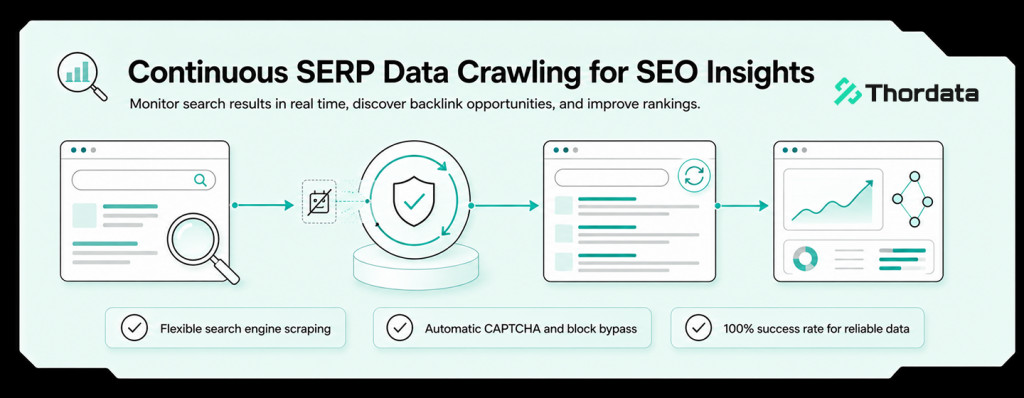
Two places, both current blind spots for most agent teams: watching how users ask AI assistants about your agent category — the fastest-moving query vocabulary in software — and tracking where your agent’s own product surfaces in an answer-layer that increasingly recommends tools. Continuous SERP data crawling delivers both, and query-level monitoring across your category’s terms is the cheapest research feed in a category this new.
The briefing’s conclusion: agent data went from nobody’s product to everybody’s bottleneck in under two years, the shelf inventory finally exists — trajectories, conversation logs, operation records — and the teams that license it now are the ones whose agents will have seen a computer before their competitors’ do.
 Looking for
Top-Tier Residential Proxies?您在寻找顶级高质量的住宅代理吗?

Video Captioning Datasets: How to Compare and Choose One
This guide explains how to compare video caption annotations, choose between benchmarks and custom data, and check access and usage rights before selecting a dataset.
Unknown
2026-10-28
Top ISP Proxy Providers: A Practical Comparison
This page is published by Thor ...
Xyla Huxley
2026-10-28
How to Choose a Video Understanding Dataset
This guide compares video understanding datasets by research goal, annotations, recording perspective, coverage and usage rights. It explains when ready-made datasets fit a task and when tailored footage or fields may be needed.
Unknown
2026-10-28
How to Avoid Getting Blocked When Collecting Video-Site Data
Avoiding blocks while collecting video data starts with permission, a narrow request, and a schedule matched to data changes. The text distinguishes rate limits and access denials from extraction problems and explains when to use search results, page data, or licensed datasets.
Unknown
2026-10-28
How to Choose Real-World Video Data for Embodied AI
Real-world video data helps em ...
Xyla Huxley
2026-10-28
YouTube Dataset Comparison by Research Goal
Compare YouTube datasets by the research task, record type, available fields, refresh cadence, access method, cost, and reuse terms. The guide contrasts fixed research datasets with Thordata, Bright Data, and Apify options.
Unknown
2026-10-27
YouTube Dataset Providers: Ready-Made vs Custom
The guide compares Thordata, Bright Data, Apify, and Oxylabs by access model, YouTube fields, delivery, refresh options, and billing units. It recommends checking sample records and delivery terms before purchase.
Unknown
2026-10-27
How to Choose an Enterprise Video Data Provider
This guide compares search-result data, structured video records, and media delivery. It describes the fields, delivery terms, and pilot checks buyers can use to evaluate providers.
Unknown
2026-10-27
How to Get YouTube Transcripts Programmatically
You can get YouTube transcript ...
Xyla Huxley
2026-10-27